
The Artificial Superintelligence Alliance token, known by its ticker FET, experienced heightened market scrutiny and a minor downward adjustment following an unauthorized security breach linked to its cross-chain migration infrastructure. Trading at approximately $0.1773 after suffering a 1.53% decline over a 24-hour period, the asset faced immediate turbulence after developers and security researchers uncovered an exploit targeting token converter contracts. Despite the exploit and the subsequent freezing of crucial cross-chain tools, core network operations, private wallets, and exchange-held assets remained entirely unaffected, demonstrating a compartmentalization of the alliance’s vast technical architecture.
The security incident centered primarily on SingularityNET contracts, specifically the interoperability bridge designed to facilitate seamless asset transfers between the Ethereum and Cardano blockchains. According to initial disclosures released by the Artificial Superintelligence Alliance, the breach enabled unauthorized actors to execute illicit minting maneuvers through the designated migration route. This vulnerability allowed the perpetrator to drain approximately $1.56 million worth of FET from the specialized converter contract tied directly to the token consolidation framework.
The Genesis of the Migration Framework and the Alliance Structure
To fully understand the mechanics of the exploit, one must examine the broader strategic consolidation that birthed the Artificial Superintelligence Alliance. Formed as a collaborative powerhouse between decentralized artificial intelligence pioneers—including Fetch.ai, SingularityNET, and Ocean Protocol—the alliance set out to unite their respective ecosystems under a single, highly liquid utility token: FET. This ambitious roadmap required sophisticated multi-chain migration systems capable of migrating legacy tokens, such as SingularityNET’s AGIX and Ocean Protocol’s OCEAN, into the unified FET standard.
The migration infrastructure relied heavily on cross-chain bridges and converter contracts to handle the complex accounting and cryptographic verification needed to burn tokens on one blockchain and mint their equivalents on another. These systems, by nature, require high-privilege smart contract interactions to manage circulating supplies across disparate distributed ledgers. Unfortunately, these exact touchpoints often present attractive surfaces for sophisticated attackers looking to exploit logic flaws or execution sequence vulnerabilities in custom-built smart contract code.
Chronology and Immediate Response from Fetch.ai

Upon detecting anomalous transaction patterns associated with the bridge infrastructure, development teams moved swiftly to contain the threat. Fetch.ai implemented an immediate, precautionary halt on all AGIX-to-FET token conversions while cybersecurity auditors and core developers initiated a comprehensive code review. Furthermore, as an extra layer of defense, the team temporarily suspended its Ethereum-side bridge contract, despite early indications that the specific vulnerability did not originate within Fetch.ai’s native codebase.
In official communications issued shortly after containment, Fetch.ai emphasized a crucial technical distinction: normal token transfers, decentralized application (dApp) interactions, and standard network operations on the core Fetch.ai blockchain were completely insulated from the breach. Treasury reserves, exchange-hosted liquidity pools, and individual user holdings residing in private self-custodial wallets were verified to be secure. Holders were officially advised that no immediate manual action was required on their part, a message that helped stabilize market sentiment and prevent widespread panic selling.
Collaboration is currently underway between the core Fetch.ai engineering division, the SingularityNET development team, and external, specialized Web3 security auditors. While preliminary containment has been successfully achieved, neither party has yet published a comprehensive post-mortem or a detailed technical breakdown of the vector used in the exploit. Verified updates and a timeline for the safe reactivation of the bridge services are anticipated once the ongoing forensic audits are fully concluded.
Market Reaction and Technical Price Analysis of FET
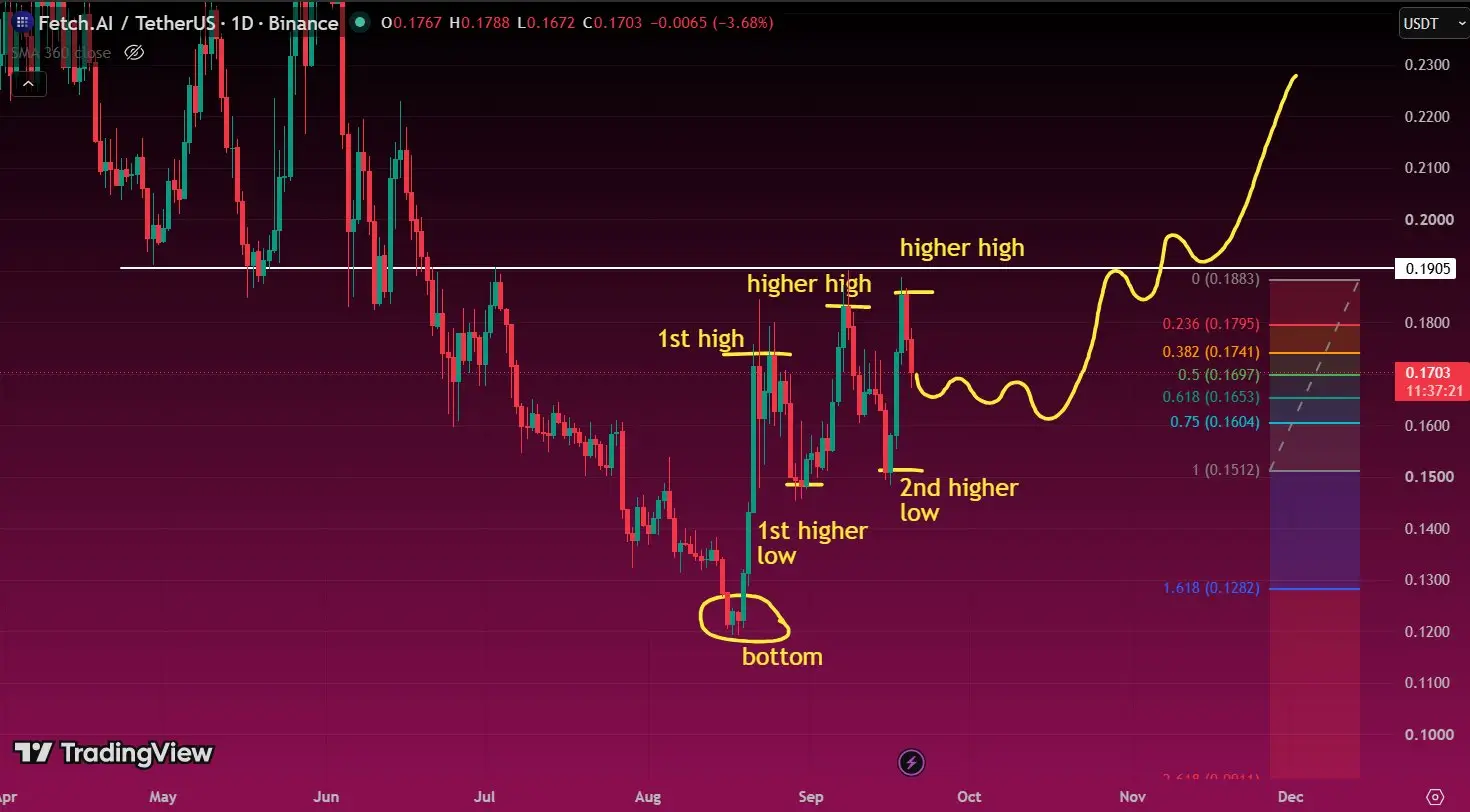
Despite the severity of the bridge compromise, the broader cryptocurrency market reaction was relatively muted compared to historical precedents involving multi-million-dollar exploits. FET’s price defended vital technical levels, absorbing the selling pressure brought on by the news. Market analysts tracking the asset’s daily charts pointed out that the token successfully tested and held its ground near the 50% Fibonacci retracement level, positioned at approximately $0.1697.
This psychological and technical threshold has emerged as a primary short-term support zone for FET. Immediate overhead resistance has formed near $0.1741, closely followed by the $0.1795 Fibonacci marker. For the asset to break out of its current consolidation range and re-establish bullish momentum, broader buying pressure will be required to clear these hurdles decisively.
Looking at the broader macro structure, FET has maintained a constructive pattern of higher lows and higher highs originating from its multi-month swing bottom near $0.12 in August. As long as the digital asset trades above its recent higher-low structuring region, the bullish continuation pattern remains intact. However, analysts note that immediate downside buffers sit at $0.1653 and $0.1604 should market-wide macroeconomic headwinds or residual fallout from the exploit amplify selling volume. The definitive structural floor remains anchored at $0.1512; a daily close beneath this critical threshold would invalidate the prevailing higher-low formation and potentially trigger a deeper correction toward historical demand zones.
Broader Implications for Cross-Chain Infrastructure and the ASI Alliance
The security breach highlights an enduring, systemic vulnerability across the decentralized finance (DeFi) and interoperability sectors: cross-chain bridges remain the single most lucrative target for malicious actors. Because bridges lock assets on one chain to issue wrapped or migrated equivalents on another, they inherently concentrate immense financial value into singular smart contract interfaces.
For the Artificial Superintelligence Alliance, the incident serves as an acute stress test of its operational resilience and governance responsiveness. While the loss of $1.56 million represents a substantial financial figure, the rapid containment executed by Fetch.ai and its partners prevented a catastrophic contagion event that could have completely derailed the multi-token merger. The swift isolation of the affected SingularityNET converter contracts demonstrated mature incident management protocols, distinguishing between systemic network infrastructure and auxiliary migration tools.
As decentralized artificial intelligence projects continue to scale and merge their economic layers, the necessity for rigorous, multi-layered smart contract auditing becomes glaringly apparent. Standardized formal verification methods and continuous real-time transaction monitoring must evolve in lockstep with the rapid deployment of cross-chain bridges.
For now, the Artificial Superintelligence Alliance remains focused on finalizing its security reviews, assisting investigators in tracing the illicitly minted funds, and ensuring that future iterations of its migration tools meet the highest possible cryptographic security standards. Investors and token holders await the official post-mortem report, which will likely dictate the timeline for the eventual restoration of AGIX-to-FET conversion services and shape the alliance’s operational roadmap moving forward.