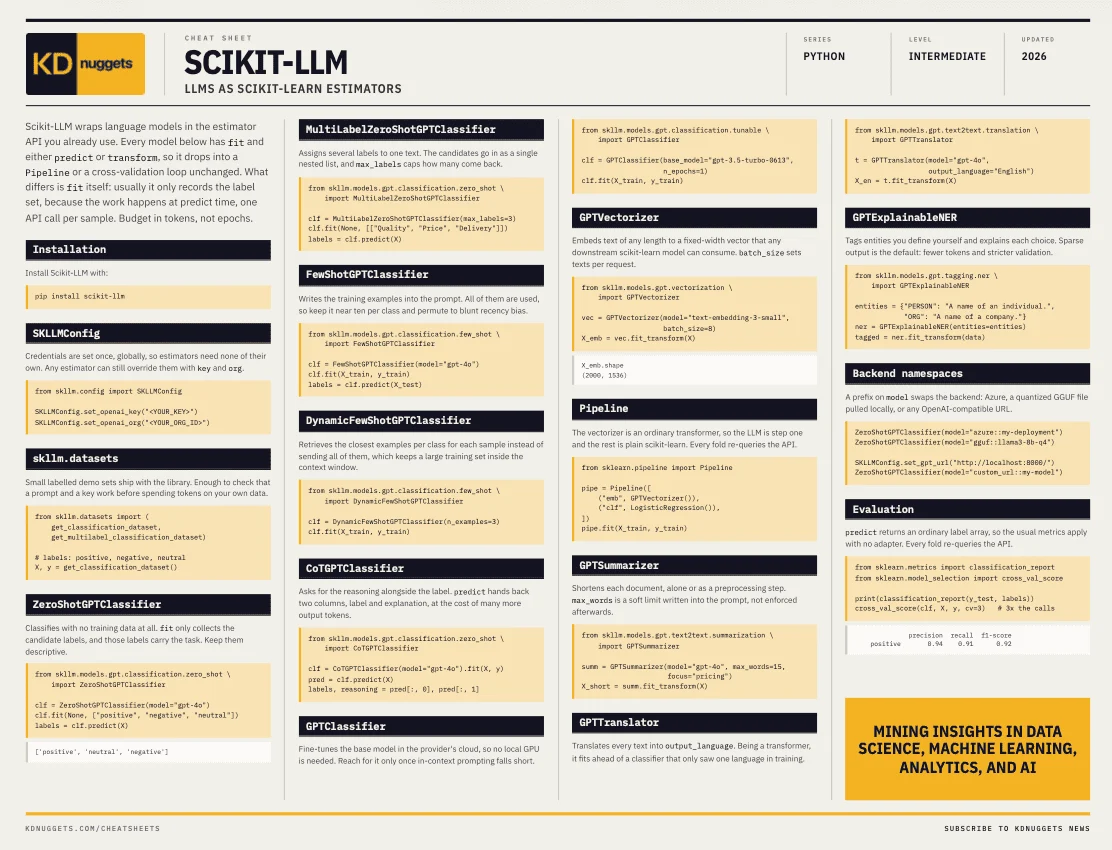
The integration of Large Language Models (LLMs) into standard machine learning workflows has historically been characterized by a dichotomy: the structured, standardized environment of scikit-learn versus the fragmented, often brittle world of custom API-loop scripts. As organizations pivot toward generative AI, the engineering challenge has shifted from merely accessing model inference to maintaining the rigorous testing and validation standards that define enterprise-grade machine learning. The emergence of Scikit-LLM serves as a critical bridge in this evolution, enabling practitioners to treat complex LLM-driven tasks with the same modularity as traditional algorithms.
The Evolution of Machine Learning Workflows
For over a decade, scikit-learn has served as the bedrock of the data science industry. Its Estimator API—standardized through fit, predict, and transform methods—allowed developers to create robust pipelines, perform cross-validation, and generate standardized metrics. This predictability fostered an ecosystem where models could be swapped, tuned, and evaluated with minimal code refactoring.
Conversely, the rapid rise of LLMs introduced a new paradigm of software development. Because these models are typically accessed via remote APIs, the standard workflow often devolved into a labyrinthine structure of nested loops, custom string parsing, and extensive error handling to manage inconsistent output formats. This "script-heavy" approach hindered scalability and reproducibility. Scikit-LLM aims to rectify this by encapsulating these calls within the familiar scikit-learn interface, allowing LLMs to function as drop-in components within existing machine learning pipelines.
Chronology and Technical Architecture
The development of Scikit-LLM represents a milestone in the "AI Engineering" movement. By wrapping models in the scikit-learn framework, the library allows for the integration of generative capabilities without forcing developers to abandon their preferred toolchains.
The fundamental shift lies in how the fit method is handled. In traditional machine learning, fit involves training a model on a dataset to learn internal weights. In the Scikit-LLM paradigm, the "training" phase is often a lightweight registration process for labels or candidate sets, as the heavy lifting of inference is performed during the predict phase via API calls.
Key architectural components include:
- ZeroShotGPTClassifier: This tool enables classification without explicit training, using descriptive labels as task specifications.
- DynamicFewShotGPTClassifier: An advanced implementation that retrieves relevant examples per sample, optimizing context window usage and improving accuracy compared to static few-shot prompting.
- GPTVectorizer: A tool that converts text into fixed-width numerical embeddings, facilitating the use of traditional downstream classifiers like Logistic Regression or Random Forest.
- GPTTranslator: A transformer-based utility designed to standardize multilingual inputs into a single target language before classification, bypassing the need for training models on multilingual corpora.
Data-Driven Considerations: The Cost of Integration
While the integration of LLMs into scikit-learn pipelines offers significant workflow benefits, it introduces a non-trivial variable: economic cost. In traditional machine learning, performing a 3-fold cross-validation or a grid search over hyperparameters is computationally intensive but relatively inexpensive in terms of marginal costs.
In the LLM context, every iteration of a cross-validation loop constitutes a new series of API calls. For instance, a grid search involving 50 hyperparameter combinations over a dataset of 1,000 samples represents 50,000 API requests. Given current pricing structures for models like GPT-4, the financial implications of common data science practices must be reassessed. The convenience of the scikit-learn wrapper can mask the cumulative cost of these operations, necessitating a more disciplined approach to model validation and hyperparameter tuning.
Expert Perspectives and Industry Implications
Industry analysts note that tools like Scikit-LLM represent a broader trend toward "operationalizing" AI. By lowering the barrier to entry, these libraries allow data scientists to iterate faster, moving from experimental scripts to production-ready pipelines in significantly less time.
"The goal of such abstractions is to remove the ‘plumbing’ burden from the developer," says an industry observer familiar with the tool. "By treating an LLM as a standard estimator, you gain the ability to chain it with preprocessing steps, feature scaling, and ensemble methods that have been refined over years of scikit-learn development."
However, this accessibility also demands a shift in skill sets. Engineers must move beyond simply querying models to understanding token management, latency optimization, and the nuances of prompt engineering as a form of model configuration. The library’s design encourages a modular approach, where the LLM is merely one stage of a multi-step data processing architecture.
Broader Impact on AI Engineering
The release of educational resources, such as the KDnuggets cheat sheet for Scikit-LLM, underscores the industry’s focus on bridging the gap between traditional data science and modern AI. As the complexity of LLM applications grows, the ability to manage these models through standard APIs becomes essential for maintaining codebases.
For organizations, the implication is clear: the integration of LLMs into existing software ecosystems is no longer an outlier task but a standard engineering requirement. Libraries that prioritize compatibility with established frameworks will likely see broader adoption than those requiring proprietary or idiosyncratic implementations.
Furthermore, the capability to perform tasks like zero-shot classification using descriptions as labels signals a departure from purely supervised learning. This allows teams to prototype and deploy models in data-constrained environments where labeled datasets are either unavailable or too expensive to curate.
Future Trajectory
Looking ahead, the evolution of Scikit-LLM and similar abstractions will likely mirror the maturation of the broader MLOps landscape. As developers become more proficient with these estimators, the focus will shift toward optimization—reducing token consumption, improving latency, and ensuring the reliability of model outputs through automated validation layers.
The adoption of such tools also highlights a cultural shift in the development community. By staying within the comfort zone of scikit-learn, practitioners can focus on the business logic of their applications rather than the underlying infrastructure of the LLM provider. This shift is critical for the long-term sustainability of AI projects, as it promotes code reuse, cleaner architecture, and a more rigorous approach to evaluating model performance.
Ultimately, Scikit-LLM serves as more than just a convenience library; it is a tactical response to the fragmentation of the AI development environment. By standardizing how we interact with, tune, and evaluate LLMs, the community is building the infrastructure necessary to move generative AI from the realm of the experimental to the core of the enterprise. For those looking to integrate LLMs into their professional workflows, mastering these estimators is a logical next step in the professional development of the modern data scientist. The provided reference material serves as a vital resource for navigating the syntax and strategic implementation of these tools, ensuring that practitioners can effectively leverage the power of LLMs while adhering to the established best practices of machine learning engineering.