The healthcare technology landscape is undergoing a profound transformation as providers grapple with administrative burnout and the inefficiencies of legacy electronic health record (EHR) systems. At the forefront of this shift is Commure, a company that has moved beyond its initial footprint in clinical documentation to claim a central role in the operational lifecycle of a patient visit. Following a significant $70 million Series F extension in May, the company is signaling that its ambition is to own the entire administrative workflow, from the pre-visit referral process to post-visit medical billing and coding.
Last week, this strategy reached a new milestone when Commure’s autonomous coding product earned the coveted Epic Toolbox designation. This status, already held by the company’s ambient AI scribe, allows health systems utilizing Epic’s EHR platform to seamlessly document patient encounters and assign accurate medical billing codes without ever toggling between disparate software windows. By embedding its intelligence directly into the clinical workflow, Commure is positioning itself as an essential layer of infrastructure for the more than 500 health systems and practices currently within its client network.
A Chronology of Strategic Consolidation
Commure’s ascent has been characterized by a dual-track strategy: organic product development and the aggressive acquisition of specialized, high-performing startups. This "buy-and-integrate" model allows the company to minimize the time-to-market for new features while immediately onboarding a pre-existing customer base.
The company’s recent history reveals a clear trajectory toward total system integration. In 2024, Commure made waves by taking the Nasdaq-listed Augmedix private, a move designed to consolidate its dominance in the ambient documentation market. Prior to that, the company integrated Rx.Health—rebranding it as Commure Engage—to capture the patient outreach and engagement vertical.
The operational timeline reflects this rapid diversification:
- May 2024: Commure secures a $70 million Series F funding extension, providing the capital necessary for further M&A activity.
- June 2024: Launch of "Orchestrator," a specialized tool designed to automate and manage incoming patient referrals, addressing a notorious bottleneck in health system administration.
- September 2024: Commure expands its international presence, officially rolling out its ambient AI solutions to the European and UK markets.
- October 2024: The company secures Epic Toolbox designation for its autonomous coding engine, cementing its status as a preferred partner for large-scale health systems.
Concurrent with these developments, Commure has been quietly building "Air," an AI-native EHR platform. By hiring top-tier engineering talent, the company is signaling that it does not merely want to sit on top of legacy systems like Epic or Cerner; it intends to provide the next generation of infrastructure that powers them from the ground up.
The Economic Drivers of Commure’s Expansion
The logic behind Commure’s acquisition strategy is rooted in the current economic realities of the US healthcare system. According to data from the American Medical Association, administrative costs account for a significant percentage of national healthcare spending, with physicians reporting that for every hour spent in direct patient care, they spend two hours on EHR and administrative tasks.
Commure’s focus on "pre-visit and post-visit" work is a direct response to this burden. By automating the intake process via Orchestrator and the billing process via autonomous coding, the company targets two of the most labor-intensive aspects of clinical practice. For a hospital system, these efficiencies translate directly into improved net patient revenue and reduced physician turnover.
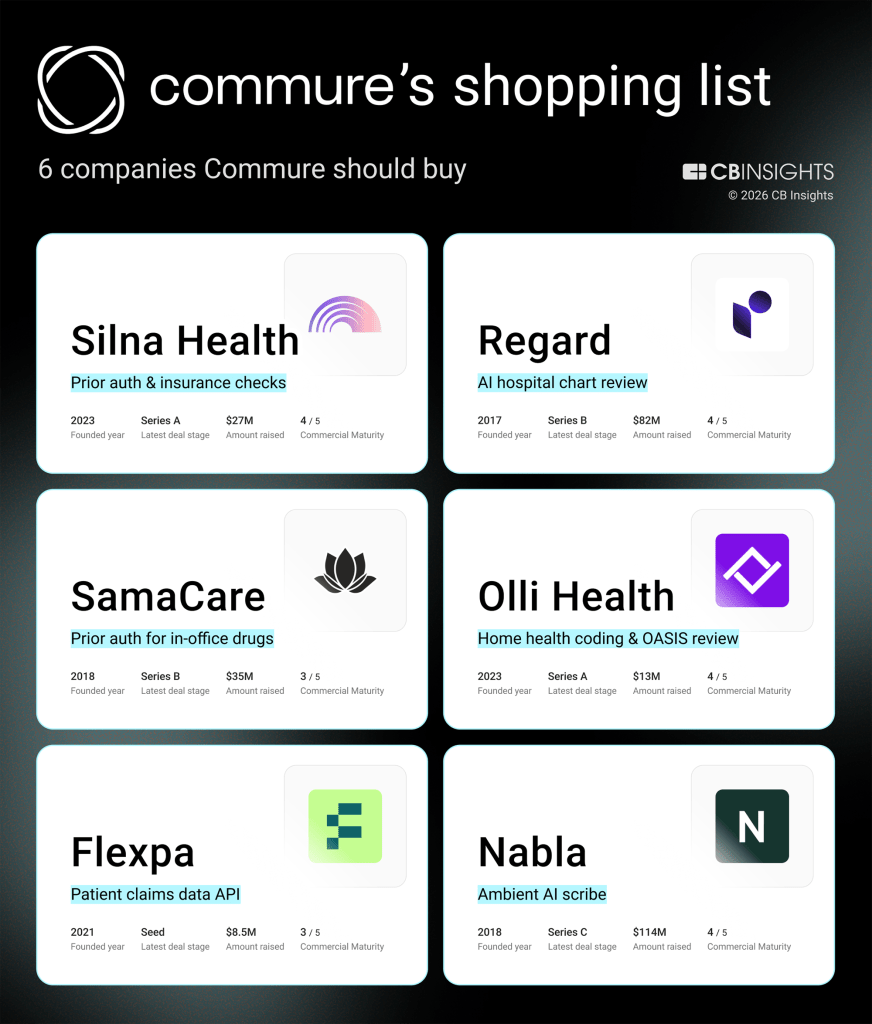
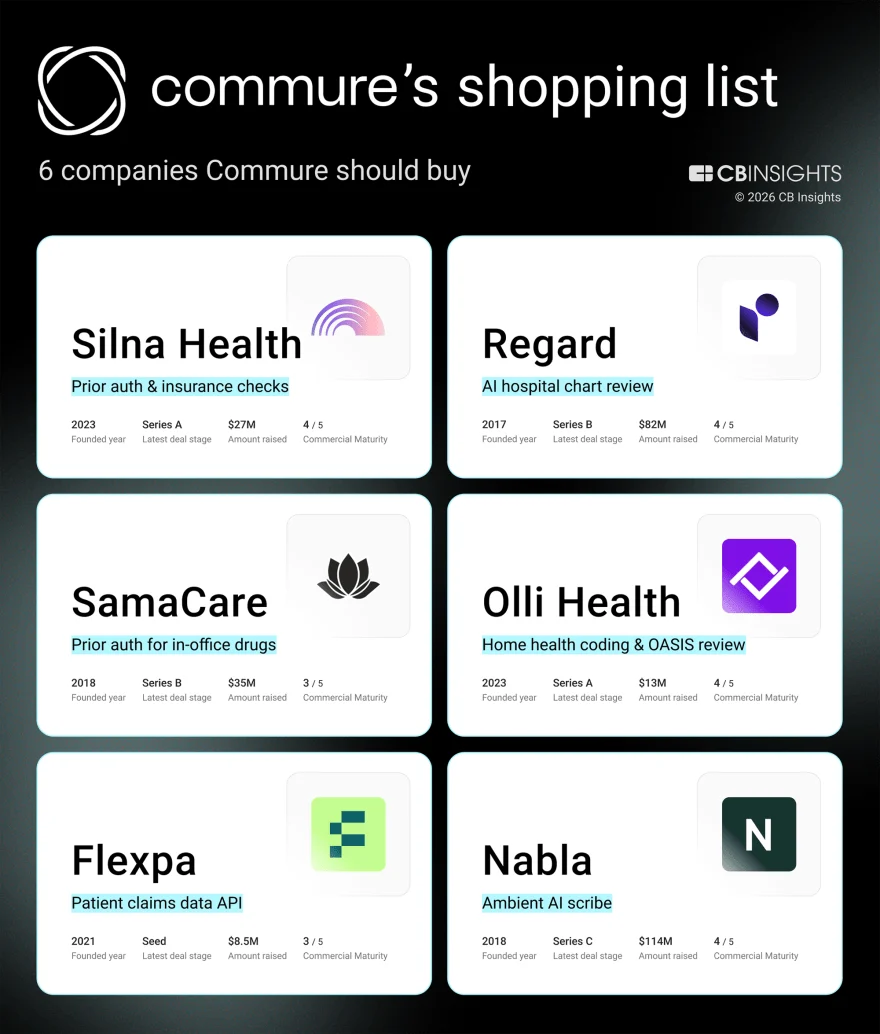
Furthermore, the company’s ability to "buy what it doesn’t build" has proven highly effective. By targeting startups that have already achieved product-market fit, Commure bypasses the risks associated with internal R&D. Data from CB Insights suggests that Commure’s approach involves identifying specific "white spaces" in its current suite—such as clinical data interoperability, prior authorization, and post-acute care coordination—and acquiring VC-backed startups with less than $150 million in total funding. This disciplined financial approach ensures that every acquisition contributes to a cohesive, interoperable ecosystem.
Market Implications and Future Outlook
The broader impact of Commure’s expansion is the potential commoditization of the EHR platform. If a third-party vendor like Commure can provide the documentation, coding, and patient engagement layers with higher efficiency than the EHR vendor itself, the EHR risks becoming a "dumb pipe"—a mere data repository that lacks functional intelligence.
Industry analysts observe that health systems are increasingly fatigued by the complexity of "best-of-breed" software stacks. They are looking for platforms that offer a unified experience. Commure’s strategy of building an "AI-native" environment appeals to C-suite executives who want to reduce the total number of vendors while increasing the automation of their clinical operations.
However, this rapid consolidation does not come without risks. Integrating diverse technological platforms into a single, cohesive user interface is a monumental engineering challenge. Furthermore, as Commure moves into European markets, it will face more stringent regulatory environments, particularly regarding data privacy and the European Union’s AI Act. Success in these markets will require the company to adapt its algorithms to adhere to local clinical practices and strict data governance standards.
Strategic Gaps and the Search for Value
An analysis of Commure’s current portfolio against industry benchmarks reveals that while the company has achieved significant breadth, there remain critical gaps in its suite. Specifically, the areas of automated prior authorization—a process that costs the industry billions annually—and specialized post-acute care software remain ripe for consolidation.
Market research indicates that there are currently several high-growth, venture-backed companies that would logically fit into the Commure fold. These candidates are typically characterized by strong Mosaic scores—a metric evaluating a company’s financial health, market momentum, and operational maturity. By targeting companies in the interoperability and authorization spaces, Commure could further insulate itself from competitors like R1 RCM and Waystar, both of which are also vying for dominance in the revenue cycle management (RCM) and AI-driven clinical workflow spaces.
The Path Forward: AI-Native Infrastructure
Looking ahead, Commure’s move to build its own AI-native EHR, "Air," represents the most ambitious phase of its roadmap. If the company succeeds in building a platform that natively understands clinical context, rather than relying on the legacy structures of older systems, it could fundamentally disrupt the way care is delivered and documented.
The integration of ambient AI—which listens to the patient-physician encounter and translates it into structured data—is already changing the nature of the clinical record. When coupled with automated coding and intelligent referral management, the result is a system that can theoretically predict resource needs, manage patient flow, and optimize financial performance in real-time.
For now, the industry is watching to see how Commure balances the maintenance of its existing 500-plus client relationships with the technical hurdles of scaling its newer products. The company’s ability to demonstrate tangible ROI to its hospital partners will be the ultimate test of its strategy. With a robust war chest from its Series F round and a proven track record of successful integrations, Commure has positioned itself as the likely architect of the next generation of healthcare operations. Whether it can maintain this velocity while ensuring the reliability and accuracy required in a clinical setting remains the central question for its stakeholders, competitors, and the broader healthcare technology sector.