
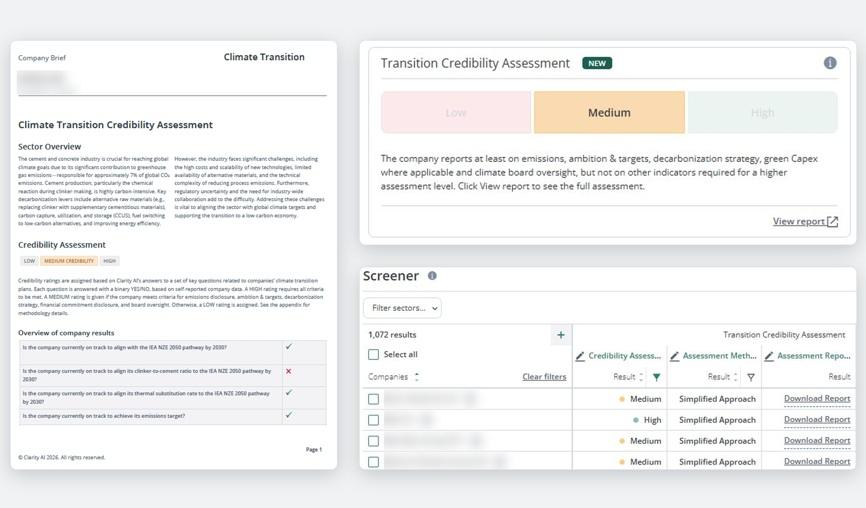
Sustainability data and analytics firm Clarity AI has officially unveiled its latest technological advancement, the Transition Credibility Assessment. This platform is designed to provide institutional investors with a granular, evidence-based methodology to evaluate whether corporations are genuinely advancing toward their stated net-zero targets or merely engaging in symbolic climate commitments. As the global investment community faces mounting pressure to align portfolios with the Paris Agreement, this tool addresses a critical market gap: the disconnect between corporate climate ambition and actual operational execution.
The Growing Need for Climate Accountability
In recent years, the adoption of corporate climate targets has reached unprecedented levels. According to data from the Science Based Targets initiative (SBTi), thousands of companies across the globe have committed to science-based emissions reduction goals. However, the proliferation of these pledges has been accompanied by widespread concerns regarding "greenwashing"—the practice of overstating environmental progress to attract capital.
Institutional investors, including pension funds, sovereign wealth funds, and asset managers, are increasingly under fiduciary and regulatory pressure to demonstrate that their capital is not just committed to sustainability in theory, but is driving real-world decarbonization. The challenge for these investors is that traditional reporting often relies on self-disclosed, non-standardized metrics that can be difficult to verify. Clarity AI’s new solution seeks to mitigate this by decoupling a company’s public narrative from its actual performance metrics.
Methodology and Analytical Framework
The Transition Credibility Assessment operates by evaluating corporate performance across several high-impact dimensions. Rather than relying on a singular score, the tool conducts a multi-layered analysis of a firm’s climate transition. Key pillars of the assessment include:
- Emissions Performance: Tracking actual greenhouse gas (GHG) emission trajectories rather than just future promises.
- Decarbonization Strategy: Analyzing the specific operational shifts being implemented to lower energy intensity.
- Low-Carbon Technology Deployment: Assessing whether a company is investing in and adopting the necessary hardware, software, or process innovations to transition away from fossil fuels.
- Green Capital Expenditure (CapEx): Evaluating the proportion of investment capital specifically earmarked for sustainable projects.
- Governance and Ambition: Reviewing the internal accountability structures, including executive compensation tied to climate KPIs.
The methodology is built upon rigorous, established international frameworks, including the Transition Plan Taskforce (TPT) Disclosure Recommendations and the Climate Action 100+ Net Zero Company Benchmark. By aligning with these standards, Clarity AI ensures that the data is not only actionable but also audit-ready for investors navigating complex ESG reporting requirements.
Sector-Specific Calibration
One of the most significant challenges in climate analytics is the disparity between sectors. A utility company’s transition path looks vastly different from that of a software provider or a retail chain. Clarity AI has addressed this by applying detailed, sector-specific criteria to high-impact industries—such as energy, manufacturing, and transport—where the carbon footprint is most concentrated. For lower-impact sectors, the tool employs a simplified, calibrated approach that ensures investors do not waste resources analyzing irrelevant metrics while still maintaining a consistent standard of rigor.
Alice Borgonovo, Senior Product Manager responsible for Clarity AI’s climate solutions, emphasized the shift in market demand. "There is no shortage of climate targets," Borgonovo noted. "What investors need to understand is whether companies are taking the steps needed to meet them. A credible plan shows up in the evidence: in emissions, in investments, and in the technologies a company deploys. We built the assessment to examine that evidence, sector by sector, and show investors exactly where it comes from."

Timeline and Evolution of Climate Data
The launch of this tool marks a significant point in the evolution of ESG data. The history of climate disclosure can be categorized into three distinct phases:
- Phase One (Pre-2015): The era of voluntary, sporadic, and inconsistent disclosure. Climate data was rarely used for investment decisions.
- Phase Two (2015–2023): The era of standardization and broad commitment. Frameworks like the Task Force on Climate-related Financial Disclosures (TCFD) became mainstream, but "data quality" remained the primary hurdle.
- Phase Three (2024–Present): The era of accountability and performance verification. Investors are now shifting from asking "Does this company have a target?" to "Is this company on track?"
The introduction of the Transition Credibility Assessment falls squarely into this third phase, providing the necessary infrastructure to move beyond static reporting and into dynamic, performance-based monitoring.
Implications for Asset Management
The implications for the financial sector are twofold. First, the assessment allows for better risk management. Companies that lack a credible transition plan are increasingly exposed to "transition risk"—the financial loss associated with regulatory shifts, carbon taxes, and the obsolescence of carbon-heavy assets. By identifying these laggards early, investors can mitigate potential portfolio volatility.
Second, the tool facilitates more effective engagement. For asset managers practicing active ownership, the ability to point to specific data—such as a lack of green CapEx or a misalignment between board governance and climate goals—provides a powerful lever during shareholder dialogues and proxy voting. Instead of vague discussions about sustainability, investors can engage with boards based on granular, data-driven critiques of their transition plans.

Challenges in the ESG Data Landscape
Despite the sophistication of new tools like those offered by Clarity AI, significant challenges remain in the broader ecosystem. Data gaps, particularly regarding Scope 3 emissions (the emissions from a company’s supply chain), persist. Furthermore, the global regulatory landscape is currently fragmented; while the European Union’s Corporate Sustainability Reporting Directive (CSRD) is driving high-quality data, other jurisdictions have adopted different timelines and standards.
Clarity AI’s reliance on traceable evidence is a direct response to these challenges. By linking ratings directly to supporting documentation, the firm aims to improve the "audit trail" of ESG ratings, a frequent point of criticism from regulators like the European Securities and Markets Authority (ESMA) and the U.S. Securities and Exchange Commission (SEC).
Future Outlook
As we look toward the 2030 and 2050 climate milestones, the pressure on companies will only intensify. The launch of the Transition Credibility Assessment signifies that the market is moving toward a period where "climate-washing" will become significantly harder to execute. For institutional investors, the ability to differentiate between leaders and laggards is no longer just a "nice-to-have" feature of their research process; it is becoming a foundational element of long-term value creation.
In conclusion, Clarity AI’s new solution provides a necessary framework for the next decade of climate finance. By bridging the gap between ambitious corporate promises and observable operational reality, the platform empowers investors to deploy capital with greater clarity and purpose. As corporations continue to refine their transition plans, the demand for this level of analytical rigor will likely become the industry standard, ultimately fostering a more transparent and resilient global economy.