As Bitcoin retreats toward the low-$70,000 range, on-chain analytics reveal that a significant wave of recent market entrants is capitulating. Fresh data from blockchain intelligence platform CryptoQuant indicates that tens of thousands of Bitcoins acquired by short-term speculators are being funneled to centralized cryptocurrency exchanges at a loss. This surge in "underwater" deposits has intensified concerns across the broader digital asset market regarding mounting sell-side pressure and the psychological toll exacted on retail and institutional buyers who entered near recent market peaks.
The latest metrics underscore a striking disparity between profit-taking and loss-realization among market participants who have held their coins for less than 155 days—the standard industry definition for short-term holders (STHs). With Bitcoin hovering around the $74,000 threshold, market analysts are closely monitoring these inflows, seeking to decode whether this transfer activity foreshadows a deeper price correction or a localized washout of weak hands.
Main Facts and Exchange Inflow Dynamics
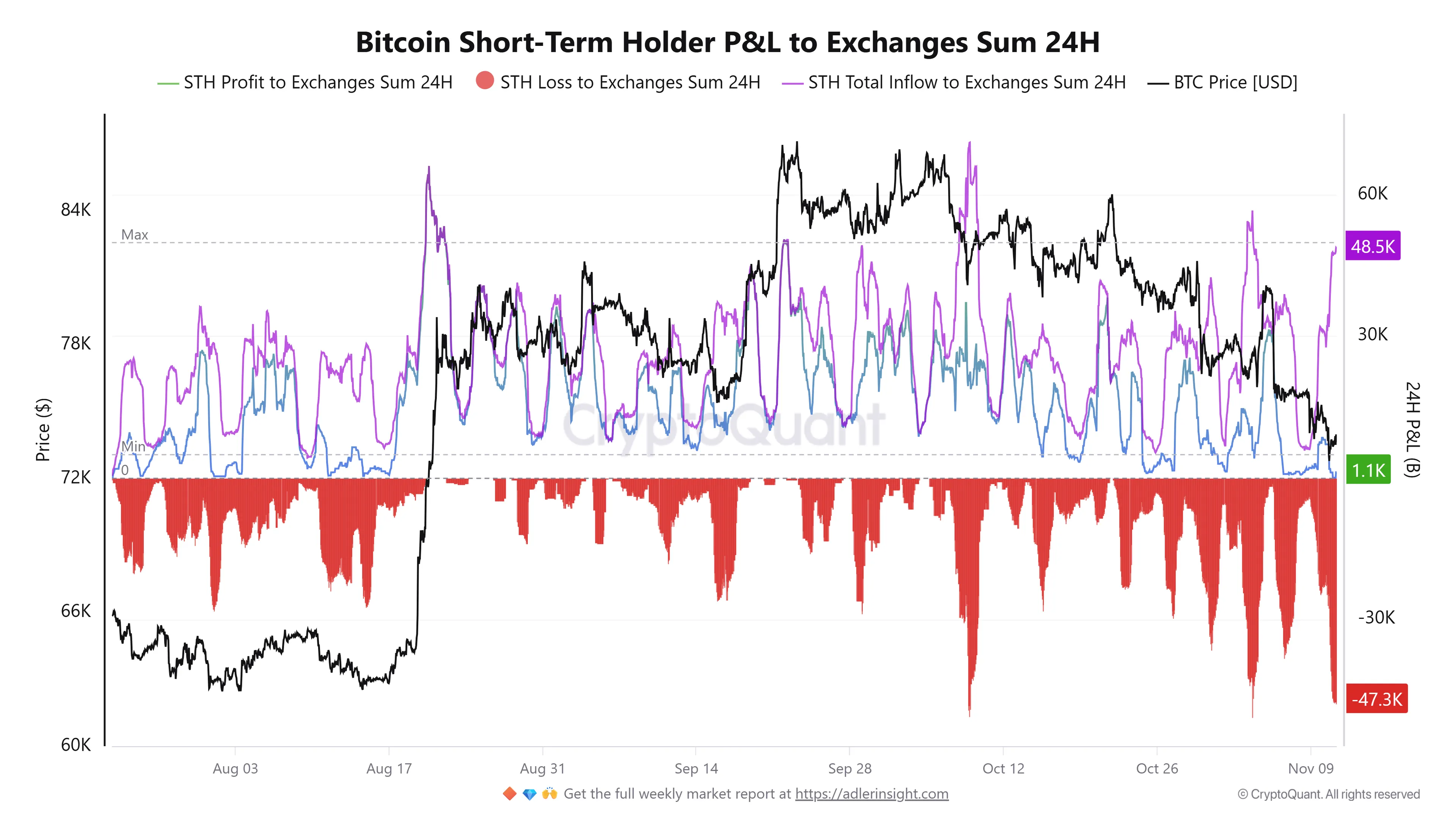
According to CryptoQuant’s short-term holder profit-and-loss data, approximately 47,300 BTC were transferred to centralized exchanges below their original acquisition price within a single 24-hour window. By contrast, inflows of profitable coins arriving at exchanges during the same timeframe stood at a paltry 1,100 BTC.

Combined inflows across major platforms registered near 48,500 BTC, translating to a staggering $3.6 billion based on prevailing market valuations. This heavily lopsided ratio demonstrates that newly minted investors or those who bought during recent local tops are overwhelmingly moving their assets to exchanges while nursing paper losses, rather than locking in gains from earlier upward momentum.
Industry experts emphasize a crucial technical distinction: these figures track on-chain transfers to exchange deposit addresses rather than immediate, executed market sales. While depositing assets to a trading venue is frequently a precursor to liquidating positions, coins sent to exchanges can also serve alternative purposes, such as posting collateral for derivatives trading, acquiring liquidity loans, or positioning for trades into other digital assets. Nevertheless, historical trading patterns suggest that high volumes of loss-making deposits consistently elevate the probability of spot selling, especially when investor sentiment sours.
Short-term holders are widely recognized by market researchers as the most volatile and reactive segment of the cryptocurrency investor base. Because their capital deployment is recent, they possess little historical buffer or unrealized profit cushion to absorb sharp drawdowns. Consequently, when prices slide below their cost basis, STHs exhibit a much higher propensity to panic-sell, amplifying downward volatility during macro corrections.
Chronology and Recent Wave Patterns
The current capitulation wave is not an isolated event but part of an escalating trend observed over the autumn months. Blockchain analysts tracking exchange metrics have mapped several distinct spikes in underwater deposits as Bitcoin’s price fluctuated between late-summer highs and mid-autumn corrections.

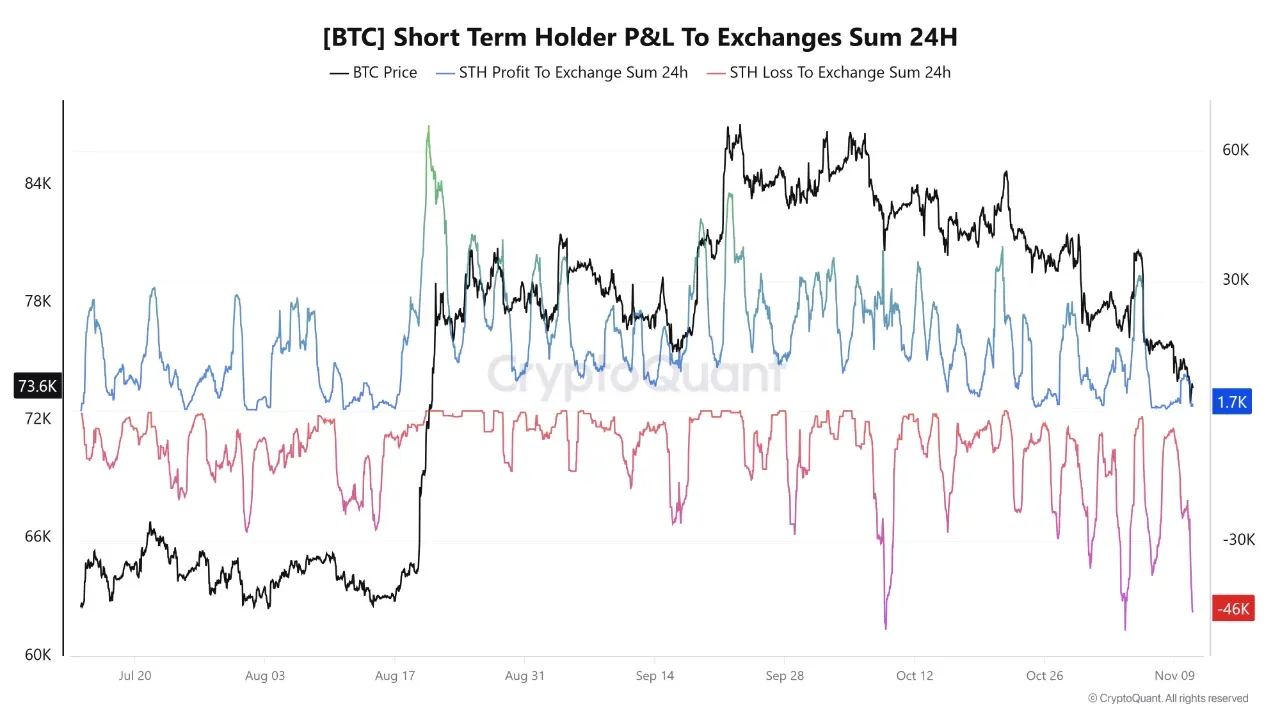
On November 3, CryptoQuant contributor Amr Taha flagged a massive initial wave involving approximately 50,790 BTC transferred to exchanges at a loss. This movement preceded a second major liquidity surge on November 10, when roughly 46,060 underwater bitcoins hit exchange infrastructure.
Detailing the velocity of the November 10 event, Taha noted that profitable transfers on that day languished near just 1,700 BTC. This created a dramatic ratio where approximately 27 BTC arrived at a loss for every single coin transferred in profit. Such anomalous metrics have not been consistently mirrored in the market since deep summer consolidation phases, signaling acute stress among recent market participants.
Further granular analysis of specific platforms, such as Binance, reveals similar behavioral cohorts sorted by coin age—measured by the duration since an asset last moved on-chain. On November 1, Binance intake logs registered 3,290 BTC from coins that had last transacted between one day and one week prior. This figure escalated sharply on November 3, with an influx of 8,114 BTC originating from the same ultra-short-term age bracket. Days later, on November 9, the exchange absorbed an additional 1,925 BTC from coins that had remained dormant for one to three months. While these age-band breakdowns illuminate the exact vintage of moving capital, they reinforce the overarching narrative that recently active capital is actively seeking liquidity venues.
Broader Market Context: The Macro Slide
This recent on-chain stress occurs against the backdrop of a broader retracement from Bitcoin’s late-September peaks, where the premier cryptocurrency traded aggressively above $85,000. As prices receded toward the $73,000 to $74,000 corridor, the economic reality for late-stage buyers became stark.
For instance, an investor who initiated a position near $80,000 faces an immediate unrealized loss of approximately 7.5% with Bitcoin trading around $74,000. For leveraged traders or retail investors relying on short-term liquidity, absorbing such a decline can trigger automated stop-losses or manual liquidations, compounding downward pressure on spot order books.
However, market vulnerability is not strictly confined to short-term speculators. Complementary data from blockchain analytics firm Glassnode highlights broader structural vulnerabilities across older investor cohorts as well. Glassnode reports that approximately 4 million BTC—held predominantly by longer-term investors—were acquired within a high-cost basis band ranging between $85,000 and $118,000. This massive overhead supply represents an enormous pool of dormant capital that is currently underwater, suggesting that any sustained relief rally toward prior all-time highs could face formidable resistance from long-term holders seeking to break even on their positions.
Fact-Based Analysis of Market Implications
The concentration of loss-making exchange inflows carries several critical implications for market structure, liquidity, and near-term price discovery:
-
Capitulation Exhaustion vs. Continuing Distribution: Historically, heavy waves of short-term holder capitulation often coincide with localized market bottoms. When weak hands are systematically flushed out of the system, market leverage resets to healthier levels, paving the way for eventual accumulation by high-net-worth entities and institutional treasuries. However, if macroeconomic headwinds or persistent spot selling overwhelms incoming buy-side demand, these inflows could signal the continuation of a protracted downtrend rather than a final capitulation event.
-
Order Book Dynamics: The influx of $3.6 billion worth of Bitcoin into exchange wallets increases immediate liquidity depth on the sell side. While not all deposited coins translate directly to market sells, an over-concentration of bearish sentiment among new buyers leaves order books vulnerable to aggressive downward slippage if market makers pull bids.
-
Institutional and ETF Buffer: Despite retail and short-term speculator distress, institutional channels—such as spot Bitcoin exchange-traded funds (ETFs) and corporate treasury accumulation programs—continue to absorb structural supply over multi-month horizons. Analysts note that the tension between on-chain retail capitulation and institutional accumulation remains one of the defining market dynamics of the current economic cycle.
As the cryptocurrency market navigates this delicate transitional phase near the low-$70,000 bracket, analysts will continue to scrutinize exchange reserve balances, funding rates, and on-chain profit-and-loss charts. Whether these thousands of underwater bitcoins represent the final exhaustion of panicked buyers or merely the opening salvo of a deeper correction will depend heavily on macro liquidity conditions and sustained buyer interest at key technical support levels.