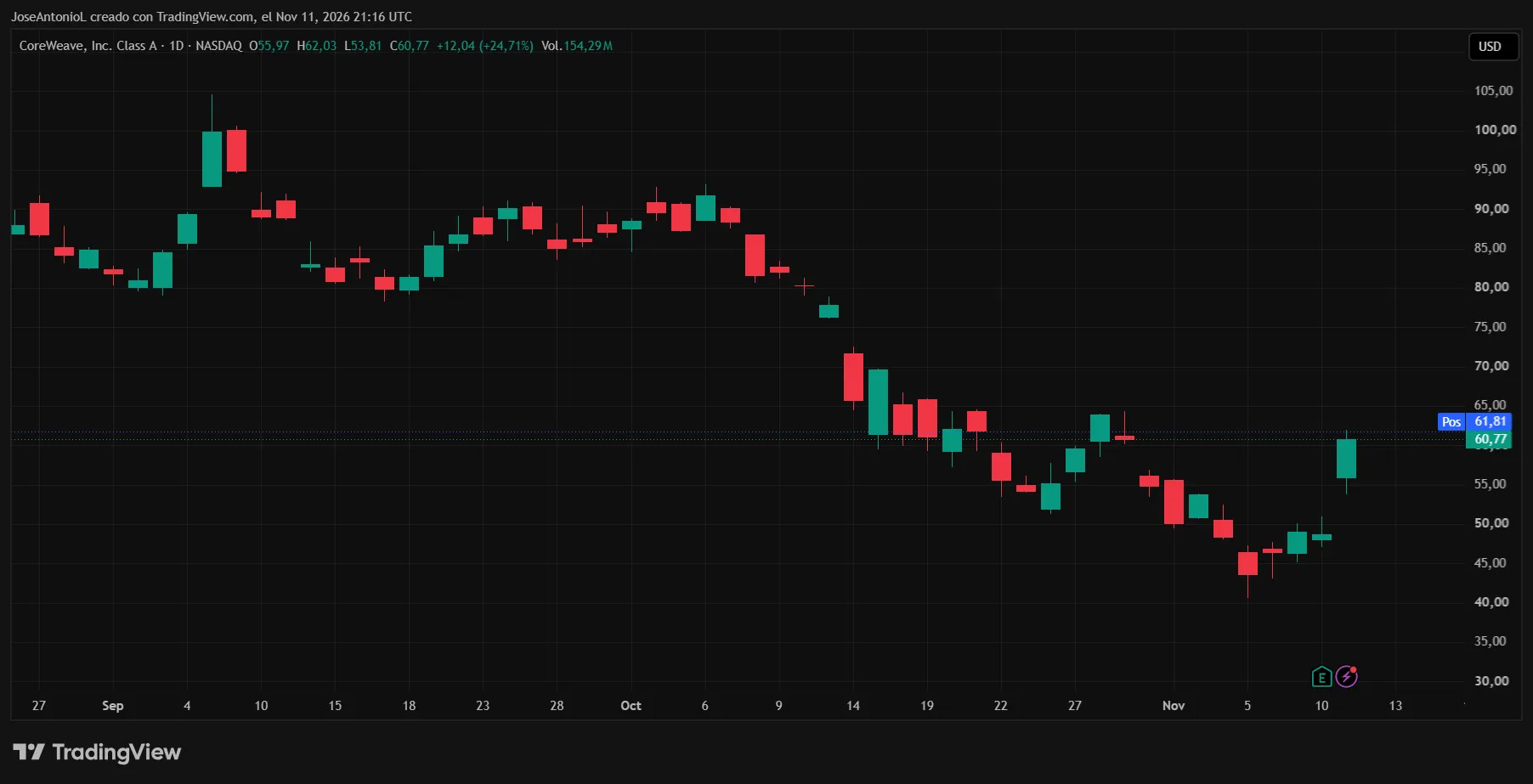
The artificial intelligence sector experienced a powerful resurgence mid-week, propelled by a stellar financial report from Nvidia-backed cloud provider CoreWeave. Shares of CoreWeave surged 24.7% on Wednesday, effectively breaking a protracted period of market sluggishness and selling pressure. The catalyst for this market-wide relief rally was the company’s third-quarter earnings report, which underscored insatiable corporate demand for the heavy-duty computing hardware underpinning the global artificial intelligence boom.
For the third quarter, CoreWeave announced an astounding revenue figure of $3.66 billion. This performance represents a staggering 168% increase compared to the same period in the previous year. Bolstered by this rapid expansion, the company aggressively raised its financial outlook for 2026, projecting full-year sales to land between $13 billion and $13.3 billion. The blockbuster earnings report immediately reverberated across global equity markets, lifting shares of its primary backer, Nvidia, alongside a slew of other critical AI infrastructure players, including Nebius, IREN, Oracle, and Applied Digital. The broader technology-heavy Nasdaq composite also benefited from the positive sentiment, climbing 1.6% by the close of the trading session.
Understanding the Mechanics of the AI Supply Chain
To fully grasp why CoreWeave’s financial health holds such immense weight for Wall Street, analysts suggest looking closely at the mechanics of the post-chipmaker ecosystem. For investors attempting to gauge the health of the AI hardware market, CoreWeave provides a vital window into what happens after Nvidia successfully manufactures and sells its advanced processors.
CoreWeave operates as a specialized neocloud provider. The company purchases advanced Nvidia Graphics Processing Units (GPUs), meticulously installs them inside massive data centers, and subsequently rents out that raw computing power to major technology enterprises and frontier model developers, including OpenAI.
While CoreWeave’s monumental revenue growth serves as undeniable empirical proof that corporations are still aggressively deploying capital to secure AI computing capacity, financial analysts urge caution. This top-line growth does not, on its own, guarantee that the staggering capital expenditures required to build and maintain these vast data centers will translate into long-term, sustainable profit margins. Nevertheless, the market’s immediate reaction highlighted a collective sigh of relief among investors who had spent recent weeks debating whether the recent downturn in tech stocks was symptomatic of fading end-user demand or merely jitters over infrastructure financing costs.

The Deep Entanglements of Nvidia and CoreWeave
The relationship between Nvidia and CoreWeave extends far beyond a standard vendor-client dynamic. It is a deeply interconnected partnership designed to accelerate the physical buildout of next-generation artificial intelligence factories.
In January, Nvidia doubled down on this alliance by injecting an additional $2 billion into CoreWeave shares, purchasing them at $87.20 apiece. This strategic investment was part of a broader, long-term initiative to establish more than five gigawatts of specialized AI data-center capacity globally by the year 2030. Furthermore, the two firms formalized an agreement to integrate Nvidia’s most advanced upcoming technologies directly into CoreWeave’s infrastructure framework, specifically targeting the deployment of the Rubin platform and Vera CPUs. This effectively positions CoreWeave not merely as a buyer of legacy hardware, but as a premier showcase customer for Nvidia’s bleeding-edge technological roadmap.
"Together, we’re racing to meet extraordinary demand for NVIDIA AI factories," Nvidia CEO Jensen Huang remarked during the formal announcement of the expanded collaboration in January.
Adding another layer of financial security to the venture, Nvidia maintains an initial agreement worth $6.3 billion to purchase CoreWeave’s unused computing capacity through April 2032, subject to specific contract conditions. While this arrangement guarantees CoreWeave a built-in safety net—ensuring a buyer for any capacity it fails to lease out commercially—it also guarantees Nvidia a steady supply of localized cloud infrastructure built explicitly around its proprietary hardware ecosystem.
The Phenomenon of Circular Finance and Market Skepticism
This multi-layered relationship has not escaped the scrutiny of financial commentators and market skeptics. The arrangement sees Nvidia selling hardware to CoreWeave, investing capital directly into CoreWeave, and simultaneously committing to purchasing the very cloud computing services that those hardware assets produce.

Financial commentators and social media observers have dubbed this phenomenon "circular finance." While these are legally binding and commercially legitimate agreements, the overlapping financial flows complicate traditional efforts by outside analysts to measure organic, independent market demand. Skeptics have frequently pointed to these intertwined transactions as a potential warning sign of an over-leveraged ecosystem, where capital essentially moves in loops among a tight-knit cluster of industry giants.
Despite these criticisms, CoreWeave’s fundamental operational metrics continue to point toward explosive growth. The company reported a massive revenue backlog of $132.5 billion at the close of the quarter—representing contracted business scheduled for delivery over the coming years rather than immediate cash on hand. Alongside major player OpenAI, CoreWeave counts prominent AI innovators such as Cohere and Perplexity among its core client roster. By the end of September, the company had successfully scaled its active power capacity to more than 1.7 gigawatts.
A Strategic Pivot Toward Prepayments and Pre-Funding
Addressing the persistent investor anxieties regarding the heavy debt burdens required to finance modern AI data centers, CoreWeave’s leadership highlighted a strategic shift in how it secures operational capital.
"This was a breakout quarter for CoreWeave, with revenue increasing by more than $1 billion sequentially," stated CEO Michael Intrator during the company’s quarterly earnings call.
Crucially, CoreWeave anticipates bringing in approximately $9 billion in customer prepayments and cash deposits over the subsequent three months. By securing capital upfront before fully delivering all contracted services, the company can substantially mitigate its immediate reliance on debt financing. This liquidity maneuver arrives at a crucial juncture when traditional credit markets have grown increasingly wary of the capital-intensive nature of AI infrastructure expansion.
Origins in Crypto and the Road Ahead
CoreWeave’s corporate DNA traces back to the digital asset sector. The company originally launched as an Ethereum mining operation before executing a timely and lucrative pivot into AI cloud infrastructure. This background in cryptocurrency mining uniquely equipped its engineering teams to manage the immense power loads, thermal dynamics, and logistical complexities required to run massive clusters of power-hungry hardware—expertise that proved invaluable when the generative AI boom suddenly materialized.
Wall Street analysts have largely praised the execution of the quarter. Research notes from Bernstein described the financial results as "about the best quarter we could have asked for," though the firm also issued a prudent caveat. Analysts warned that specialized neocloud providers like CoreWeave would likely face the sharpest headwinds if the broader structural shortage of available AI computing capacity begins to normalize or ease.
The partnership with Nvidia does not completely insulate CoreWeave from industry-wide risks. The rapid pace of technological obsolescence means that newer microprocessors can quickly diminish the market competitiveness of older-generation GPUs. Additionally, localized electricity grid constraints, real estate construction delays, and elevated borrowing costs remain persistent variables that could squeeze operating margins. Should the market eventually experience an oversupply of AI computing power, downward pressure on rental rates would inevitably follow.
For now, however, Wednesday’s historic market rally demonstrates that investor appetite for proven AI infrastructure leaders remains remarkably robust. As the race to build out the world’s cognitive infrastructure presses forward, CoreWeave’s stellar financial performance has successfully quieted immediate doubts, reaffirming that the foundational engine of the artificial intelligence revolution is still running at full throttle.