
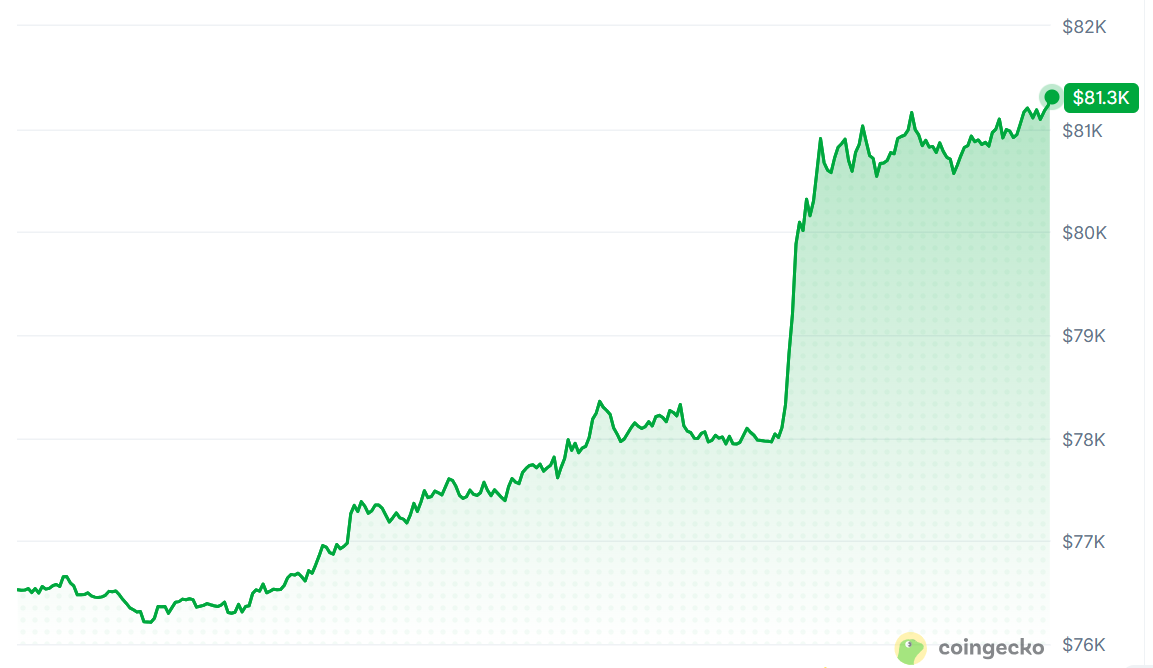
Bitcoin has successfully mounted a resilient recovery, surging back above the psychologically significant $80,000 threshold after weathering a volatile confluence of macroeconomic, legislative, and security-related shocks. At the time of reporting, the world’s largest cryptocurrency trades at approximately $81,137.97, reflecting a 6.05% gain over the trailing 24 hours and a 4.30% increase across the past seven days. Concurrently, CoinGecko data highlights robust market participation, with 24-hour trading volumes hovering around $42.20 billion.
This swift price action marks a sharp reversal from earlier in the week when digital asset markets slumped toward the mid-$75,000 region. On-chain analytics and social intelligence platform Santiment reported that sentiment was severely dragged down by three distinct fear narratives: the legislative stalling of the CLARITY Act, a surprise benchmark interest rate hike by the U.S. Federal Reserve, and a series of high-profile security incidents within the broader blockchain ecosystem. Despite these compounding bearish catalysts, the ability of Bitcoin to rapidly absorb negative news and reclaim ground above $80,000 underscores a fundamental shift in market absorption capacity, suggesting that widespread panic may have triggered aggressive accumulation by institutional and high-net-worth buyers.
Chronology of Market Shocks: A Week of Compounding Pressures
The downward pressure experienced by digital asset markets did not stem from a single isolated event, but rather unfolded through a rapid sequence of policy, monetary, and security disruptions throughout mid-September 2026.
The turbulence began in Washington on September 15, when the U.S. Senate failed to advance the much-anticipated CLARITY Act. During a high-stakes procedural vote on H.R. 3633, the legislation fell short in a 49-50 tally, stalling its legislative momentum and plunging the digital asset industry back into a state of regulatory ambiguity. For months, market participants had looked to the CLARITY Act to establish clear jurisdictional boundaries between regulatory bodies like the Securities and Exchange Commission (SEC) and the Commodity Futures Trading Commission (CFTC). The failure of the bill to clear this procedural hurdle introduced immediate legislative uncertainty, prompting cautious traders to trim their risk exposure.
Barely twenty-four hours after the legislative setback, macroeconomic headwinds intensified. On September 16, the Federal Reserve announced a 25-basis-point increase to its benchmark interest rate, lifting the target range to 3.75%-4.00%. This unexpected tightening marked the central bank’s first rate hike since July 2023, catching various financial markets off guard. Traditional economic theory dictates that higher interest rates elevate borrowing costs across the global economy, subsequently driving capital away from speculative or alternative asset classes—such as cryptocurrencies—and toward safer, yield-bearing instruments like U.S. Treasuries.

Compounding these regulatory and macroeconomic challenges, the crypto ecosystem was rattled by fresh security concerns. Santiment highlighted the multi-million-dollar Symbiosis Bitcoin Bridge exploit, which resulted in the unauthorized creation of $46 million in fake syBTC tokens and a subsequent direct loss of roughly $336,000 by the attacker. Simultaneously, a separate data breach involving Revolut compromised sensitive personal information belonging to a subset of crypto-active customers. Together, these three compounding narratives—legislative failure, monetary tightening, and structural security vulnerabilities—fueled a wave of social media panic that accelerated Bitcoin’s descent toward the $75,000 support band.
Supporting Data and Market Metrics
Despite the overwhelming volume of negative commentary across social channels, on-chain metrics indicate that the actual market reaction diverged sharply from peak retail panic. The liquidation cascades that typically accompany steep drawdowns failed to materialize in destructive volumes, hinting that derivatives markets were not excessively over-leveraged prior to the correction.
CoinGecko figures place Bitcoin’s market capitalization comfortably above $1.6 trillion, cementing its dominant position relative to the broader altcoin market. The 24-hour trading volume of $42.20 billion signifies robust liquidity, ensuring that large-scale buyers could execute sizable transactions without triggering catastrophic slippage. Analysts monitoring exchange inflows and outflows noted a steady tapering of exchange balances during the mid-$75,000 dip, a historical indicator that long-term investors were moving coins off centralized platforms into cold storage rather than preparing to dump holdings at a loss.
Furthermore, historical market behavior suggests that when an asset absorbs profoundly adverse news without breaking critical long-term structural supports, it often signals seller exhaustion. Once the marginal seller has exited the market, the path of least resistance frequently shifts back to the upside, enabling a rapid price recovery once fresh capital enters the order books.
Technical Analysis and Key Price Thresholds
As Bitcoin establishes a firmer footing above the $80,000 mark, technical analysts and chart strategists are closely monitoring key inflection points to determine whether the current rebound is a temporary relief rally or the precursor to a sustained continuation of the broader bull cycle.
Prominent crypto analyst Crypto Patel highlighted the formation of an 8-hour bullish flag pattern, identifying $80,000 as the decisive breakout trigger. According to Patel’s technical framework, a confirmed daily close and sustained holding above this psychological handle validates the continuation pattern, opening a pathway toward initial resistance at $82,250 and potentially paving the way for a more aggressive push toward the $98,000 region. Conversely, the invalidation of this bullish setup lies beneath the $75,000 threshold. Should macroeconomic or regulatory pressures resurface and force a breakdown below this zone, Bitcoin could find itself vulnerable to deeper corrections toward lower support levels at $71,000 and $68,000.
Providing a complementary risk-management perspective, trader KillaXBT outlined a strategic hedging framework for navigating the $80,000 to $86,000 range. According to KillaXBT’s advisory notes, a continued advance toward the $82,000-$84,000 bracket could warrant a 50% hedge to protect open long positions against sudden volatility. Furthermore, a sustained reclaim of the $85,000-$86,000 zone would establish a strong foundation for a subsequent test of the highly anticipated $88,000-$95,000 trading corridor.
These divergent technical projections illustrate the nuanced nature of current market sentiment. While the immediate structural outlook favors the bulls, market participants remain acutely aware that price trajectories remain tethered to incoming economic data releases, regulatory developments in Washington, and the overall stability of decentralized infrastructure.
Broader Impact and Industry Implications
The events of mid-September 2026 offer a valuable case study in the evolving maturity of the digital asset market. Historically, the simultaneous occurrence of a major legislative failure in the U.S. Congress, a hawkish pivot by the Federal Reserve, and high-profile security exploits would have likely triggered a protracted, multi-week bear market characterized by cascading liquidations and panic selling.
The fact that Bitcoin reclaimed the $80,000 level within days demonstrates a notable decoupling from absolute panic. It highlights an institutionalizing asset class that is increasingly capable of pricing in macroeconomic shifts and legislative delays without unraveling structurally.
Nevertheless, the vulnerabilities exposed by the Symbiosis Bridge exploit and the Revolut data breach serve as a persistent reminder that cybersecurity remains the Achilles’ heel of the broader blockchain economy. As capital continues to flow into decentralized finance (DeFi) and cross-chain interoperability protocols, the demand for rigorous, institutional-grade smart contract audits and fortified custody solutions has never been more urgent. Security failures no longer just impact isolated protocols; they contribute to macro sentiment shifts that temporarily weigh on foundational assets like Bitcoin.
Looking ahead, the trajectory of Bitcoin will be dictated by how the market digests upcoming regulatory maneuvers—such as potential resubmissions or revisions of the CLARITY Act—alongside future signals from the Federal Reserve regarding the trajectory of interest rates. For now, the successful defense of the $75,000 floor and the subsequent recapture of the $80,000 milestone demonstrate that Bitcoin’s underlying demand drivers remain robust, even in the face of a challenging external landscape.