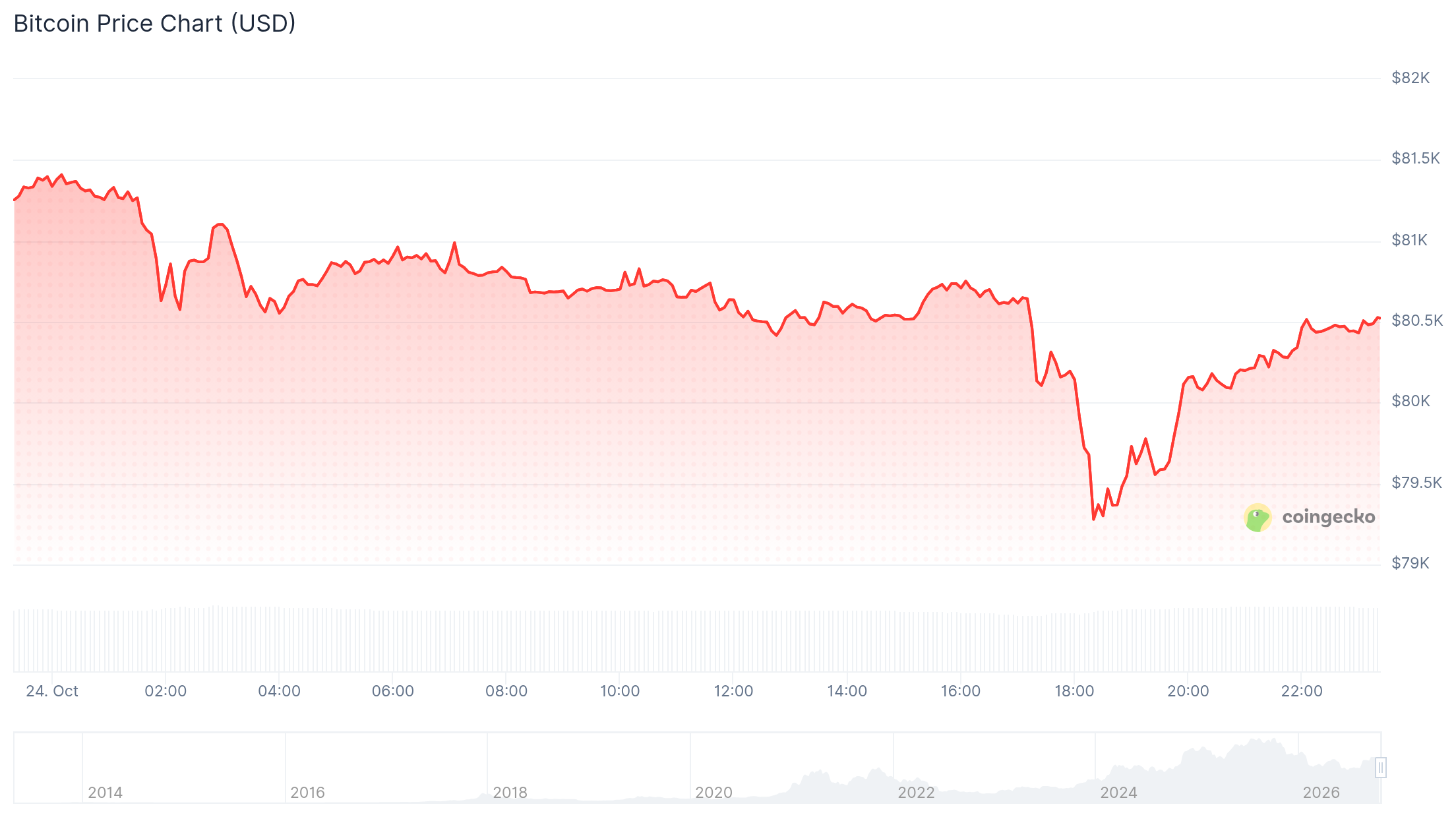
The digital asset market experienced a sharp and volatile contraction as Bitcoin (BTC) slipped beneath the closely watched psychological threshold of $80,000. This downward movement extended a broader market-wide correction, dragging the premier cryptocurrency into critical support territory and triggering a cascade of leveraged liquidations. As intraday trading fluctuated between $79,146 and $79,263 before stabilizing near $80,300, market participants faced mounting pressure from a confluence of macroeconomic headwinds, shifting institutional fund flows, and technical breakdowns across major moving averages.
The recent decline highlights the fragile equilibrium within modern cryptocurrency markets, where traditional macroeconomic factors, such as energy prices and central bank policy expectations, intersect heavily with decentralized financial instruments and exchange-traded funds (ETFs). Industry analysts, macro strategists, and prominent market critics have increasingly turned their attention to upcoming macroeconomic catalysts, including the Federal Reserve’s impending monetary policy meeting, as the crypto ecosystem navigates its most turbulent trading period in months.
Chronology of the Selloff: From Institutional Outflows to Technical Failures
The downward trajectory of Bitcoin did not occur in a vacuum; rather, it was preceded by a series of significant institutional and technical developments throughout the trading week. The prelude to the drop involved record-breaking activity in crypto prediction markets followed by a sudden reversal in institutional sentiment toward U.S. spot Bitcoin exchange-traded funds.
On Thursday, October 22, U.S. spot Bitcoin funds experienced a dramatic shift, bleeding approximately $635.5 million in net outflows. This marked the worst single-day exodus for these financial products since June 25. Institutional heavyweight BlackRock’s IBIT bore the brunt of the pressure with $254.1 million in withdrawals, closely followed by Fidelity’s FBTC, which shed $217.5 million. Although these funds had previously enjoyed a robust multi-day streak of inflows—including a notable $528.4 million intake on October 21—the sudden reversal severely damaged market confidence.

The bleeding continued into Friday, October 23, with funds shedding an additional $137.9 million. This steady drain of institutional capital pulled Bitcoin’s price down to approximately $81,668 just before the weekend market pause. However, the unique structural design of U.S. spot ETFs created a distinct vulnerability for traditional investors: while Bitcoin continued to trade continuously across global digital asset exchanges over the weekend, ETF shareholders were barred from adjusting their positions until traditional U.S. stock markets reopened on Monday morning. This structural lag left traditional finance participants exposed to weekend volatility without any immediate recourse to mitigate losses.
Liquidations and Market Mechanics
As Bitcoin’s price slid through the $81,000 to $80,000 range, it breached its 50-day simple moving average (SMA), a critical technical indicator that had successfully supported the asset’s price action for roughly two months. This technical failure triggered a massive wave of forced liquidations across major derivatives exchanges.
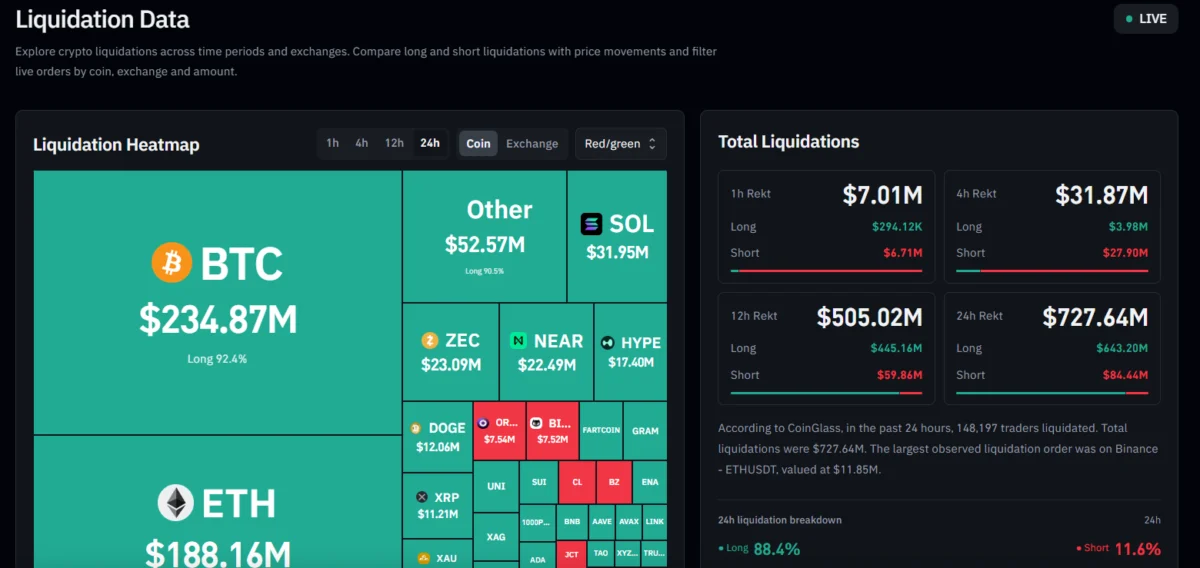
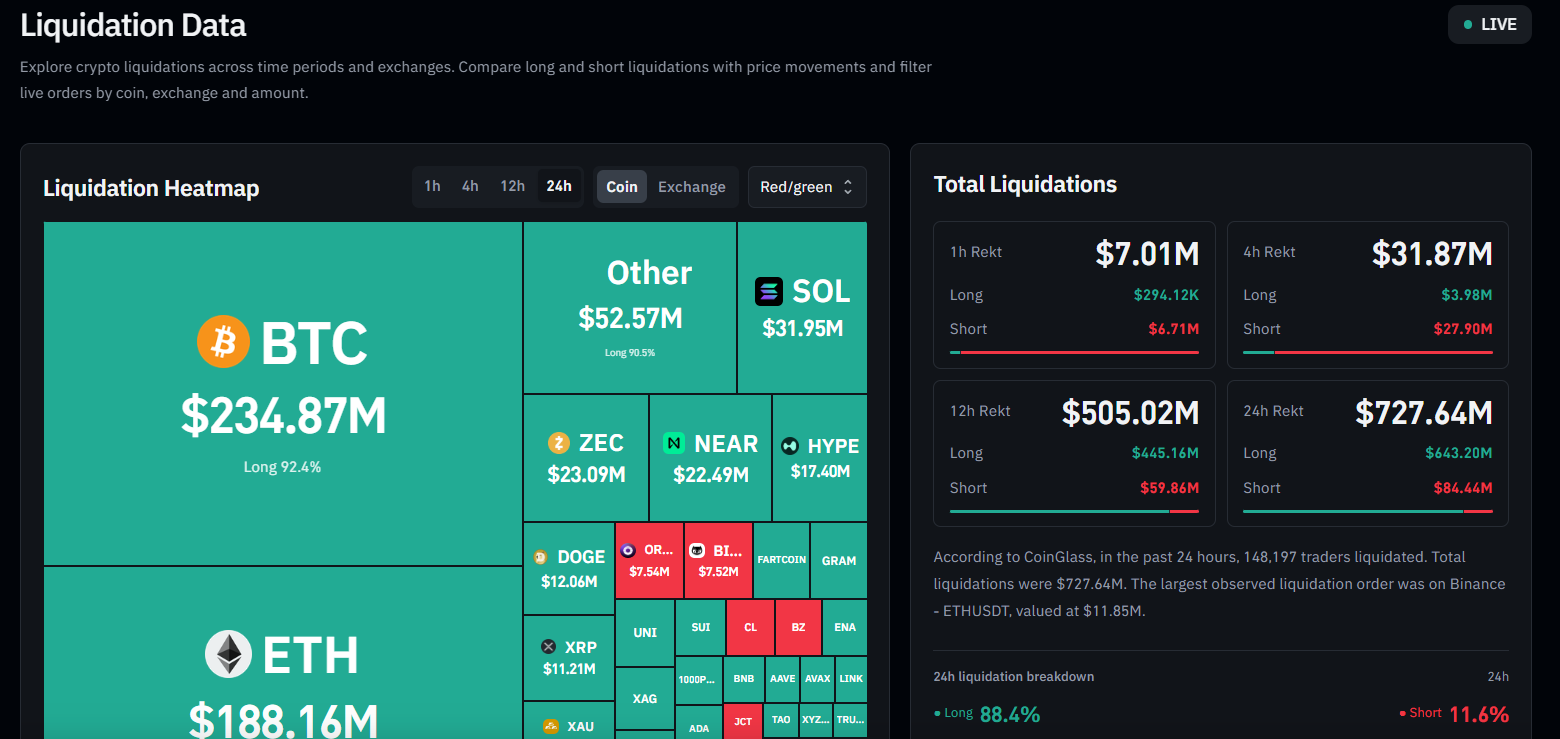
According to data compiled by CoinGlass, Bitcoin liquidations totaled $239.65 million over a single 24-hour window. The composition of these liquidations revealed a heavily skewed market: long positions accounted for an overwhelming $234 million—representing 93.1% of the total—while short positions accounted for a mere $16.65 million. Across the broader cryptocurrency market, total liquidations reached $727.78 million, forcing out 196,033 individual traders. Long positions constituted 83.7% ($686.93 million) of this market-wide total.
These figures illustrate that a vast majority of market participants were aggressively positioned for continued upside momentum. When prices unexpectedly broke lower, these over-leveraged long positions were automatically unwound by exchanges, generating a cascading wave of forced sell orders that further accelerated Bitcoin’s downward momentum.
Broader Macroeconomic Headwinds
The cryptocurrency market’s struggles did not occur independently of traditional financial markets. Risk-off sentiment intensified sharply across global equities and commodities, driven by compounding macroeconomic and geopolitical pressures.
In traditional equities, the technology-heavy Nasdaq Composite tumbled 2.6% on Thursday, marking its steepest single-day percentage drop since June 5. Investors increasingly questioned whether trillion-dollar technology corporations could sustain their massive capital expenditures dedicated to artificial intelligence infrastructure without realizing immediate, tangible returns. Because Bitcoin has historically shared a high correlation with risk-on growth assets and technology equities during periods of macro stress, the tech sector’s pullback weighed heavily on crypto valuations.
Simultaneously, energy markets added to inflationary concerns. Brent crude climbed past $117 per barrel amid escalating tensions in the Middle East. Higher energy prices threaten to reignite global inflation, complicating the macroeconomic backdrop just ahead of the Federal Reserve’s scheduled two-day Federal Open Market Committee (FOMC) meeting on October 27–28. Market participants are closely watching the central bank’s upcoming rate decision for clues regarding future monetary easing cycles.
The heightened macro uncertainty prompted prominent industry figures to adjust their risk exposure. Arthur Hayes, co-founder of BitMEX and CIO of Maelstrom, publicly noted that he had closed his firm’s directional book and locked in profits on several altcoins, including Ethereum (ETH), ENA, and UNI, citing unpredictable macroeconomic and geopolitical currents.
Expert Commentary and Downside Price Scenarios
The breach of the $80,000 milestone has ignited intense debate among market analysts regarding the depth of the ongoing correction. Peter Schiff, chief executive and chief global strategist at Euro Pacific Capital and a well-known Bitcoin skeptic, argued that the cryptocurrency has suffered a definitive structural breakdown.
Schiff warned that if bulls fail to defend the current support levels, $75,000 will likely serve as the next significant stopping point. He emphasized that a drop toward or below $75,000 would create severe distress for ETF investors who remain trapped over the weekend due to traditional market closure hours. Furthermore, Schiff pointed out that a retreat to $75,000 would severely narrow the paper-gain buffer held by corporate treasury holders like Strategy, which maintains a substantial reserve of over 640,000 BTC. While Strategy’s reported average cost basis sits near $73,981—meaning a $75,000 price point would still place the firm slightly above its aggregate cost per coin—Schiff has repeatedly criticized the company’s share dilution models and warned that sustained downward pressure could eventually turn its market premium into a steep discount.
Technical analysts, meanwhile, are mapping out a series of critical support and resistance bands as the market prepares for the new week’s opening bell. Immediate downside support levels are identified near $78,400 and $77,876. A more substantial and broader support zone is established between $76,700 and $72,500, with Schiff’s targeted $75,000 level resting squarely inside this lower demand band. Conversely, for the bullish momentum to resume, Bitcoin must successfully reclaim the $80,000 handle and decisively retake its 50-day moving average.
Implications for Institutional Adoption and Market Structure
The recent market turbulence serves as a critical stress test for the maturation of the cryptocurrency asset class, particularly following the widespread adoption of spot Bitcoin ETFs. While financial products issued by asset management giants have successfully funneled billions of dollars into the digital asset ecosystem, they have also introduced structural vulnerabilities unique to traditional financial plumbing.
The inability of ETF shareholders to trade outside standard banking and exchange hours creates asymmetric risk during weekend selloffs, occasionally exacerbating panic when traditional markets finally open. As regulators, institutional allocators, and retail traders evaluate the fallout from the sub-$80,000 correction, the interplay between 24/7 decentralized digital assets and regulated traditional financial market schedules will likely remain a central point of discussion.
With the Federal Reserve’s policy announcement looming and key technical supports hanging in the balance, the coming days will determine whether the current market correction represents a temporary consolidation phase within a larger structural bull market or the onset of a deeper, prolonged bearish retracement.