The current venture capital environment is undergoing a rigorous period of recalibration, characterized by "down-rounds" and strategic acquisitions that underscore a shift from growth-at-all-costs to fiscal reality. As high-valuation unicorns from the 2021-2022 period face the expiration of their capital runways, new buyers are emerging to consolidate market share at steep discounts. Simultaneously, the healthcare sector is experiencing a structural evolution toward holistic care, while the insurance industry is signaling a departure from the hype cycle of artificial intelligence, opting instead to prioritize human capital as its primary competitive advantage.
The Era of Distressed Unicorn Consolidation: Bending Spoons and Beyond
The recent acquisition activity by Bending Spoons serves as a case study for the current state of late-stage private equity. The firm’s recent acquisitions of Miro and Airtable illustrate a broader phenomenon: the "valuation reset." Miro, a workplace collaboration powerhouse, was acquired for $1.4 billion—a stark contrast to its 2022 peak valuation of $17.5 billion. Similarly, Airtable was picked up for $1.3 billion in August, down significantly from its $11.7 billion valuation in 2021.
These companies were not failing enterprises; they possessed robust revenue streams and highly engaged user bases. Instead, they were victims of a "cap table trap." During the pandemic-era boom, these firms secured funding at valuations that the current macroeconomic climate—defined by higher interest rates and a more cautious investor sentiment—cannot support. When a company’s valuation becomes untethered from its revenue multiples, future fundraising rounds become mathematically impossible without massive dilution or liquidation preferences that existing investors cannot accept.
Market analysts estimate that more than 150 unicorns are currently trapped in this "valuation purgatory." These companies are facing a difficult choice: accept a hostile down-round that wipes out early equity holders, or seek a strategic exit to a firm like Bending Spoons. For the acquirers, these deals represent a unique opportunity to purchase established software-as-a-service (SaaS) infrastructure at revenue multiples—often between 2x and 3x—that would have been unthinkable three years ago.
The Integration of Mental Health into Mainstream Clinical Care
While the tech sector focuses on consolidation, the healthcare industry is witnessing a profound shift in how behavioral health is delivered. The traditional "siloed" model, where mental health care exists as a separate referral system from primary care or specialty medicine, is being dismantled in favor of embedded behavioral health.
The most notable progress is occurring within oncology. In January, the National Comprehensive Cancer Network (NCCN) officially updated its distress management guidelines to include collaborative care models. This regulatory nod has triggered a surge in cross-sector partnerships. In the three months following the announcement, the industry saw as many partnership announcements as it did throughout the entirety of 2025.
This trend reflects a growing recognition that clinical outcomes for complex diseases are inextricably linked to the psychological well-being of the patient. By embedding mental health clinicians directly into oncology practices, providers can address "distress" in real-time, potentially reducing hospital readmission rates and improving adherence to rigorous treatment protocols.
Data from the sector suggests that this shift is not merely a clinical preference but an economic one. Value-based care models, which prioritize patient outcomes over the volume of services provided, have incentivized providers to address mental health earlier in the diagnostic process to avoid the high costs associated with untreated anxiety, depression, and trauma in patients with chronic conditions.
Insurance Brokerages: Betting on Human Capital Over AI
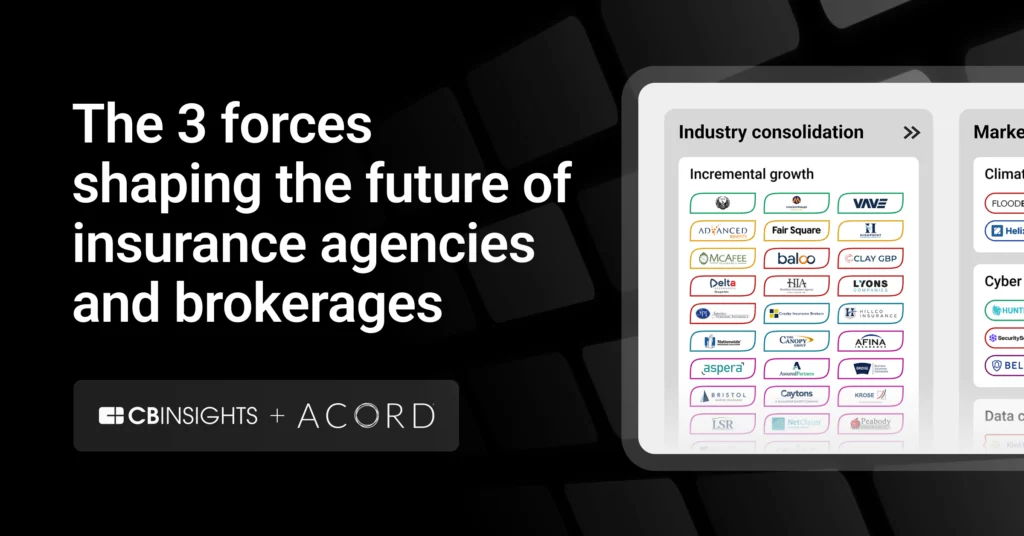
Perhaps the most surprising development in the current industrial landscape is the divergence between the tech sector’s AI fervor and the conservative strategy adopted by the insurance brokerage industry. A recent collaborative report between CB Insights and ACORD—the global standards-setting body for the insurance industry—reveals that the sector is choosing to prioritize people over algorithms.
According to the research, among the largest insurance brokerages globally, only four acquisitions involving AI-focused companies were recorded over the past 30 months. This figure is notably low, given the pervasive narrative that AI would fundamentally disrupt the brokerage business model by automating underwriting and client management.
The consensus among industry leaders is that the insurance brokerage model is fundamentally relational. While AI can certainly improve the speed of data processing and the accuracy of risk assessments, it cannot replicate the complex negotiations, trust-building, and high-stakes problem-solving required in commercial insurance. Consequently, talent has emerged as the single most important strategic differentiator.
For these firms, the "future of work" is not about replacing the broker with a chatbot; it is about providing elite brokers with the tools to manage larger, more complex portfolios. The industry is doubling down on human expertise because it recognizes that the long-term value of a brokerage lies in its institutional knowledge and its ability to act as a strategic advisor to corporate clients, rather than a mere conduit for standardized policies.
Implications and Future Outlook
The convergence of these three disparate trends—distressed consolidation in SaaS, the medicalization of mental health, and the human-centric pivot in insurance—points to a broader "return to fundamentals" in the global economy.
For investors and corporate leaders, the primary takeaway is that the "growth-at-any-cost" paradigm is being replaced by a focus on sustainable value. In software, that means ensuring that valuations align with actual revenue multiples to avoid the fate of the 150+ trapped unicorns. In healthcare, it means recognizing that the most efficient way to manage long-term costs is to integrate care, even when that integration is logistically complex. And in insurance, it serves as a reminder that technological innovation is an accelerant, not a replacement for human skill in relationship-driven industries.
As we move into the final quarter of the year, these trends will likely accelerate. Expect further consolidation in the SaaS sector as more companies hit the "funding wall." In healthcare, the success of the new oncology-behavioral health partnerships will likely serve as a blueprint for other specialties, such as cardiology and endocrinology. Finally, the insurance sector will likely continue to invest heavily in training and talent acquisition, positioning itself as a buffer against the volatility of the tech sector.
Ultimately, these developments illustrate a market that is maturing. After a period of excessive speculation and rapid technological disruption, the business world is refining its approach, focusing on the integration of existing technologies into established frameworks and prioritizing long-term stability over the promise of immediate, exponential disruption. For stakeholders, the mandate is clear: identify where the true value resides—whether it is in a sticky user base, a patient-centric care model, or a highly skilled workforce—and invest accordingly.