Billie Eilish, the 24-year-old U.S. singer-songwriter whose moody, genre-defying music has won 10 Grammies and two Oscars, has her own take on how to mark the end of a long run of shows. After her latest tour, Hit Me Hard and Soft, Eilish took a health break, worked on new music, and released a comprehensive environmental impact report measuring the success of her efforts to slash the carbon footprint of arena tours. This move marks a significant departure from standard industry practices, where the conclusion of a world tour is typically measured by box office grosses and ticket sales rather than carbon sequestration and waste diversion. By prioritizing ecological accountability, Eilish is challenging the traditional "Big Music" infrastructure and establishing a new blueprint for how large-scale entertainment can exist in a climate-conscious world.
The release of the report, produced in collaboration with the non-profit consultancy Reverb, serves as a data-driven testament to Eilish’s long-standing commitment to environmentalism. While many high-profile artists have expressed support for climate causes, Eilish has integrated these values into the logistical core of her operations. Having sold the digital equivalent of 80 million albums, her influence is vast, and she is increasingly using that leverage to force a reckoning within an industry known for its massive plastic waste, high-energy consumption, and heavy carbon emissions from international travel.
The Roots of a Climate-Conscious Career
Eilish’s environmental advocacy is not a marketing pivot but a continuation of her upbringing. Her mother, Maggie Baird, an actress and activist, raised Eilish and her brother Finneas in a no-meat, no-waste household where sustainability was a daily practice rather than a choice. In this environment, common household items like paper towels and traditional Christmas wrapping paper were banned to minimize waste. This foundational experience shaped Eilish’s worldview long before she entered the global spotlight.
Maggie Baird has since expanded this philosophy into the professional sphere through her organization, Support + Feed. The not-for-profit advocates for a global shift toward plant-based food systems as a primary tool for combating climate change. By aligning her daughter’s tours with the mission of Support + Feed, Baird has helped create a bridge between the entertainment world and environmental activism, ensuring that every stop on a world tour becomes an opportunity for education and resource redistribution.
When Eilish began her rise to superstardom, she was reportedly horrified by the sheer scale of waste inherent in the music industry. In an interview with a CNN reporter last year, she expressed her disbelief at the lack of institutional foresight regarding sustainability. "You would not believe how wasteful this industry is," Eilish stated, noting that when she initially approached organizations and venues about eco-conscious planning, she found that "nobody had a plan." Consequently, she began demanding one, making environmental compliance a central pillar of her touring contracts.
A Chronology of Climate Action and Advocacy
Eilish’s transition into a Gen Z climate champion has been marked by several high-profile moments that signaled her intent to lead by example. In 2022, she attended the Met Gala in a custom Gucci dress constructed entirely from recycled materials, using one of fashion’s biggest nights to highlight the importance of the circular economy. This was followed by a cover story for Vogue magazine, where she notably pivoted the conversation from her music to the urgency of climate disruption, bringing a group of young climate activists to the photoshoot to share their perspectives.
One of the most significant milestones in her advocacy was the launch of "Overheated," a climate-action initiative that debuted during her O2 Arena residency in London. Overheated included the production of a documentary on climate change and a series of formal climate conferences featuring scientists, activists, and fashion designers. These events were designed to be accessible to fans, demystifying the complexities of climate science and providing actionable steps for individual and collective change.
The 2024/2025 "Hit Me Hard and Soft" tour represents the culmination of these efforts. Rather than treating sustainability as a peripheral concern, the tour’s logistics were built around the goals of waste reduction and carbon mitigation. This included requiring venues to provide free water-bottle filling stations to eliminate the need for single-use plastics and mandating that all concert staff be provided with plant-based meals.
Analyzing the Environmental Impact Report
The environmental impact report released by Reverb provides a granular look at what "green touring" actually looks like in practice. The data suggests that spirited leadership and strict logistical requirements can yield measurable results, even at the arena level. According to the report, the 2024/2025 tour raised US$13.3 million for various climate organizations, a sum generated through ticket sales, partnerships, and direct donations.
One of the most striking figures in the report involves the shift in food consumption. The tour delivered 7.7 million plant-based meals to fans, staff, and volunteers. By opting for plant-based catering over meat-heavy alternatives, the tour effectively reduced food-related emissions by 50%. This focus on "food as fuel" for the climate movement is a core tenet of the Support + Feed mission, demonstrating that large-scale events can significantly lower their impact by altering their supply chains.
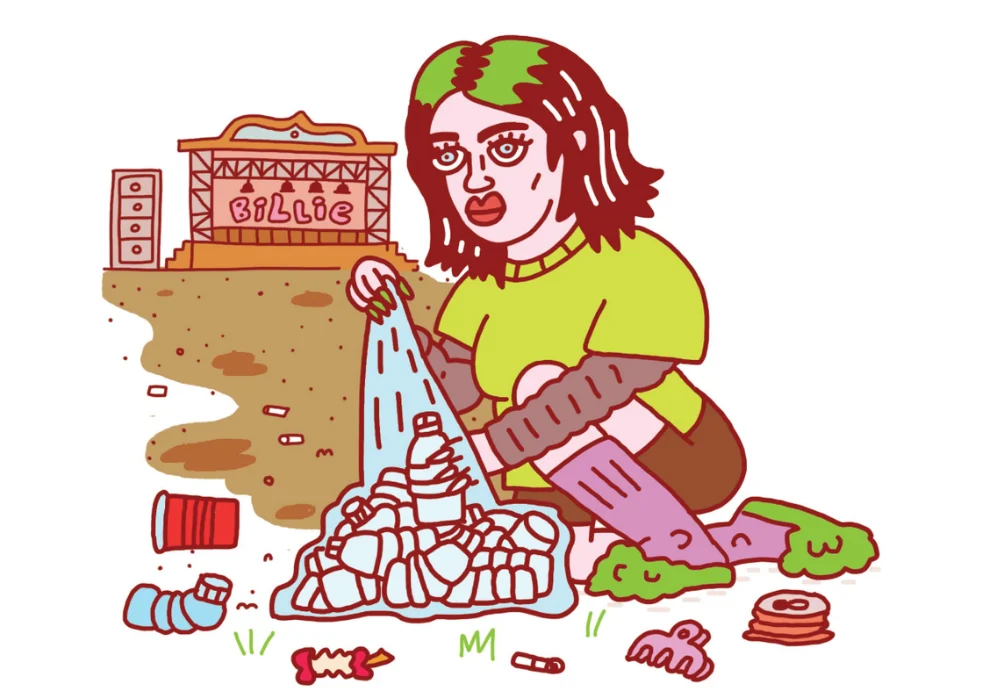
Waste reduction was another primary focus. The report indicates that the tour successfully avoided the use of 135,000 single-use water bottles. This was achieved through a combination of fan education and the installation of high-capacity water stations. By encouraging fans to bring their own reusable containers, the tour minimized the plastic footprint that typically litters arena floors after a performance.
Addressing the Logistics of Fan Transportation
While waste and food are significant factors, the single largest climate impact of arena shows remains transportation. The movement of tens of thousands of fans to and from a venue often accounts for the majority of a concert’s total carbon footprint. To address this, Eilish’s team implemented a multi-faceted strategy involving technology and local infrastructure.
Working in partnership with Google Maps and local transit authorities, Eilish’s team plotted the "greenest" transit alternatives for every venue on the tour. Fans were provided with information on public transportation routes, bike-sharing programs, and carpooling incentives. This level of logistical coordination is rare in the music industry, where the responsibility for travel is usually left entirely to the consumer. By taking an active role in fan transit, Eilish has highlighted a critical area where artists can influence systemic change.
Furthermore, Reverb noted that the impact of these initiatives extends beyond the duration of Eilish’s tour. Many venues, having been forced to upgrade their infrastructure or change their operations to meet Eilish’s requirements, have opted to keep these new practices as part of their standard operating procedures. This "trickle-down" effect suggests that one artist’s demands can permanently alter the sustainability profile of a venue, benefiting every subsequent act that performs there.
Official Responses and Industry Implications
The response from environmental organizations has been overwhelmingly positive, with many citing Eilish as a model for the future of the industry. Industry analysts suggest that Eilish’s success proves that sustainability is not a barrier to profitability. The US$13.3 million raised for climate causes demonstrates that environmentalism can be a powerful engine for philanthropic growth within the music business.
However, the path has not been without friction. Eilish has been vocal about the resistance she faced from established industry players who viewed her demands as "difficult" or "unnecessary." By refusing to back down, she has shifted the narrative from what is "possible" to what is "necessary." Unlike many climate crusaders who focus on the limitations of current systems, Eilish remains bullish about the possibilities for change. Her guiding philosophy—that "things don’t always have to be done the way they’ve always been done"—is now being echoed by other artists looking to follow in her footsteps.
The Broader Impact on Global Music Culture
The implications of Eilish’s environmental impact report go beyond the numbers. They represent a cultural shift in how Gen Z artists view their responsibility to their audience and the planet. As the music industry continues to grapple with its role in the climate crisis, the "Eilish Model" provides a tangible framework for action. It emphasizes that sustainability is not just about reducing harm, but about using the massive platform of a global tour to fund solutions and educate millions of people.
As Eilish moves into the next phase of her career, the data from the "Hit Me Hard and Soft" tour will likely serve as a benchmark for the entire industry. The report proves that with enough leverage and a clear plan, the "wasteful" nature of Big Music can be dismantled. For Billie Eilish, the success of a tour is no longer just about the standing ovations or the record-breaking sales; it is about the legacy of a cleaner, more sustainable industry left in her wake.