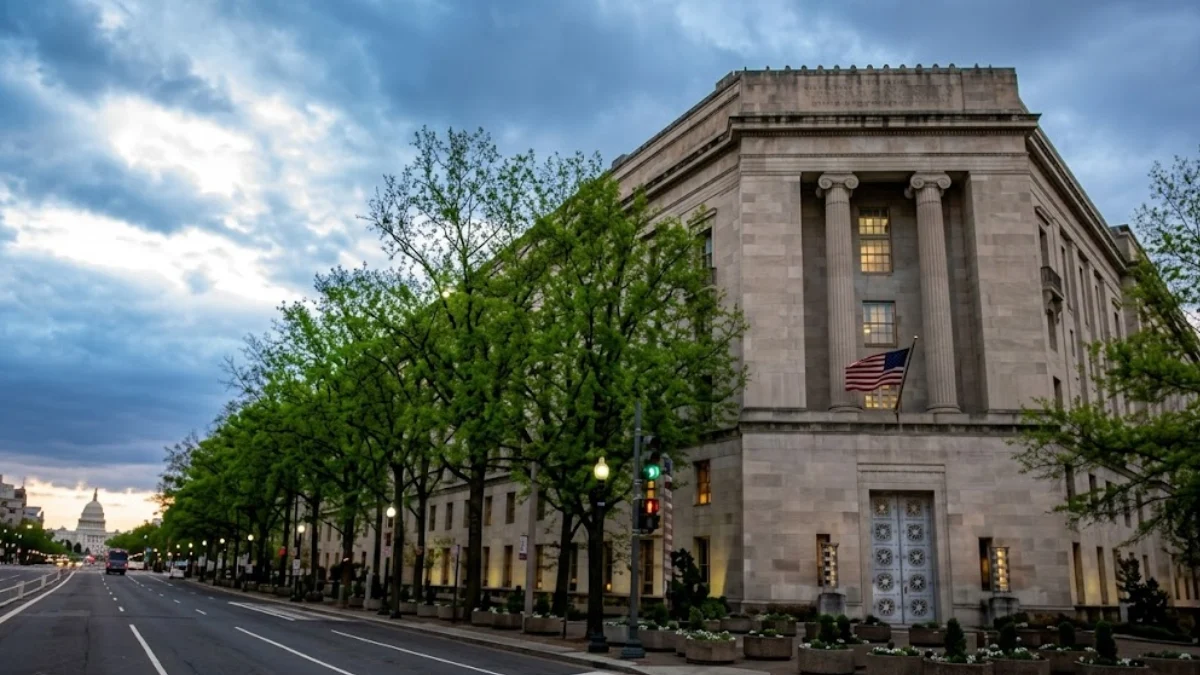
The Department of Justice (DOJ) announced today that the Trade Fraud Task Force (TFTF), an interagency initiative launched in August 2025, has officially surpassed $1 billion in civil and criminal recoveries, penalties, and forfeitures within its first year of operation. This landmark figure, which includes publicly charged losses across a spectrum of customs-related offenses, signals a transformative shift in how the United States federal government approaches the enforcement of trade laws. By moving away from viewing customs violations as mere administrative errors, the government has adopted a rigorous strategy of criminal prosecution and civil litigation, primarily utilizing the False Claims Act (FCA) to target those who attempt to bypass the nation’s economic borders for illicit profit.
Assistant Attorney General Colin McDonald, who leads the Justice Department’s National Fraud Enforcement Division, emphasized that the billion-dollar milestone is a testament to the department’s renewed focus on economic integrity. He noted that for far too long, unscrupulous actors in the global supply chain have treated customs violations as a "mere surcharge" or a "cost of doing business." According to McDonald, the full weight of the Justice Department is now being deployed to ensure that trade fraud is recognized as a serious economic crime that threatens the stability of domestic markets and the security of the American taxpayer. The message from the TFTF is intended to resonate throughout every level of the global supply chain, from manufacturers and importers to customs brokers and downstream distributors.
The Genesis and Mandate of the Trade Fraud Task Force
The Trade Fraud Task Force was established as a joint venture between the Department of Justice and the Department of Homeland Security (DHS) to address the growing complexity of international trade crimes. Since its inception in August 2025, the task force has been tasked with investigating and prosecuting entities that defraud the United States government through material misrepresentations to U.S. Customs and Border Protection (CBP). These misrepresentations often take the form of transshipment schemes—where goods are routed through a third country to disguise their true origin—mislabeling of products, and the submission of false declarations regarding the value or nature of imported merchandise.
The mandate of the TFTF is exceptionally broad, covering the entire lifecycle of a product’s entry into the United States. While the primary targets are often the importers of record, the task force also scrutinizes customs brokers, downstream distributors, and industrial or commercial end-users who knowingly profit from merchandise imported contrary to law. By focusing on the entire supply chain, the TFTF aims to dismantle the financial incentives that drive large-scale customs evasion.
Key priorities for the task force include the evasion of Section 301 tariffs, which are often applied to goods from specific nations to address unfair trade practices, as well as the avoidance of antidumping (AD) and countervailing duties (CVD). These duties are critical for protecting American industries from foreign products that are sold at less than fair value or are unfairly subsidized by foreign governments. Furthermore, the TFTF is heavily involved in the eradication of forced labor from global supply chains, ensuring that goods produced through exploitation do not find a home in U.S. markets.
Significant Enforcement Actions: The Chicago Gold Jewelry Cases
A substantial portion of the $1 billion milestone can be attributed to high-impact enforcement actions led by the United States Attorney’s Office for the Northern District of Illinois (NDIL). The TFTF selected the Chicago-based office as its lead prosecutorial partner due to the city’s status as a global transportation and logistics hub. Recently, the NDIL announced charges in two major cases involving the systematic evasion of customs duties on gold jewelry, highlighting the sophisticated methods used by fraudsters to deceive federal authorities.
In the first case, Raj Kohli and Veena Kohli, operators of the South San Francisco-based Surya International, Inc., were charged in U.S. District Court in Chicago. The couple is alleged to have participated in a massive scheme to falsely declare the country of origin for gold jewelry imported into the United States. Between August 2020 and May 2024, Surya International reportedly filed approximately 563 separate entries for gold jewelry, claiming the items were manufactured in Singapore. Investigations revealed, however, that the jewelry actually originated in India and the United Arab Emirates.
By misrepresenting the origin of these goods, the defendants allegedly avoided paying customs duties ranging between 5.5% and 5.8% of the declared value. With the total estimated value of the imported jewelry exceeding $693 million, the federal government estimates that the scheme resulted in the avoidance of more than $38 million in duties. This case underscores the massive scale at which trade fraud can operate and the significant revenue loss it inflicts on the U.S. Treasury.
In a separate but similar enforcement action, Narain Gulabani, the owner of Barkha Wholesale, Inc., based in Naperville, Illinois, was also charged with falsely declaring the country of origin for imported gold jewelry. Between May 2016 and October 2021, Gulabani allegedly imported 242 separate entries of jewelry, claiming they were manufactured in Oman or Singapore to avoid the same 5.5% to 5.8% duty rates. The total value of the jewelry in this scheme exceeded $240 million, leading to an estimated loss of $13.6 million in unpaid customs duties. These cases illustrate a broader pattern of "origin-jumping," a tactic used to exploit free trade agreements or lower duty rates associated with specific countries.
Strategic Collaboration Between CBP and HSI
The success of the Trade Fraud Task Force relies on the seamless integration of operational data from U.S. Customs and Border Protection and the investigative expertise of Homeland Security Investigations (HSI). CBP Commissioner Rodney S. stated that ensuring a level playing field for law-abiding American businesses is a core component of the agency’s mission. He noted that every day, CBP officers confront criminal networks that attempt to exploit supply chains, endanger families with unsafe goods, and undermine the integrity of consumer markets.
By pairing CBP’s vast operational reach at ports of entry with the DOJ’s prosecutorial authority, the task force is able to move beyond simple seizures of goods and toward the total dismantling of criminal networks. This collaborative approach allows investigators to trace the flow of illicit goods and the accompanying financial trails, leading to more comprehensive charges and higher recovery amounts.
Homeland Security Investigations Acting Executive Associate Director John A. echoed these sentiments, highlighting HSI’s role in protecting American businesses from the consequences of illegal trade. He stated that HSI combines investigative expertise with global partnerships to confront networks that threaten fair trade and national economic interests. By holding offenders accountable, the task force builds consumer trust in the products people rely on daily and supports a fair marketplace where honest businesses can thrive without being undercut by those who cheat the system.
Broader Implications and the Future of Trade Enforcement
The achievement of the $1 billion milestone within less than a year suggests that the federal government’s new approach to trade enforcement is yielding immediate results. However, the implications of the TFTF’s work extend beyond financial recoveries. The task force’s focus on "down-chain" activities serves as a warning to every participant in the commercial ecosystem. Under federal law, any entity that knowingly handles, distributes, or profits from merchandise entered contrary to law can be held liable.
This means that the port of entry is no longer the only focus for enforcement. The TFTF has a nationwide mandate to investigate and prosecute cases in any district through which an imported object moves or where the impact of the fraud is felt. This geographic flexibility allows the government to bring charges in jurisdictions that may be more severely impacted by specific types of trade fraud, such as manufacturing hubs or major retail centers.
Furthermore, the task force’s emphasis on public health and safety ensures that the enforcement of trade laws is not just about revenue, but also about protection. By targeting the importation of unsafe or counterfeit goods—ranging from electronics that pose fire hazards to tainted food products—the TFTF plays a vital role in national security.
As the Trade Fraud Task Force enters its second year, experts anticipate an even greater focus on the use of data analytics to identify anomalies in shipping patterns and valuation declarations. The integration of artificial intelligence and machine learning into CBP’s screening processes is expected to provide the TFTF with a steady stream of leads, potentially leading to even larger recoveries in the future.
The $1 billion milestone reached this year is not merely a number; it represents a fundamental change in the risk-reward calculus for those engaged in international commerce. With the National Fraud Enforcement Division and its partners at DHS and CBP showing no signs of slowing down, the era of treating trade fraud as a minor administrative hurdle appears to have come to a definitive end. The federal government has made it clear: the integrity of American borders and markets is not for sale, and those who seek to exploit the trade system will be identified, investigated, and brought to justice.