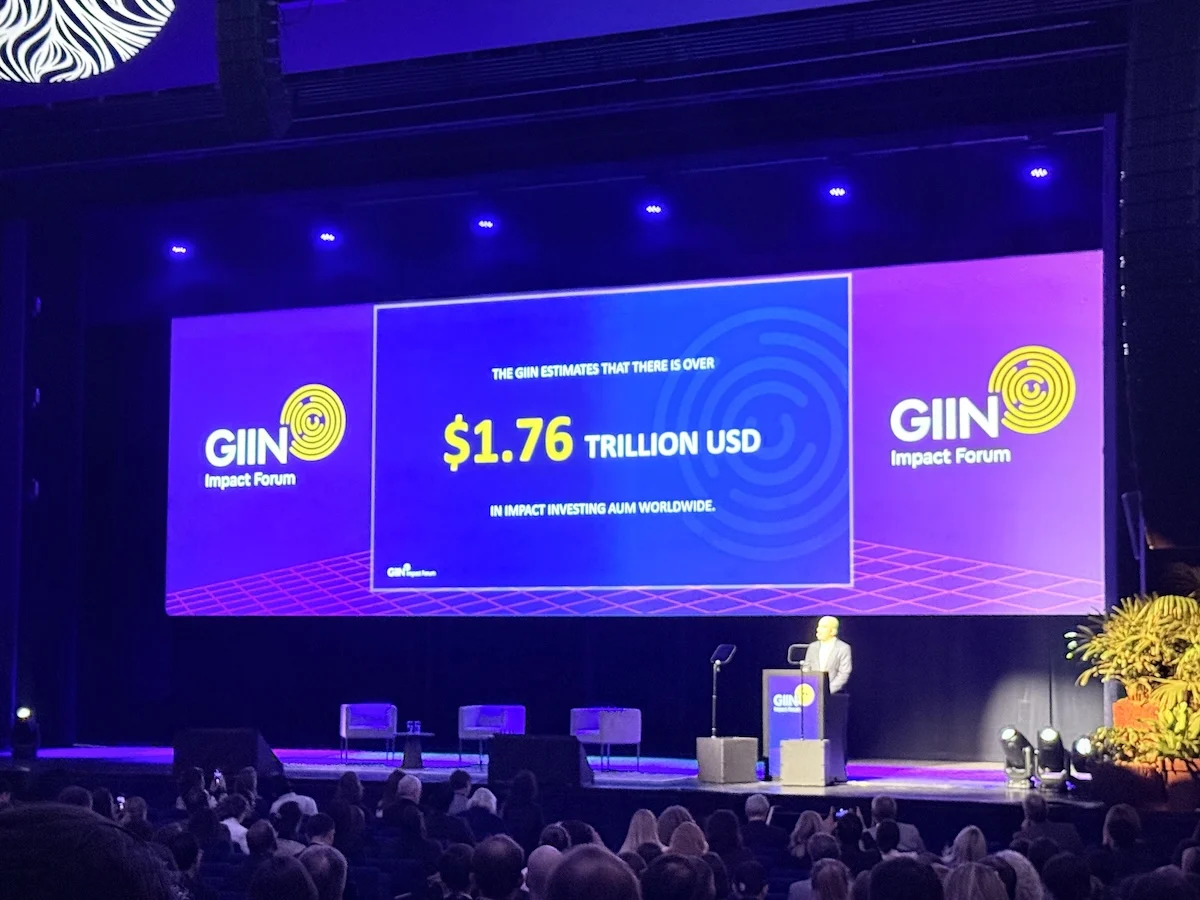
The global impact investing landscape has demonstrated remarkable resilience, expanding to an estimated $1.76 trillion in assets under management, according to the latest biannual market report released today by the Global Impact Investing Network (GIIN). Despite a complex backdrop of macroeconomic friction, fluctuating public market valuations, and shifting political hostility toward environmental, social, and governance (ESG) frameworks in key regions such as the United States, the sector has registered a $200 billion gain since 2024.
While the 6% annualized growth rate represents a deceleration from historical pulses—which have traditionally averaged closer to 20% year-on-year—industry leaders maintain that the milestone underscores the structural durability of the asset class. Impact investing, long viewed by skeptics as a transient financial trend or a marginal philanthropic offshoot, has officially entered a new phase of maturity. The overarching narrative is no longer solely about proving that capital can scale, but rather about ensuring that deployed funds generate verifiable, systemic shifts in social and environmental outcomes.
A Historical Trajectory of Scale and Maturation
To understand the current state of the impact investing ecosystem, one must examine its evolutionary trajectory over the past decade and a half. When the Global Impact Investing Network was formally established in 2008 in the wake of the global financial crisis, the concept of intentionally embedding social or environmental outcomes alongside financial returns was considered avant-garde. Institutional participation was sparse, and finding a fund manager overseeing more than $100 million specifically dedicated to impact was a rarity.
In the ensuing years, the sector experienced exponential growth, propelled by a rising tide of millennial wealth transfer, heightened public awareness of climate change, and systemic inequalities exposed by various global disruptions. By the mid-2010s, impact investing had graduated from a niche strategy practiced by specialized boutique firms into a formalized institutional asset class. Major mainstream private equity players, sovereign wealth funds, and traditional asset managers began establishing dedicated impact arms.
By 2020, total assets under management had breached the trillion-dollar threshold, turning heads across Wall Street and global financial capitals. However, the subsequent years brought unprecedented turbulence. The post-pandemic inflationary spike, rapid interest rate hikes by central banks worldwide, and a tightening of global liquidity created a challenging fundraising environment. Furthermore, the political landscape in major Western economies—particularly in the United States, where conservative lawmakers launched coordinated legislative and rhetorical campaigns against climate action and diversity, equity, and inclusion (DEI) initiatives—introduced a layer of regulatory and reputational risk that forced many allocators to re-evaluate their public positioning.
Despite these formidable headwinds, the market has continued to expand, reaching the $1.76 trillion mark documented in GIIN’s 2026 report. This sustained upward trajectory highlights a structural shift: impact investing is no longer dependent on hyper-favorable macroeconomic conditions or political tailwinds; it is increasingly embedded into the fiduciary strategies of long-term investors.
Decoding the Data: Means, Medians, and Market Concentration
A granular analysis of the data compiled from the more than 320 impact investors, asset allocators, and fund managers surveyed for the report reveals a bifurcated market structure. On one end of the spectrum sits a powerful cohort of institutional heavyweights; on the other, a vibrant ecosystem of agile, smaller-scale innovators.
According to the findings, approximately 60 of the surveyed entities manage portfolios exceeding $1 billion in impact assets. This concentration pulls the mathematical average of assets under management (AUM) across the broad sample up to $1.4 billion. However, the median tells a different story: half of the participating organizations manage significantly smaller sums, with an average of just $162 million in their impact portfolios.
Amit Bouri, chief executive officer and co-founder of the GIIN, emphasized the significance of this dual structure during an interview discussing the report’s findings. "In the early days of the GIIN, having someone above $100 million in impact investing was a big deal," Bouri noted. "Now we have a set of players that are of a significant scale and can engage with institutional investors."
At the same time, Bouri highlighted that the large contingent of smaller market participants remains vital for the ongoing health and evolution of the industry. These smaller fund managers and allocators are uniquely positioned to test novel financial instruments, explore unchartered geographic frontiers, and pioneer grassroots methodologies that larger institutional behemoths cannot easily replicate. "It’s important and exciting in terms of innovation and new models and experimentation in the market," he added.
The Changing Guard of Capital Allocation
The composition of capital owners within the impact space has also undergone a notable transformation. Institutional investors—including pension funds, insurance companies, endowments, and foundations—now represent the single largest category of asset owners, accounting for 35% of total impact AUM. Their involvement provides the deep pools of capital necessary to scale proven solutions and integrate impact strategies into mainstream portfolio management.
Conversely, family offices are playing an entirely different, yet equally critical, role in the ecosystem. While family offices represent a modest 6% of total impact capital, they are doing the heavy lifting when it comes to seeding new funds and supporting emerging capital providers. Data from the survey reveals that family offices have invested in 51% of the fund managers and capital providers polled by the GIIN. This willingness to provide early-stage risk capital—often referred to as patient capital or catalytic capital—remains indispensable for launching innovative strategies that can eventually attract larger institutional checks.
Geographic Shifts and the North American Headwind
One of the most revealing trends documented in the 2026 market report is a shifting geographic distribution of impact capital. While North America has historically served as the epicenter of the impact investing movement, a subtle yet meaningful reallocation is underway.
Investors are increasingly scaling back their domestic allocations in North America, influenced in part by the hostile political rhetoric and regulatory friction emanating from conservative political factions. The aggressive pushback against climate disclosure rules and DEI mandates under various political administrations has created a chilling effect for certain public market investors. Additionally, market analysts note that public market-focused impact investors sought to diversify their geographic exposure during peak market valuations in search of more favorable entry multiples.
Consequently, capital is actively flowing toward emerging and frontier markets, with Africa and Latin America emerging as primary beneficiaries of this geographic diversification. Investors are finding compelling opportunities to address critical developmental needs—such as financial inclusion, renewable energy infrastructure, and sustainable agriculture—in regions where market-rate financial returns can be coupled with profound developmental impacts.
This geographic rotation is clearly reflected in regional institutional dominance. Europe-based firms now represent the largest category of surveyed organizations, accounting for 36% of the total compared to North America’s 35%. More impressively, European firms command the lion’s share of total assets under management, holding 53% of the global impact assets surveyed, while North American firms manage 39%. Europe’s stringent regulatory frameworks, such as the Sustainable Finance Disclosure Regulation (SFDR), while presenting compliance challenges, have ultimately fostered a more institutionalized and transparent market environment that attracts deep-pocketed allocators.
Navigating the Liquidity Crunch and Valuation Pressures
The deceleration in the growth rate of impact AUM—down from historical 20% annual pulses to 6% in the current reporting period—is not solely a function of political and geographic repositioning. It is also deeply intertwined with broader macroeconomic realities, specifically a severe liquidity crunch.
Across both public and private markets, declining valuations and a near-freeze in exit activity have left many investors cash-strapped. Initial public offerings (IPOs) have remained subdued, and mergers and acquisitions (M&A) activity has faced headwinds due to elevated borrowing costs. As a result, capital is locked up in existing portfolios. "Assets are locked up. They don’t have free cash to make new allocations," Bouri explained, capturing the sentiment of fund managers struggling to realize liquidity events for their limited partners.
Despite these operational hurdles, investor sentiment regarding both impact and financial performance remains remarkably stable and robust. According to the GIIN survey, an overwhelming 91% of respondents reported satisfaction with their impact performance, while 71% expressed satisfaction with their financial returns.
These figures carry significant weight when considering the risk-return profile of the modern impact market. Approximately 95% of total impact capital actively targets risk-adjusted, market-rate returns, debunking the persistent myth that impact investing necessitates a compromise on financial performance. "Investors still have a lot of confidence in the market," Bouri noted, pointing out that the fundamental thesis of blending purpose with profit continues to hold up under rigorous market testing.
Entering a Consequential New Chapter: Effectiveness Over Scale
As the impact investing market digests its growth to $1.76 trillion, leadership at the GIIN and across the broader financial community are articulating a strategic pivot. The upcoming phase of the industry’s development is being characterized as a "consequential new chapter," one where success will no longer be judged merely by the sheer volume of capital mobilized, but by the tangible effectiveness of those investments in achieving deep-seated social and environmental objectives.
This qualitative shift requires a delicate balance. The market requires continued scale to tackle macro-level challenges such as climate change, biodiversity loss, and systemic economic disparity. At the same time, it demands relentless innovation to reach marginalized populations and overlooked sectors that traditional capital markets historically fail to service.
"We need scale and innovation," Bouri emphasized. "We need people who are developing new models, doing more experimental things. A really important role for this market is to reach people and issues markets don’t normally reach." He concluded with a forward-looking mandate for the sector: "Then, of course, we need things to get to a global scale."
Implications for the Broader Financial Ecosystem
The findings of the 2026 state of the market report carry profound implications for the future of global finance. By demonstrating resilience in the face of geopolitical resistance, liquidity constraints, and valuation contractions, impact investing has graduated from an alternative asset strategy into a critical benchmark for modern fiduciary duty.
As institutional capital continues to consolidate its leadership position and family offices pioneer the next wave of high-risk experimentation, the lines between traditional finance and impact investing are blurring. Asset owners are increasingly recognizing that environmental degradation and social instability are not external externalities, but material financial risks that directly threaten long-term portfolio value.
Moving forward, the ability of fund managers to rigorously measure, report, and verify non-financial outcomes will dictate their ability to capture institutional mandates. The era of impressionistic impact claims—often criticized as impact washing—is drawing to a close, replaced by a data-driven discipline that matches the sophistication of traditional financial auditing.
Ultimately, the growth of the impact market to $1.76 trillion signals that the integration of purpose and profit is not a temporary ideological movement, but a permanent structural evolution in how global capital is allocated, managed, and evaluated for the twenty-first century and beyond.