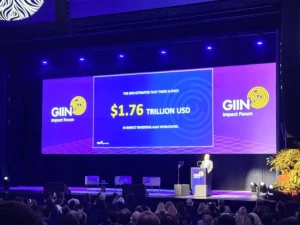
The global impact investing landscape is undergoing a profound structural evolution, defined simultaneously by resilient financial growth, a shifting macroeconomic environment, and a generational changing of the guard among its foundational pioneers. According to the latest biannual market sizing report released by the Global Impact Investing Network (GIIN), total impact assets under management (AUM) have climbed to $1.76 trillion. This marks a notable $200 billion expansion since 2024, demonstrating remarkable durability in the face of ongoing geopolitical headwinds, regulatory uncertainties, and a complex fundraising climate—particularly within the United States.
Simultaneously, the ecosystem is experiencing a historic wave of leadership transitions. Longtime architects of the impact investing sector—including executives, academics, and network leaders who spent decades institutionalizing triple-bottom-line finance—are stepping down. This simultaneous departure of first-wave leaders signals both the maturation of the market and an opening for a new generation of institutional allocators, fund managers, and visionaries to redefine the next era of sustainable and catalytic capital.
Resilience and Growth: The State of the Impact Market
The achievement of $1.76 trillion in managed impact assets dispels concerns that sustainable finance might experience a broad contraction following the peak enthusiasm of the early 2020s. While the rate of growth has moderated compared to historical surges—which routinely averaged annual increases of 20%—market participants view the continued upward trajectory as a testament to the institutionalization of impact strategies.
Industry analysts attribute this stability to the diversification of asset classes and a broadening investor base. Rather than relying solely on venture capital and high-risk equity, contemporary impact portfolios increasingly integrate private debt, real assets, community development finance, and blended capital structures. This maturity allows the market to weather macroeconomic pressures, such as high interest rates and shifting public sector policies, while continuing to direct capital toward renewable energy, affordable housing, financial inclusion, and agricultural innovation.
The GIIN’s findings underscore that institutional investors are no longer treating impact investing as an experimental asset class or a philanthropic afterthought. Instead, environmental, social, and governance (ESG) integration and intentional impact mandates have become core components of institutional risk management and long-term portfolio construction.
A Changing of the Guard Among Impact OGs
The maturation of the impact economy is starkly illustrated by a wave of high-profile departures among the movement’s longest-serving leaders. After 17 years at the helm of the GIIN, Amit Bouri delivered his final address at the GIIN Impact Forum in Amsterdam, marking the end of a foundational tenure during which the organization grew alongside the very market it measures.
Similar transitions are reshaping academia, blended finance, and catalytic capital institutions. Cathy Clark, a towering figure in impact education who spent two decades training future leaders at Duke University’s Fuqua School of Business, announced she will step down in June. Joan Larrea is planning her retirement from Convergence, the global blended finance network she successfully led and scaled over the past decade. Additionally, Beth Bafford—whose career spans instrumental roles at Calvert Impact and Climate United, where she helped navigate complex regulatory and market structures—has departed to pursue a new path in wealth management.
Reflecting on these departures, Ben Thornley of impact consultancy Tideline observed that these leaders spent over a decade navigating difficult terrain to build the infrastructure of modern impact finance. While their exits feel like the end of an era, industry insiders view the turnover as a healthy progression that invites fresh perspectives, diverse ideas, and new capital allocation strategies into the ecosystem.
The Rise of Impact-First Mandates and Catalytic Capital
As traditional impact strategies assimilate into mainstream finance, a distinct sub-sector of asset owners is pushing boundaries through explicit "impact-first" mandates. Organizations such as the IKEA Foundation, Arnold Ventures, and Earlystone are explicitly prioritizing targeted social and environmental outcomes over maximized financial returns. These investors accept asymmetrical risk-return profiles, deploying flexible, catalytic capital into emerging markets, underserved communities, and asset classes that mainstream commercial capital consistently overlooks.
To explore how these mandates operate in practice, industry stakeholders are mobilizing collaborative platforms. Upcoming discussions hosted by ImpactAlpha in partnership with the Catalytic Capital Consortium and Ceniarth are set to spotlight how institutional leaders—including Marilia Bezerra of the IKEA Foundation, Chris Chen of Arnold Ventures, and Sean Campbell of Earlystone—operationalize impact-first strategies to unlock systemic change.
Faith-Based Investors Anchor Innovative Fund Structures
The integration of values-driven capital is also taking root in novel financial products, bridging historical philanthropic traditions with modern fund-of-funds architecture. A prime example is Charism Capital, which successfully secured a $25.4 million first close for its evergreen faith-based investment vehicle.
The fund’s foundation rests upon a legacy established over half a century ago by Catholic religious orders, particularly women religious who historically deployed balance-sheet capital into underbanked communities where traditional financial institutions refused to lend. Charism Capital’s initial close drew commitments from a dozen prominent limited partners, including the Benedictine Sisters of Erie, the Benedictine Sisters of Mount St. Scholastica, the Conrad N. Hilton Fund for Sisters, the Franciscan Sisters of Mary, the Franciscan Sisters of Perpetual Adoration, the Sisters of Notre Dame, and the Congregation of the Sisters of St. Joseph of Peace, alongside several family offices and monasteries making their inaugural impact investments.
According to Charism founder Elizabeth Garlow, the fund-of-funds model was intentionally designed to alleviate the administrative burdens facing aging religious congregations while ensuring their capital continues to generate measurable community impact for decades to come.
Unlocking Idle Capital and Evolving Talent Networks
Beyond venture capital and private equity, the impact ecosystem is expanding its focus toward overlooked reservoirs of capital. In the United States, more than $18 trillion sits stagnant in traditional bank accounts, typically viewed exclusively as passive liquidity for operational expenses. Initiatives like KEEP are working to reframe cash as an active impact asset class by directing deposits through a network of over 1,000 community banks, community development financial institutions (CDFIs), minority depository institutions (MDIs), and low-income designated credit unions that fund local small businesses, farms, and municipal infrastructure.
As capital flows continue to shift, the human infrastructure supporting the sector is also adapting. Recent leadership appointments highlight the ongoing professionalization of the field. Clean Energy Ventures recently appointed Aruna Ramsamy—formerly of Generation Investment Management’s Just Climate—as managing partner to spearhead European operations. Concurrently, Social Finance welcomed Katherine Adam as chief communications officer, the US International Development Finance Corporation (DFC) recruited Nikolas Foster as director for East Asia and the Pacific, and the Purpose Trust Ownership Network appointed Elena Noyes as network coordinator while adding RSF Social Finance’s Dana Stranz to its board of directors.
Implications and Outlook for the Future
The milestone of $1.76 trillion in assets under management, paired with the generational transition of institutional leadership, marks a critical inflection point for impact investing. The movement has successfully graduated from an alternative, niche strategy into a permanent pillar of global finance.
However, challenges remain. Navigating political scrutiny, maintaining rigorous impact measurement standards against greenwashing, and mobilizing sufficient concessional capital to address pressing global crises—such as climate change and systemic economic inequality—will require disciplined execution from the incoming wave of leaders. As foundational pioneers pass the torch to a new cadre of executives, asset owners, and fund managers, the sector’s long-term resilience will depend on its ability to balance financial pragmatism with uncompromising intentionality.