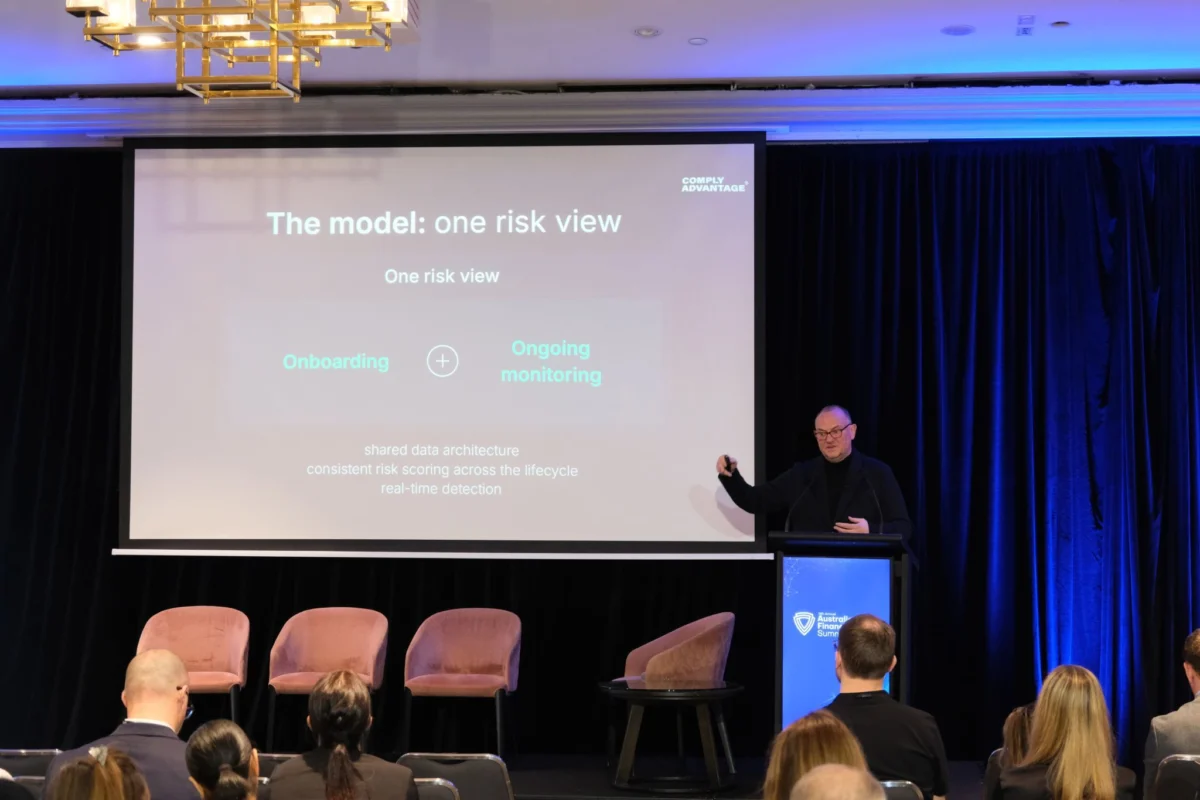
Effectiveness is the primary metric by which regulators now judge the integrity of a financial institution’s anti-money laundering (AML) and counter-terrorism financing (CTF) programs. As the Australian financial landscape undergoes a period of profound regulatory expansion, the traditional approach of managing compliance through fragmented, siloed systems is no longer merely inefficient—it is increasingly viewed as a liability. At the Australian Financial Crime Summit (AFCS) held in Sydney on September 1, 2026, industry leaders and regulators converged to address a central challenge: the systemic failure to link customer onboarding data with ongoing transaction monitoring.
Andrew Davies, the Global Head of Financial Crime Compliance (FCC) Strategy at ComplyAdvantage, articulated a stark warning during the summit: organizations that operate in silos are fundamentally unable to demonstrate "effectiveness" to oversight bodies. This operational disconnect is not just an internal IT concern; it is a critical vulnerability that allows illicit actors to exploit gaps between the initial vetting process and daily account activity.
The Regulatory and Threat Landscape
The urgency of this transition is underscored by staggering financial losses and a tightening regulatory net. According to the National Anti-Scam Centre, Australia recorded $2.18 billion in scam-related losses throughout 2025, driven by 274,577 individual reports. This data highlights the immense pressure on financial institutions to not only detect fraud but to prevent it before funds leave the ecosystem.
Simultaneously, the sophistication of criminal enterprises has evolved. The Australian Transaction Reports and Analysis Center (AUSTRAC) Money Laundering Update for 2026 identifies a marked rise in AI-enabled document fraud, where synthetic identities and deepfake imagery allow bad actors to bypass conventional Know Your Customer (KYC) checks.
This environment coincides with a historic regulatory shift in Australia. As of July 1, 2026, the implementation of Tranche 2 AML/CTF obligations has brought approximately 80,000 businesses into the scope of federal oversight, many of which previously lacked robust compliance infrastructure. Looking ahead, the pressure will only intensify; by March 31, 2027, the Scams Prevention Framework will impose strict, mandatory detection obligations on banks, telecommunications firms, and digital platforms. Under this framework, firms must be able to view their customers as a holistic risk profile, rather than a collection of data points spread across disparate databases.
A Chronology of Compliance Evolution
The history of compliance has been one of reactive expansion. Initially, firms focused on basic sanctions screening. As global regulations matured, institutions added anti-money laundering protocols, followed by transaction monitoring. The mid-2020s saw the rise of "FRAML," an attempt to merge fraud prevention and AML into a single discipline. However, industry experts now argue that even a unified "FRAML" approach is insufficient for the threats of 2026 and beyond.
The modern threat landscape includes not only money laundering and fraud, but also human trafficking, proliferation financing, and systematic bribery. Research from the International Labour Organization (ILO) suggests that approximately 50 million people currently live in conditions of modern slavery. The proceeds of these crimes are often laundered through legitimate, regulated payment networks, making the intersection of fraud detection and human rights monitoring a new frontier for financial institutions.
The Network Problem: A Strategic Pivot
Transnational crime is estimated by Global Financial Integrity to account for between $1.6 trillion and $2.2 trillion in illicit annual flows. These criminal operations function as sophisticated, cross-border supply chains. For example, the global fentanyl trade—moving precursors from China through transit hubs in Mexico before entering the U.S. market—relies on complex, multi-layered financial maneuvers that traditional, siloed systems are ill-equipped to detect.
"Financial crime is a network problem," Davies stated during the summit. "We have to solve this network problem with networks ourselves." This perspective suggests that the future of compliance lies in collaborative intelligence, where information is shared and analyzed in real-time across the entire lifecycle of a customer relationship.
The Operational Handoff: A Critical Vulnerability
One of the most persistent issues identified by the AFCS is the "handoff" failure. In most firms, the onboarding department operates independently of the transaction monitoring team. While the onboarding team performs the initial risk assessment and identity verification, this context is often lost or poorly integrated once the account is active.
According to the State of Financial Crime 2026 report, over 50% of compliance leaders manage their workflows across eight to ten separate systems. Despite 99% of these leaders agreeing that an integrated interface is essential, the reality remains one of fragmented data. This lack of continuity creates a "blind spot" where risk profiles become stale, and unusual activity—which might be a red flag for human trafficking or illicit trade—is missed because it is not cross-referenced with the initial KYC documentation.
The consensus among analysts is that a total "rip and replace" of legacy systems is often unnecessary and prohibitively expensive. Instead, the industry is trending toward the implementation of an "orchestration layer." This middleware acts as an overlay that unifies identity and risk signals, pulling data from various legacy silos into a single, cohesive view.
Measuring Effectiveness: A Three-Dimensional Approach
For compliance teams to move from a defensive posture to a proactive one, they must quantify their effectiveness across three distinct dimensions:
- Risk Exposure and Quantification: Establishing a single view of the customer allows firms to provide executives and regulators with a clear, data-backed assessment of their risk exposure. This moves the conversation from vague compliance adherence to quantifiable risk management.
- Operational Remediation: By centralizing data, teams can streamline the investigation of alerts. If transaction monitoring triggers an alert, the investigator should have immediate access to the customer’s original onboarding documentation and any subsequent changes in their risk profile.
- Business Value and Trust: Finally, effective compliance is a driver of commercial growth. Customers prioritize safety and security in their financial relationships. When an institution demonstrates robust, effective financial crime controls, it reinforces the lifetime value of the customer and strengthens trust in the wider financial system.
The Future of the Vanguard
The professionals working in financial crime compliance serve as the "vanguard" of the modern economy. Their work has direct consequences for the safety of vulnerable populations and the stability of global markets. By shifting away from siloed, reactive systems and toward a model of unified intelligence, financial institutions can better protect their customers and the broader public.
As the regulatory environment in Australia continues to harden, the firms that will succeed are those that view compliance not as a cost center, but as a core component of their business strategy. The integration of data, the adoption of advanced orchestration layers, and a commitment to viewing financial crime as a network-based challenge are the necessary pillars for the next generation of financial integrity.
As the industry prepares for the 2027 Scams Prevention Framework, the message from the AFCS remains clear: the era of the silo is over. In its place, the industry must embrace a holistic, intelligence-driven approach that ensures every piece of data serves the dual purpose of protecting the firm and upholding the integrity of the global financial order. Whether through internal investment or partnerships with advanced technology providers, the imperative is to bridge the gap between onboarding and monitoring, ensuring that the "effectiveness" demanded by regulators is not just an aspiration, but an operational reality.