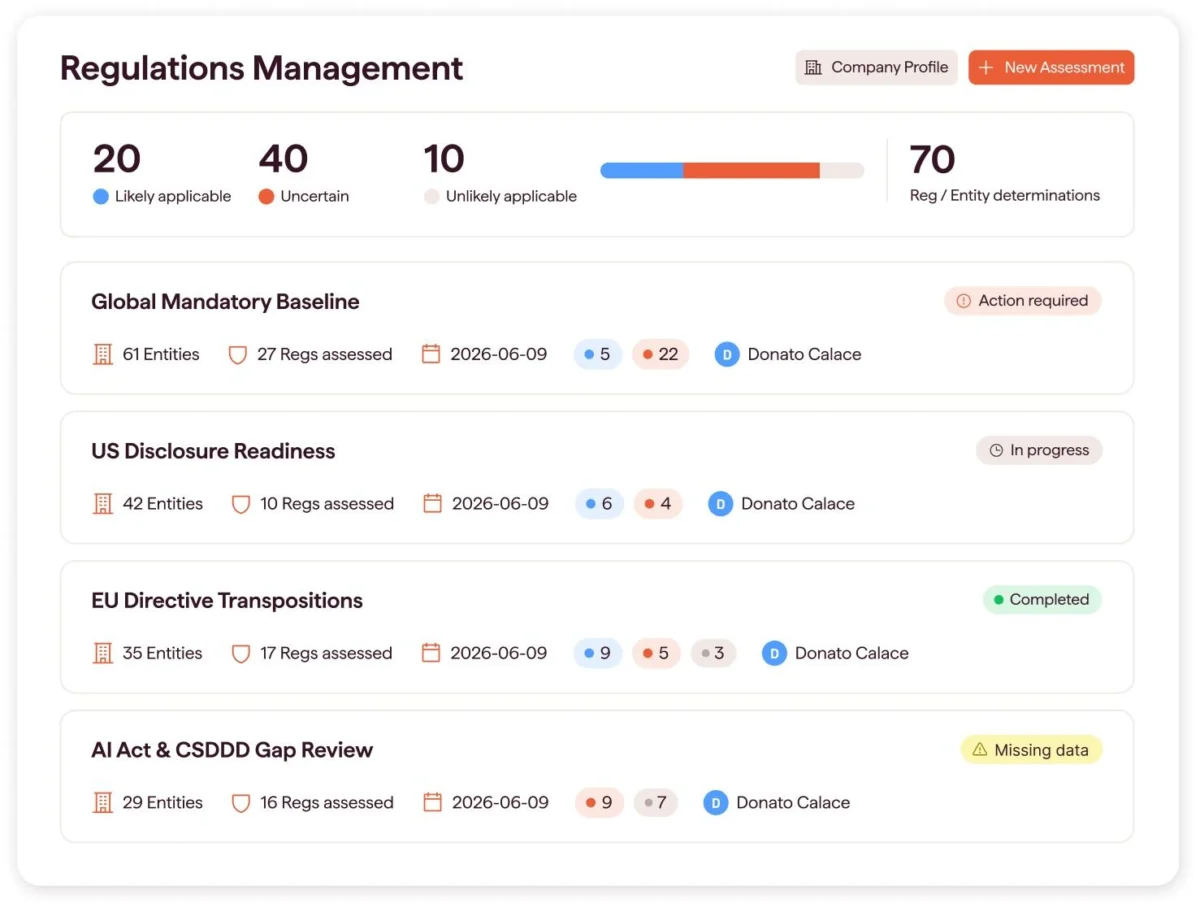
In an era where the global ESG (Environmental, Social, and Governance) landscape is shifting from voluntary disclosure to mandatory compliance, multinational corporations are facing an unprecedented deluge of new regulations. To address this complexity, Datamaran, a leading provider of ESG-focused software analytics, officially launched its "Applicability Assessment" tool on October 26, 2026. This new feature, integrated directly into the company’s existing Regulatory Monitoring Platform, is designed to automate the traditionally labor-intensive process of identifying which sustainability regulations apply to specific business entities across diverse global jurisdictions.
The release marks a significant milestone in Datamaran’s product evolution, aimed at bridging the gap between high-level regulatory tracking and granular, entity-level operational compliance. As organizations struggle to manage fragmented requirements spanning different regions, sectors, and revenue thresholds, this tool promises to provide a scalable solution for legal, compliance, and sustainability departments.
The Growing Complexity of Global ESG Compliance
The urgency behind Datamaran’s latest innovation stems from the rapid expansion of mandatory sustainability reporting frameworks. Over the past several years, jurisdictions worldwide have accelerated the implementation of legislation such as the European Union’s Corporate Sustainability Reporting Directive (CSRD), the SEC’s climate-related disclosure rules in the United States, and various supply chain due diligence laws across Asia and Europe.
For a global enterprise, the compliance burden is no longer a centralized task. It involves mapping thousands of individual regulations against a complex web of subsidiaries, each with its own operational footprint, revenue profile, and industry classification. Historically, companies have relied on manual spreadsheets and external legal counsel to perform these "applicability assessments." This process is not only costly but inherently prone to human error and rapidly outdated, as legislative amendments can occur at any time.
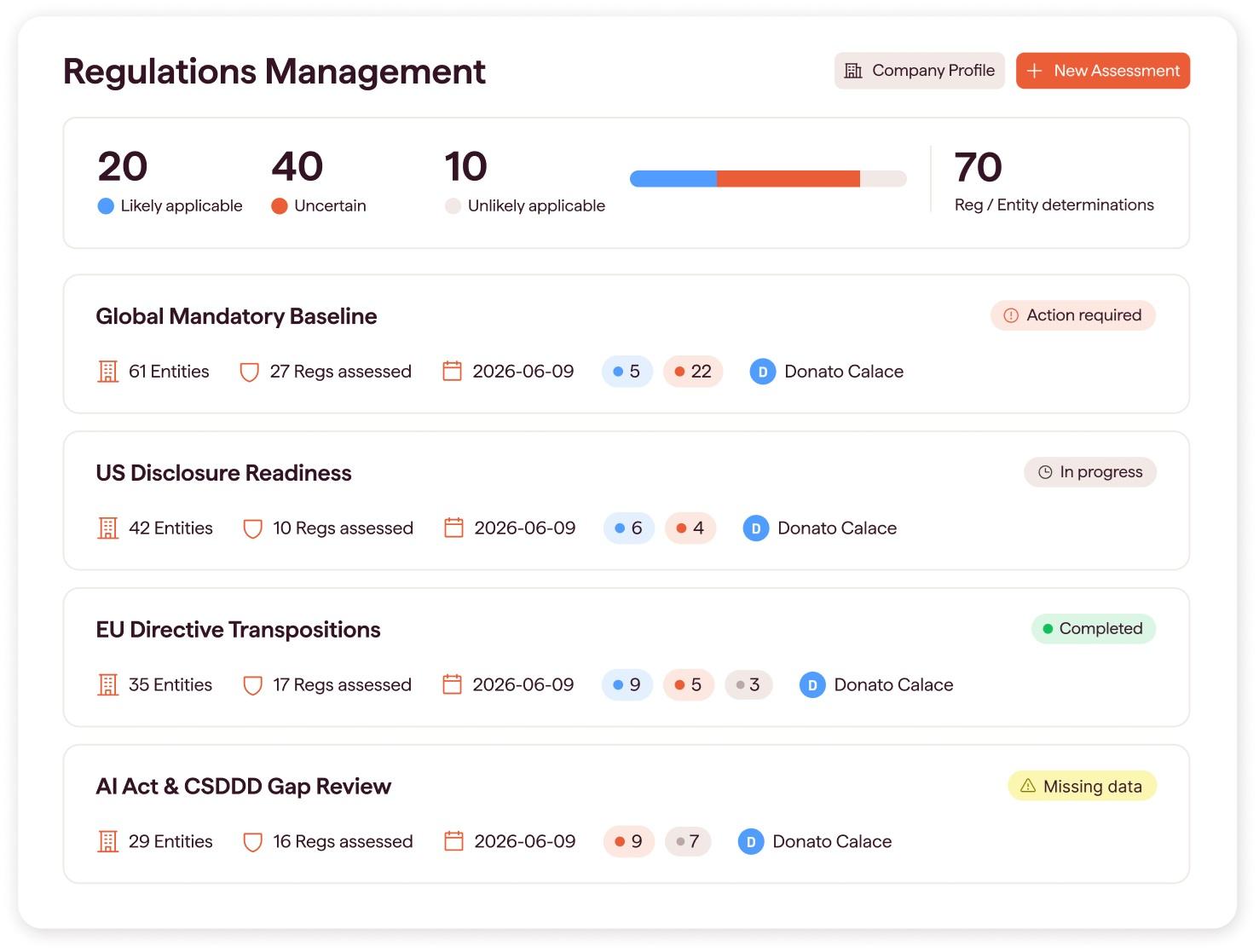
By automating this discovery phase, Datamaran’s Applicability Assessment tool enables firms to move away from reactive compliance. It allows teams to instantly determine whether a specific entity is subject to a regulation, providing a logical framework—classified as "Likely," "Unlikely," or "Uncertain"—backed by the specific criteria that triggered the designation.
Chronology of Development and Strategic Integration
The rollout of the Applicability Assessment feature follows a series of strategic technological advancements by Datamaran. The company’s trajectory highlights a shift toward providing more actionable, rather than merely observational, data.
- March 2026: Datamaran launches its dedicated Regulatory Monitoring Platform. The goal was to consolidate the tracking of evolving ESG policies into a single digital interface, helping companies monitor legislative developments in real-time.
- Mid-2026: The company initiates pilot programs with select enterprise clients to test the feasibility of automated entity-level mapping, identifying a major pain point: while companies knew which laws existed, they struggled to define the impact of those laws on specific, remote business units.
- October 26, 2026: Official launch of the Applicability Assessment feature, incorporating entity profiling, dashboard-driven exposure tracking, and automated categorization logic.
This timeline illustrates a focused effort to evolve the platform from a library of regulatory data into a sophisticated operational tool for corporate governance.
Technical Capabilities and Functional Design
The tool is built to handle the structural nuances of modern corporations. It utilizes a centralized database of regulatory requirements and overlays this with "entity profiles." These profiles are pre-populated with key data points, including:
- Geographic Footprint: Identifying which countries an entity operates in, which is crucial for regional laws like the EU’s taxonomy regulations.
- Sectoral Classification: Aligning operations with NACE or other industrial codes to determine industry-specific compliance requirements.
- Financial Metrics: Tracking revenue and employee headcount, which are frequently used as "thresholds" by regulators to determine if a company falls within the scope of a law.
Beyond simple identification, the platform offers dynamic dashboards that allow users to aggregate data across business units, regions, or supplier tiers. If a regulation changes or a new mandate is passed, the system updates the assessment across all mapped entities. This ensures that legal teams are no longer performing a "re-check" from scratch every quarter. Furthermore, the platform includes a "Validation" layer, where users can conduct expert reviews to confirm that the automated assessment aligns with the company’s internal legal interpretation, creating a defensible audit trail.

Official Perspectives on the Regulatory Burden
Marjella Lecourt-Alma, CEO and co-founder of Datamaran, emphasized that the tool addresses the most frequent request from her firm’s client base. "‘We just need to know what applies to us’ is something we hear often from legal, compliance, and sustainability teams," Lecourt-Alma noted during the launch. "Applicability Assessment provides that information quickly and reliably at the entity level at scale."
This sentiment reflects a broader industry consensus: the primary challenge for sustainability professionals is no longer a lack of information, but the noise created by an overabundance of disparate, changing mandates. By providing a clear, binary-style assessment of applicability, Datamaran is effectively reducing the cognitive load on corporate departments, allowing them to focus on the substantive aspects of ESG strategy—such as carbon reduction or human rights auditing—rather than administrative compliance mapping.
Broader Implications for Corporate Governance
The emergence of such tools signals a professionalization of the ESG function. As regulatory authorities increase their oversight and potential for litigation or fines grows, the "manual spreadsheet" approach is increasingly seen as a corporate liability.
- Risk Mitigation: By identifying regulatory obligations at the entity level, firms can avoid the catastrophic risk of failing to report under a mandate they were unaware of.
- Operational Efficiency: Automated compliance monitoring significantly lowers the cost of entry for legal teams, allowing them to redirect resources from regulatory monitoring to strategic risk assessment.
- Standardization: As more companies use standardized software to interpret regulations, there is a potential for greater uniformity in how global businesses report on ESG matters. This, in turn, helps investors and regulators gain a more accurate, apples-to-apples comparison of corporate performance.
Market Context and Future Outlook
The launch of the Applicability Assessment comes at a time when the ESG software market is witnessing significant consolidation and maturation. With the influx of capital into the sector, providers are under pressure to prove that their platforms provide "return on investment" (ROI) rather than just "compliance coverage."
By moving the needle from passive monitoring to active assessment, Datamaran is positioning itself as a critical layer in the corporate technology stack. In the coming years, as the definition of "materiality" continues to evolve under standards like the ISSB (International Sustainability Standards Board) and the ESRS (European Sustainability Reporting Standards), the ability to map these complex requirements to specific global assets will become a competitive advantage.

Companies that successfully integrate these tools will likely find themselves better equipped to handle the "alphabet soup" of global regulation, ultimately protecting their reputations and ensuring smoother operational continuity in a volatile regulatory climate.
Conclusion
The introduction of the Applicability Assessment tool represents a necessary shift toward technological maturity in the ESG space. As the world moves toward a future where sustainability disclosures are as scrutinized as financial statements, the ability to accurately, rapidly, and consistently identify legal obligations will be the cornerstone of effective corporate governance. Datamaran’s latest feature provides a robust framework for firms to navigate this landscape, moving the conversation from "what are the rules?" to "how are we performing against them?" – a shift that will likely define the next decade of corporate sustainability.