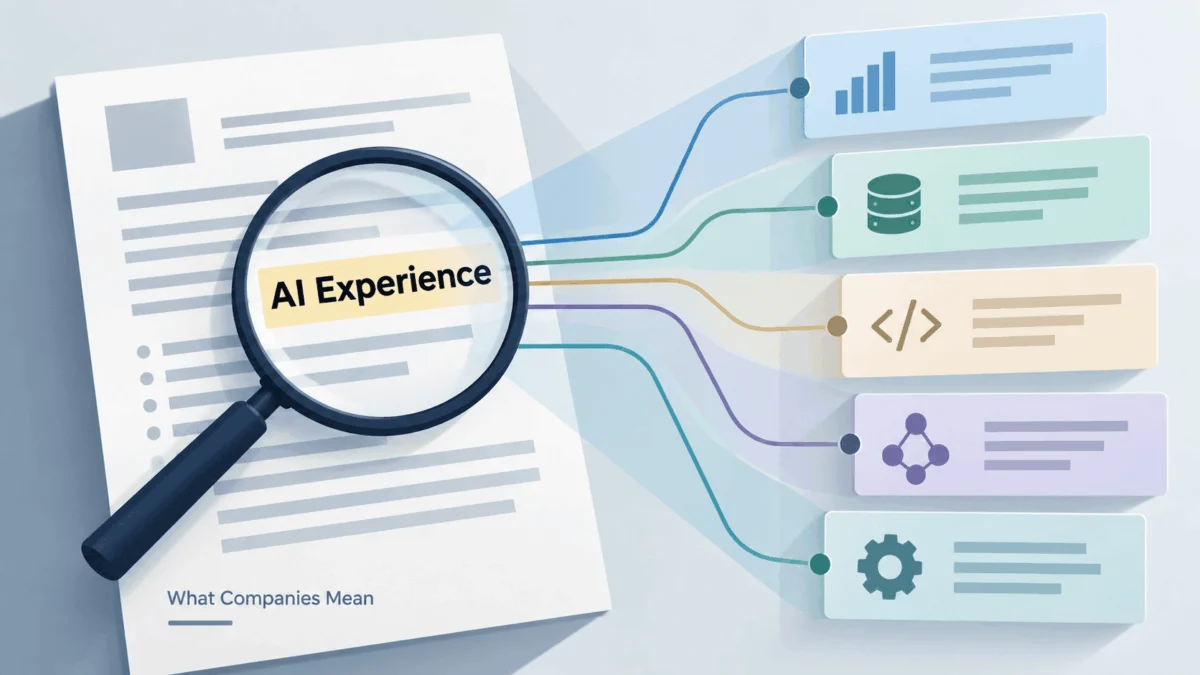
The modern labor market for data science and analytics is currently defined by a significant linguistic shift. As corporations across sectors—from retail and logistics to biotechnology and quantitative finance—scramble to integrate generative AI and machine learning into their operational workflows, job postings have become saturated with the phrase "AI experience." While this term appears as a prerequisite in thousands of listings for data analysts, statisticians, and researchers, it lacks a standardized definition. Consequently, the term functions more as a marketing signal for corporate modernity than as a rigid technical requirement. For the job seeker, this ambiguity creates a significant hurdle: identifying what a hiring manager actually expects when they request "AI experience" is now as much a part of the job search as the application process itself.
The Evolution of a Catch-All Term
To understand why "AI experience" has become a pervasive, yet nebulous, requirement, one must look at the rapid acceleration of artificial intelligence adoption since late 2022. Following the public release of generative AI models, companies faced intense pressure from stakeholders to demonstrate "AI-readiness." According to recent industry surveys, nearly 70% of Fortune 500 companies have accelerated their hiring for roles involving machine learning or AI oversight. However, internal talent acquisition teams often lack the technical depth to differentiate between a data engineer capable of deploying neural networks and a business analyst skilled in prompting Large Language Models (LLMs).
This has resulted in a "semantic inflation" where "AI experience" is used as a filter to attract candidates who are perceived as being on the cutting edge. In practice, this means the term is rarely used consistently across different industries. A retail firm seeking to optimize supply chain logistics may view AI experience as the ability to work with automated demand-forecasting tools. Conversely, a biotech startup might interpret the same phrase as a requirement for familiarity with Python-based frameworks for genomic data analysis.
Decoding the Four Pillars of Employer Expectation
While the terminology remains inconsistent, an analysis of current hiring trends reveals that most "AI experience" requirements fall into four distinct categories. Identifying these categories is the first step in tailoring a professional profile to meet organizational needs.
- AI Tool Proficiency: This category focuses on the functional ability to utilize off-the-shelf AI tools—such as GitHub Copilot, ChatGPT, or specialized enterprise automation software—to increase personal or team productivity. Employers here value efficiency and familiarity with modern workflows.
- Foundational Machine Learning Literacy: This level requires an understanding of the underlying principles of supervised and unsupervised learning. Employers are not necessarily looking for researchers who can invent new architectures, but rather for professionals who understand how to validate, interpret, and troubleshoot existing models.
- Hands-on Implementation: This is the most technical tier. Roles in this category require the ability to write production-level code, manage data pipelines, and deploy models into a live environment. These positions are often found in software-heavy industries where the product itself is AI-driven.
- Strategic Domain Expertise: In senior or leadership roles, "AI experience" refers to the ability to govern AI initiatives. This includes assessing the ethical implications, managing regulatory compliance, and deciding when traditional statistical methods are superior to complex AI models.
Translating Statistical Competency into AI Readiness
A common misconception among veteran statisticians is that their existing skill set is obsolete in the era of AI. On the contrary, the core principles of statistics—probability, variance, data distribution, and hypothesis testing—are the fundamental building blocks of all AI systems. The primary gap is not one of logic, but of vocabulary and tooling.
For instance, a data analyst who has spent years building predictive regression models to forecast quarterly demand already possesses the necessary intuition for supervised learning. When drafting a resume, the goal is to map these legacy skills to modern terminology. By describing "predictive regression models" as "supervised learning implementations for demand forecasting," the candidate demonstrates that they understand the underlying mechanism of the AI, rather than just the tool used to build it. This translation process is crucial, as it signals to the hiring manager that the candidate possesses the critical thinking skills required to evaluate model outputs—a competency that many self-taught AI enthusiasts lack.
The Impact of Seniority on Technical Expectations
The seniority level of a position serves as a reliable indicator of what an employer truly means by "AI experience." For junior-level roles, the emphasis is almost exclusively on adaptability. Employers are looking for candidates who are comfortable experimenting with new tools and who do not view AI outputs with either blind faith or paralyzing skepticism.
At the mid-level, the requirement shifts toward "informed collaboration." In this context, an analyst is expected to act as a bridge between engineering teams and business stakeholders. They must be able to translate complex technical constraints into business outcomes. Finally, at the senior or leadership level, the requirement becomes one of strategic judgment. Organizations are seeking professionals who can articulate the limitations of AI, identify the hidden costs of deployment, and prevent the organization from over-relying on automated systems for sensitive decision-making processes.
Navigating the Job Posting as Data
Job seekers should treat a job description as a dataset: it must be cleaned, analyzed, and interpreted for underlying patterns. Headline requirements in job postings are frequently aspirational, often reflecting a "wish list" of skills that no single candidate is expected to possess in full.
To distinguish between a "nice-to-have" and a "hard requirement," candidates should focus on the body of the job description rather than the bulleted list of qualifications. If the description emphasizes "automating workflows" and "enhancing productivity," the role is likely focused on tool proficiency. If it emphasizes "model evaluation," "data quality," and "statistical rigor," it is a role that prioritizes core data science expertise. Furthermore, linguistic modifiers are key: terms like "preferred" indicate a secondary skill, while "required" followed by specific tool names (e.g., PyTorch, TensorFlow) indicates that the company is looking for a technical implementer.
Clearing Up Persistent Misconceptions
The transition into AI-focused roles is often hindered by three pervasive myths. First, the belief that a candidate must list every AI tool they have ever used is counterproductive. Hiring managers value evidence of reasoning and problem-solving over a long list of software certifications. Second, the fear that one is disqualified for not having built a machine learning model from scratch is largely unfounded. Most organizations are more concerned with a candidate’s ability to interpret data and avoid bias than with their ability to build a model from the ground up.
Finally, the reliance on certifications is often overstated. While formal education provides a baseline, most hiring managers are far more interested in the candidate’s ability to explain the failure points of an AI system. The capacity to identify why an AI model might be providing an incorrect output—and how to correct it—is a rare skill that is highly prized in the current market.
Ultimately, "AI experience" should be viewed as a conversation starter rather than a rigid barrier. By recognizing that their foundational statistical training is the bedrock upon which modern AI is built, data professionals can confidently reframe their existing experiences. The key to success in this changing landscape is not the acquisition of a new technical credential, but the ability to articulate one’s existing analytical reasoning in the context of the modern, AI-augmented business environment.