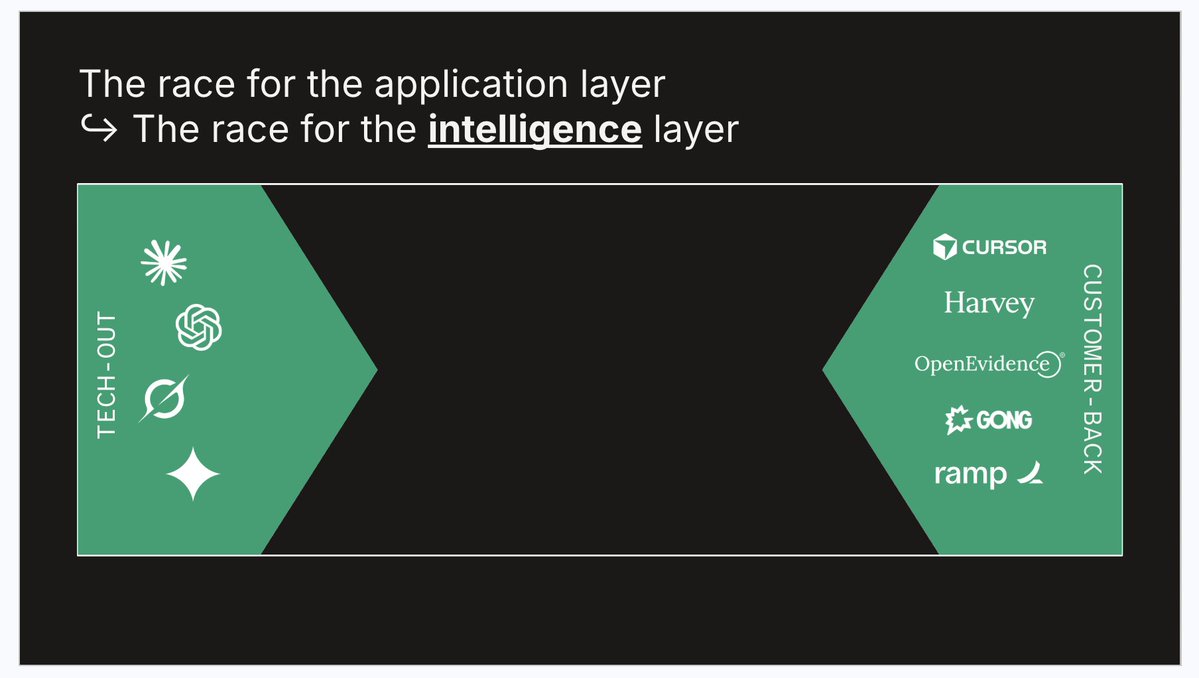
Published August 19, 2026, the modern technological landscape is confronting a profound structural shift regarding who controls the cognitive core of enterprise software. The race for dominance in the artificial intelligence application layer has evolved beyond mere user interface design, workflow optimization, and go-to-market strategies. Industry leaders increasingly recognize that the definitive battleground is for the intelligence layer itself.
Calls for organizations to command their own computational destiny are escalating rapidly across the technology sector. Palantir CEO Alex Karp famously urged enterprises to "own the means of production," warning against becoming passive tenants in an ecosystem governed entirely by a handful of frontier model providers. Shortly thereafter, Microsoft CEO Satya Nadella echoed these sentiments, publicly noting that purchasing intelligence directly from a third-party frontier lab carries a hidden, compounding toll. According to Nadella, utilizing external APIs is akin to paying twice: once with traditional capital, and a second time by surrendering the proprietary domain knowledge and telemetry revealed during utilization, which labs subsequently leverage to improve their own generalized models.
This dynamic has catalyzed a central strategic dilemma for corporate boardrooms: Who should ultimately own the intelligence at the core of modern business operations?
The Strategic Shift: Renting Versus Owning the AI Stack
For the majority of enterprise workloads, utilizing third-party frontier APIs and pre-packaged agents remains a pragmatic, cost-effective initial approach. However, across venture portfolios and forward-thinking engineering organizations, a definitive trend is emerging. Companies are increasingly building proprietary AI capabilities for critical segments of their product offerings, vertically integrating toward owning and actively shaping their model weights.

This evolution was the focal point of a recent exclusive summit hosted by Sequoia Capital, which brought together prominent AI founders, researchers, and technical builders to discuss the mechanics of owning the complete AI stack. The gathering featured insights from legal tech pioneer Harvey, alongside technical deep-dives from infrastructure and tooling leaders including Mercor, LangChain, Trajectory, and Fireworks. Presentations from these industry participants painted a cohesive picture of a maturing technical playbook that makes proprietary intelligence acquisition more viable than ever before.
Two primary industry catalysts have accelerated this movement toward self-reliance. First, the open-weight frontier has evolved at a velocity far exceeding initial industry projections. The introduction of high-performing models such as Kimi K3 and GLM 5.2 has fundamentally altered the economics of model customization. Historically, fine-tuning open-source models often felt like running on a permanent treadmill; organizations would invest months fine-tuning an open baseline, only for a subsequent frontier lab release to instantly render their competitive gains obsolete. Today, open-weight models frequently start from a baseline remarkably close to the frontier, allowing developers to build durable advantages without constantly playing catch-up.
Second, the independent post-training infrastructure stack has reached enterprise-grade maturity. Through specialized tooling provided by platforms like Mercor and Fireworks, organizations of varying scales can now access an end-to-end research-lab-grade technology stack. This encompasses everything from advanced pre-training and hyper-optimized inference engines to human-in-the-loop and synthetic data generation. Equipped with robust evaluation frameworks, harness engineering, post-training pipelines, and online learning architectures, open models can now consistently outperform generalized frontier models within highly specialized commercial domains.
Where utilizing open-weight alternatives was once viewed as a performance compromise accepted solely to reduce costs or protect data, it has rapidly transformed into an existential and strategic imperative.
Key Drivers: When and Why Enterprises Make the Leap
The decision to transition from renting to owning intelligence is not universal, but rather governed by specific operational pressures. Industry analysts have identified four primary operational bottlenecks that compel companies to bring their intelligence layers in-house:

-
Cost Dynamics and COGS Protection: As AI-driven applications achieve mainstream commercial success, artificial intelligence Cost of Goods Sold (COGS) scales in direct proportion to user adoption. When inference expenses are tied directly to external usage fees paid to a third-party lab, profit margins face continuous compression. Owning and self-hosting optimized models serves as a primary financial defense mechanism to protect long-term unit economics.
-
Latency and Operational Speed: In time-critical domains such as real-time code generation (tab autocomplete) or cybersecurity threat detection, milliseconds matter. Smaller, highly distilled custom models routinely outperform massive general-purpose models simply because localized inference infrastructure eliminates network latency and unnecessary computational overhead.
-
Proprietary Data Sovereignty: For businesses operating in regulated or highly competitive sectors, the operational feedback loops—including user corrections, rigorous evaluations, customer interaction patterns, and proprietary domain data—represent the core IP of the enterprise. Ensuring that this operational telemetry never leaves corporate perimeters is paramount for maintaining competitive moats.
-
Controlling Corporate Destiny: The traditional boundary dividing the application layer from the intelligence layer is actively dissolving. Frontier labs are increasingly pushing upward into traditional software product domains, while sophisticated application companies are moving downward into the foundational training loops that dictate how their products reason. Consequently, owning the application user experience increasingly requires absolute control over the underlying learning loop and intelligence weights, a philosophy championed by market leaders such as Harvey Research, RampLabs, Glean, and Factory.
The Zero-to-One Roadmap for Enterprise Intelligence
For organizations that decide to strategically split their architecture between rented frontier capabilities and owned domain intelligence, executing a transition requires a disciplined, methodical roadmap. Industry consensus emphasizes that building an in-house intelligence capability cannot simply be relegated as a secondary responsibility for a general platform engineering team.
Successful organizations establish small, dedicated, de novo research and engineering teams that operate on the offensive. For instance, the legal AI platform Harvey famously advanced its sophisticated research initiatives utilizing a highly focused team of just seven specialists, partnering strategically with a select group of ecosystem vendors. Furthermore, establishing external credibility through published research, technical whitepapers, and transparent benchmarks has become a primary competitive differentiator when enterprise buyers evaluate competing AI vendors.
The technical execution of this strategy relies on four foundational pillars: rigorous evaluations, sophisticated harness engineering, targeted post-training, and continuous online learning.
1. Establishing Rigorous Evaluations (Evals)
As Gabe Pereyra of Harvey frequently emphasizes, "If you don’t have a good benchmark, you can’t train models." An evaluation framework represents a systematic collection of automated tasks designed to quantitatively measure system performance. Each task incorporates a standardized prompt, necessary contextual data, and an objective grading mechanism.
While initial evaluation efforts often begin informally—with founders reviewing outputs and relying on qualitative "vibe-checks"—scaling requires codifying these subjective judgments into repeatable, automated benchmarks. Harvey, for instance, constructed its comprehensive Legal Agent Benchmark by translating real-world legal workflows into over 1,200 distinct agent tasks spanning 24 legal practice areas, evaluated against more than 75,000 expert-authored rubric criteria. Maintaining robust evaluations prior to modifying model architectures allows engineering teams to make data-driven decisions regarding model selection rather than relying on speculation.
2. Harness and Context Engineering
Modern AI agent architectures fundamentally consist of three discrete components: the underlying model, the contextual data supplied to it, and the software harness governing its execution. The harness controls the operational logic surrounding the model, including dynamic request routing, retrieval-augmented generation (RAG), tool invocation, memory management, fallback protocols, and execution tracing.

As LangChain founder Harrison Chase notes, the primary function of the harness is to deliver the precise context to the model at the exact moment it is required. When a task falls outside a model’s native distribution, off-the-shelf harnesses invariably falter. A well-engineered custom harness empowers organizations to route complex sub-tasks to the most economically and computationally efficient model for the job, reuse standardized evaluations across diverse model backends, and maintain full inspectability over every tool call, memory retrieval, and execution trace.
3. Targeted Post-Training Methodologies
Post-training encompasses a spectrum of technical interventions designed to align model behavior with specific enterprise requirements. Selecting the appropriate technique depends entirely on the specific performance deficit identified through system evaluations.
According to Lin Qiao of Fireworks AI, if a model is merely lacking factual information, expensive post-training is unnecessary; standard context enrichment or RAG protocols provide an immediate solution. When output formatting or behavioral consistency is flawed, supervised fine-tuning (SFT) is deployed. For aligning models with complex product aesthetics or human preferences, reinforcement learning or preference tuning is utilized. Conversely, if an existing model proves excessively sluggish or computationally expensive, distillation techniques are employed to compress intelligence into smaller, faster architectures. The guiding principle is to apply the lightest possible post-training intervention required to measurably improve evaluation scores, followed by continuous monitoring of quality, latency, and operational cost.
4. Continuous Online Learning Loops
Once evaluations, harnesses, and custom models are deployed, the final architectural frontier involves improving the intelligence system dynamically during production operations.
As Arjun Karanam of LangChain has observed, while foundational models grow progressively more intelligent with each generation, every user session often mimics an initial onboarding day. An exceptionally brilliant theoretical intellect dropped into a specialized corporate accounting firm will not instantly outperform tenured staff on day one; the missing variable is operational experience rather than raw intelligence. Production AI agents actively generate this crucial experience during day-to-day execution.

A trajectory represents the complete operational path taken by an agent to solve a task: the initial context provided, the external tools and sub-agents invoked, the final generated output, and the subsequent edits, retries, or rejections performed by the human user. Capturing these trajectories via production monitoring tools like LangSmith is essential for establishing a continuous learning loop. Within this architecture, a failed task is automatically converted into a new evaluation benchmark, missing informational elements are injected into contextual memory, and faulty tool responses prompt immediate harness remediation.
Broader Implications and Industry Outlook
Opting to own the internal AI intelligence stack introduces significant operational complexity. The conventional closed-model paradigm offers a high baseline floor with minimal friction—calling a frontier model API, pairing it with an out-of-the-box harness, writing basic prompt instructions, and deploying to production. However, this convenience inherently caps maximum performance capabilities.
Conversely, embracing full ownership of the production stack—comprising open-source base models, custom execution harnesses, proprietary toolsets, and localized context engines—demands substantial engineering investment. While this approach carries a potentially lower initial operational floor, it fundamentally removes the ceiling on system capability and competitive differentiation.
Industry analysts suggest that the future of enterprise software will not be characterized by a winner-take-all monopoly of giant foundational models. Rather, frontier labs will continue developing massive, generalized cognitive engines that serve as baseline infrastructure for the broader economy. In parallel, however, agile product companies are cultivating specialized, domain-obsessed cognitive models tightly integrated with their unique proprietary workflows.
As an increasing number of enterprises take active ownership of their foundational intelligence layers, the broader technological ecosystem is projected to experience a renaissance of specialized innovation, wherein individual corporate identity and domain expertise triumph over generic automation.