In the rapidly evolving landscape of artificial intelligence, the deployment of Large Language Models (LLMs) has often been characterized by massive compute requirements and latency constraints. However, a pivot toward Small Language Models (SLMs)—typically those under 3 billion parameters—is enabling a new paradigm of efficient, high-performance, and cost-effective automation. Building upon previous investigations into output space constraints, this report examines the strategic implementation of prompt prefix caching, a technique that significantly reduces the computational overhead required for repetitive, narrow-domain tasks.
The Shift Toward Efficient SLM Inference
For many enterprise applications, such as customer support ticket classification, document summarization, or entity extraction, the primary bottleneck is not model intelligence but rather the redundant processing of static prompt instructions. In a typical narrow automation workflow, a developer might employ a "few-shot" prompting strategy. This involves providing the model with a robust system prompt, a taxonomy of categories, and a series of high-quality examples to guide the output.
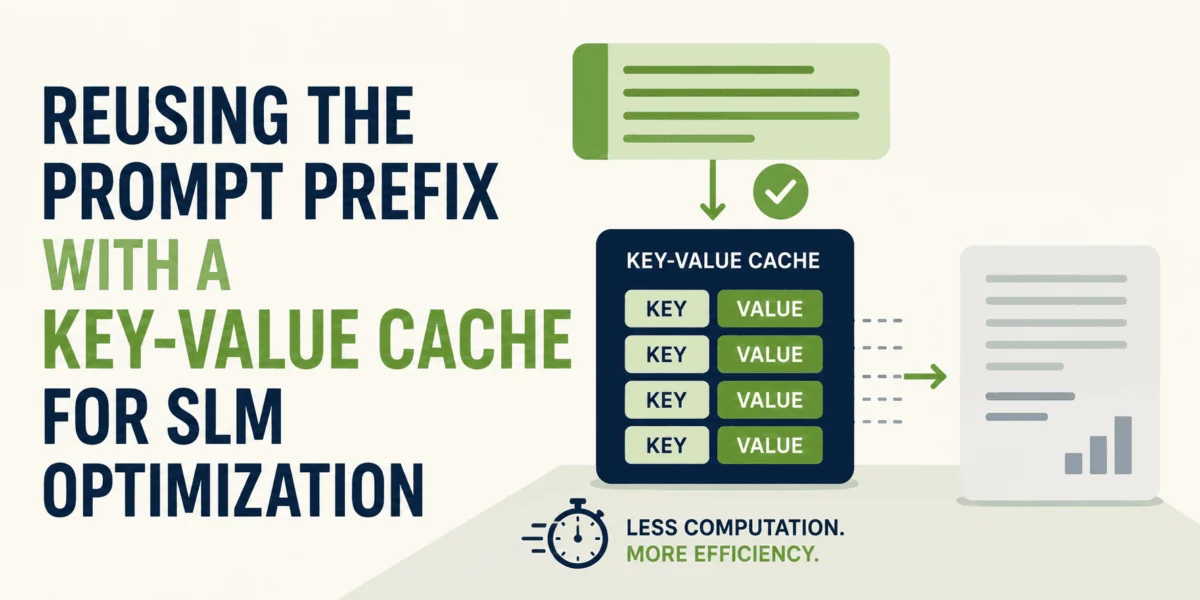
In a standard inference loop, these instruction tokens—often numbering in the hundreds—are re-encoded for every single input. Given that a typical support ticket may only add twenty to thirty tokens, the vast majority of the compute time is spent re-processing the static prefix. This inefficiency is particularly pronounced when processing thousands of records per hour. By utilizing Key-Value (KV) caching, developers can pre-compute the hidden states of the instruction block once and reuse them across subsequent requests, fundamentally altering the performance profile of the model.
Chronology of Optimization Strategies
The evolution of SLM optimization has moved through several distinct phases over the past eighteen months. Early efforts focused heavily on quantization—reducing the precision of model weights from float32 to float16 or int8—to shrink the memory footprint. This was followed by the adoption of specialized inference engines such as vLLM or optimized Hugging Face implementations, which allowed models to run on consumer hardware like the Apple M2 series or modest NVIDIA GPUs.
The current focus, however, is on the "algorithmic" layer of optimization. The first stage, which we previously explored, involved constraining the output space. By restricting the model to specific logits or token sequences, developers can force the model to reach a decision in a single forward pass, eliminating the need for expensive autoregressive token generation. The second stage, currently under examination, is the optimization of the pre-fill phase through KV cache manipulation. This strategy ensures that the model "remembers" the system instructions without having to perform the mathematical heavy lifting of re-encoding them for every input.
Technical Benchmarks and Comparative Analysis
To quantify the impact of prefix caching, we conducted a series of benchmarks using the Qwen2.5-0.5B-Instruct model. Operating on an M2 Macbook Air with 24GB of RAM, we established a baseline performance metric by processing 600 synthetic customer support tickets.
Under the standard, naive implementation—where the entire prompt, including the system instructions, is re-encoded for every ticket—the average latency was measured at approximately 308.1 milliseconds per ticket. The total processing time for the batch was 184.85 seconds.
By implementing a persistent KV cache—where the prefix is processed once and the resulting key-value pairs are stored in memory—we observed a substantial reduction in latency. In this configuration, the model only processes the unique "suffix" (the actual ticket content). The average latency dropped to 133.5 milliseconds per ticket, resulting in a total processing time of 80.07 seconds. This represents a performance gain of approximately 57%.
These results are consistent with broader findings in the field of transformer architecture optimization. The computational cost of a transformer layer is proportional to the sequence length. By effectively removing the instruction prefix from the "new" work required for each token, the system maximizes the efficiency of the Neural Engine and reduces the power consumption of the inference task, a critical consideration for edge deployments.
Broader Implications for Enterprise Automation
The implications of this optimization are profound for the development of autonomous agents and automated workflows. Historically, small models were viewed as "compromise" solutions—capable of following simple instructions but prone to degradation as the complexity of the prompt increased. Prefix caching flips this narrative. Because the computational cost of the instruction block becomes a one-time "sunk cost" at initialization, developers are no longer discouraged from using long, highly descriptive, and context-heavy prompts.
This allows for the creation of more robust and nuanced automation systems. A developer can now afford to include fifty examples in a few-shot prompt rather than five, knowing that the cost of processing those examples is paid only once at start-up. This encourages a higher degree of precision and stability in model outputs, which is a necessary prerequisite for production-grade, autonomous decision-making.
Furthermore, this technique is not restricted to specific hardware. While these benchmarks were conducted on Apple silicon, the underlying principles of KV cache reuse are applicable across all modern deep learning frameworks, including PyTorch, JAX, and TensorFlow. As long as the inference engine supports the injection of cached key-value states, the benefits remain consistent.
Fact-Based Operational Analysis
For organizations looking to integrate these findings, the path forward involves a shift in how infrastructure is managed. Integrating prefix caching requires that the application logic be "cache-aware." The model must be kept in a persistent state, and the developer must ensure that the prefix remains invariant across requests.
One potential risk identified in this study is "token-clean" alignment. When using tokenization-based caching, developers must ensure that the prefix and suffix, when combined, result in the exact same tokenization sequence as the full prompt. Failure to maintain this alignment results in incorrect KV cache indexing, leading to model hallucination or complete failure of the task. Therefore, rigorous unit testing—such as comparing the outputs of the cached model against a standard un-cached reference model—is a non-negotiable step in the deployment process.
Looking ahead, the next frontier in SLM optimization lies in the integration of specialized adapters and LoRA (Low-Rank Adaptation) layers. As models become more efficient at processing static context, the ability to rapidly swap task-specific heads without re-initializing the entire model will further drive down costs and latency.
Conclusion
The optimization of Small Language Models is not merely a task of hardware acceleration but a disciplined exercise in computational logic. By treating static prompt instructions as a fixed, pre-computed foundation rather than a recurring cost, we can unlock the full potential of sub-billion parameter models. The transition from a "stateless" approach to a "cached" approach marks a maturation point for AI engineering, moving away from the brute-force processing of massive sequences and toward a smarter, more efficient integration of machine intelligence into existing business workflows. As these techniques become standardized, the "small model" will increasingly become the default choice for the vast majority of narrow, high-frequency automation tasks.