While the corporate narrative surrounding artificial intelligence has been dominated by the rapid evolution of large language models, generative APIs, and digital agentic workflows, a silent revolution is taking place in the physical world. Physical AI—an umbrella term encompassing autonomous robotics, edge-computing devices, smart sensors, and self-navigating hardware—is rapidly transitioning from a theoretical R&D curiosity into a tangible component of enterprise infrastructure. New data from a comprehensive 2026 enterprise survey reveals that the chasm between "early adopter" status and mainstream integration is closing significantly faster than industry analysts previously anticipated.
The current technological landscape is defined by a dichotomy: while digital AI dominates software budgets, physical AI is beginning to command attention from operational leaders. According to a survey of 100 enterprise technology leaders at organizations with 1,000 to 5,000+ employees, approximately 26% are already engaged in active implementation of physical AI. This engagement is bifurcated into distinct phases: 13% of companies are currently conducting dedicated research and development, 7% are in the pilot phase, and 6% have achieved full-scale production deployment. Perhaps more telling for the future trajectory of the sector is that another 23% of the surveyed organizations, while currently inactive, have finalized plans to begin exploring physical AI integration within the next 12 months.

The Correlation Between Generative AI and Physical Adoption
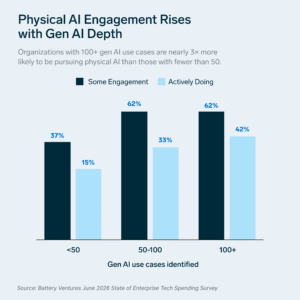
A critical finding in the recent study is the strong positive correlation between an organization’s maturity in generative AI and its willingness to adopt physical AI. The data suggests that companies already deeply invested in software-based AI are significantly more likely to be the pioneers of the physical wave. Organizations that have successfully implemented more than 100 generative AI use cases are nearly three times as likely to be working on physical AI initiatives—at a rate of 42%—compared to their peers with fewer than 50 active use cases.
This suggests that the "AI-first" organizational mindset is becoming a foundational requirement. Companies that have already built the data pipelines, governance structures, and internal expertise for LLMs are finding it easier to extend those capabilities into the physical realm. They are not viewing physical AI as a separate silo, but rather as the next logical extension of their digital transformation efforts.
Leadership and Governance: The Ownership Gap
Despite the momentum, the strategic ownership of physical AI remains fragmented, posing potential risks for enterprises. Unlike traditional software, which usually falls under the purview of the CIO or CTO, physical AI touches on real-world safety, infrastructure, and significant capital expenditure. The survey revealed that 35% of respondents rely on their CTOs to lead physical AI initiatives, while 27% look to the CIO. Notably, 8% of organizations reported no clear owner for the strategy at all.
This lack of centralized accountability is particularly striking regarding the Chief Operating Officer (COO). While the COO manages the factories, logistics chains, and physical infrastructure where these technologies are most transformative, they are identified as the primary owners of physical AI strategy in only 8% of organizations. This suggests a disconnect: while the technology is being driven by the IT department, the operational accountability required for safety, insurance, and maintenance is lagging. As physical AI transitions from pilot to production, analysts expect this governance gap to force a realignment between IT and operational leadership.
Sector-Specific Adoption Trends
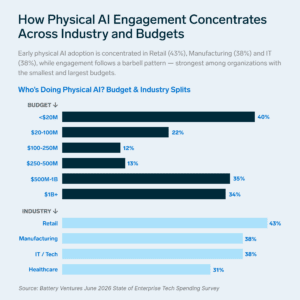
The adoption of physical AI is not uniform across industries, with retail leading the charge at a 43% engagement rate. In contrast, manufacturing and the information technology sector currently sit at 38%. The variation in adoption rates highlights the different pressures facing these industries. Retailers are primarily driven by the need for real-time inventory management and supply-chain visibility, while manufacturers are focused on precision and yield optimization.
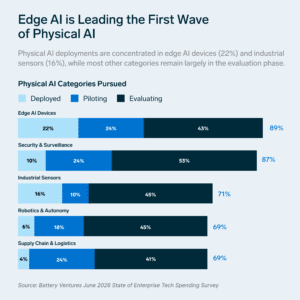
Within the landscape of physical AI, the hierarchy of adoption is clear: edge AI is currently the most mature, while robotics—despite dominating media headlines—remains in the earlier stages of practical, large-scale deployment.
- Edge AI Devices: Processing data locally on the device, edge AI is the most prevalent form of physical AI in production. By avoiding the latency of cloud-based processing, these devices allow for real-time inference in sensitive environments.
- AI-Enabled Security and Surveillance: Smart cameras and access control systems follow as the second most common subcategory, with 17 organizations currently engaged.
- Industrial Sensors and Predictive Maintenance: This is perhaps the most operationally mature category. With 13 organizations actively engaged, this segment boasts the highest production deployment rate. It is here that physical AI is delivering the most immediate, measurable ROI.
- Robotics and Autonomous Systems: While receiving the most public attention, robotics is currently the least deployed. Only three surveyed companies have achieved production-level status, with 12 currently in the pilot phase. The complexity of integrating robotics into existing human-centric workflows remains the primary barrier to entry.
Creating a Proprietary Data Moat
The most effective use cases for physical AI share a common characteristic: the hardware acts as a unique collector of proprietary data that software alone could never access. In the steel industry, sensor networks are being deployed across mill floors to adjust raw material consumption in real time, a move that directly impacts profitability. In warehouse logistics, camera towers at loading docks autonomously verify freight, significantly reducing the incidence of fraud and shipping errors.
Perhaps the most sophisticated implementations are found in precision agriculture, where tractor-mounted robotic systems use computer vision to identify and target individual weeds. This allows for precise chemical application, drastically reducing labor costs and environmental impact. For these enterprises, the hardware is not merely a tool; it is a data-generation engine that creates a "moat" against competitors who lack the physical infrastructure to collect similar datasets.
Barriers to Scaling and Future Outlook
The challenges associated with scaling physical AI are fundamentally different from those associated with software. When asked about barriers, 69% of enterprises cited the complexity of integrating new hardware with legacy systems. Unlike a SaaS platform that can be deployed via API, physical AI often requires retrofitting decades-old infrastructure.
Cost is also a major hurdle, with 59% of respondents citing infrastructure investment as a barrier, followed by 55% pointing to safety and security concerns. Furthermore, 47% of enterprises struggle with the "ROI conundrum"—a persistent issue where the long-term business case remains difficult to quantify during the early stages of adoption.
The workforce narrative is also shifting. Contrary to fears of mass displacement, 39% of enterprises believe the primary goal of physical AI is to augment human workers. Only 6% of organizations envision the technology as a means to replace human labor entirely. The prevailing sentiment is that the physical layer of AI will act as a force multiplier, handling dangerous, repetitive, or high-precision tasks while keeping human operators at the center of the decision-making loop.
As organizations move from the planning phase to active experimentation, the window of opportunity for vendors, hardware manufacturers, and infrastructure providers is expanding. While the sector remains in its infancy, the trajectory is clear: the integration of intelligence into the physical environment is no longer a matter of "if," but "how soon." The companies that successfully bridge the gap between their digital AI strategy and their physical operational realities will likely define the industrial landscape for the next decade.