
In a significant development for the financial technology sector, Wealthfront, a prominent automated investment and wealth management platform, has officially surpassed 100 billion dollars in total platform assets. This milestone, reached in late August 2026, underscores the accelerating shift in how digital-native generations—specifically Millennials and Gen Z—manage their financial futures. The achievement reflects a decade and a half of growth for the firm, which has evolved from a niche automated investment provider into a comprehensive financial ecosystem offering banking, lending, and sophisticated tax-optimized investment strategies.
The journey to the 100-billion-dollar threshold represents a rapid scaling phase for the company. When Wealthfront launched its flagship Automated Investing Account in 2011, the concept of a "robo-advisor" was largely experimental and met with skepticism from traditional banking institutions. Within its first year of operation, the platform managed approximately 79.5 million dollars. By 2023, that figure had climbed to 50 billion dollars, and in the subsequent three years, the company doubled its assets under management, demonstrating both high client retention and the efficacy of its automated, long-term wealth-building model.
A Chronology of Strategic Evolution
The evolution of Wealthfront’s platform provides a clear window into the changing priorities of modern investors. Following the initial success of its automated investment portfolios, the company recognized that its user base—primarily young professionals navigating the aftermath of the Great Financial Crisis and later the economic disruptions of the Covid-19 pandemic—required more than just passive index investing.
Between 2015 and 2020, Wealthfront began diversifying its product suite. The integration of cash management services and automated bond ladders allowed clients to centralize their financial lives, moving away from fragmented banking relationships. This period was critical in transforming the firm from an investment tool into a full-service platform. By 2024, the company further expanded into credit, launching Wealthfront Home Lending. This digital-first mortgage experience was designed to address one of the most significant pain points for young adults: housing affordability. By leveraging software to reduce operational overhead, the company sought to offer mortgage rates consistently below the national average.

Most recently, the introduction of custodial accounts has allowed the platform to capture the next stage of its clients’ lives, providing tax-efficient vehicles for parents to save for their children’s futures. This lifecycle-based approach to product development has allowed Wealthfront to capture a larger share of wallet from its 1.5 million clients, effectively anchoring their financial decision-making within a single software environment.
Supporting Data and Demographic Trends
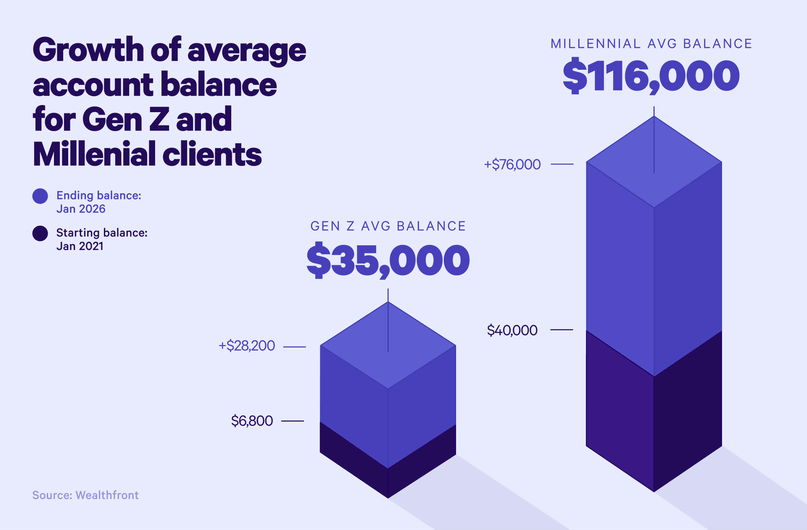
The growth of Wealthfront’s platform assets is not merely a result of market appreciation but is driven by consistent inflows from a user base that has demonstrated remarkable resilience despite macroeconomic headwinds. Data analysis of clients who have remained with the platform for the five-year period between January 2021 and January 2026 indicates a sustained commitment to systematic saving and investing.
While mainstream economic commentary often characterizes younger investors as being preoccupied with speculative assets or high-risk trading, Wealthfront’s internal data suggests a more disciplined trend. Younger generations are currently saving and investing at roughly double the rate of previous cohorts at similar ages, even when adjusted for inflation. This demographic shift is partially attributed to the lower barriers to entry provided by automated software, which removes the need for high-net-worth minimums that once barred young professionals from professional-grade portfolio management.
Furthermore, the company reports that its commitment to tax-efficient strategies—such as direct indexing and tax-loss harvesting—has saved its clients billions in potential tax liabilities. Since the firm’s inception in 2012, these automated optimizations have been a primary driver of long-term wealth accumulation, proving that for many digital natives, the automation of tax strategy is as valuable as the performance of the underlying assets themselves.
The Client-First Business Model and Incentives
A cornerstone of Wealthfront’s business model, and a key factor in its rapid growth, is its fee structure. Unlike traditional financial advisory firms that may rely on transactional commissions or heavy front-end loads, Wealthfront’s revenue is fundamentally tied to the assets under management (AUM). This model aligns the firm’s incentives directly with those of its clients: as the client’s wealth grows, the firm’s revenue scales accordingly.

This alignment has fostered a high degree of trust, which is essential in an era of increased digital skepticism. By removing the incentive for transactional activity, the firm emphasizes long-term outcomes over short-term market volatility. The "flywheel effect" described by company leadership suggests that as automated strategies compound client wealth, the resulting platform growth allows for further reinvestment into product innovation, which in turn attracts more users and improves service quality.
Industry Implications and Future Outlook
The crossing of the 100-billion-dollar mark serves as a bellwether for the broader financial services industry. It confirms that software-driven, low-cost wealth management is no longer an alternative to traditional banking—it is a dominant force. Legacy financial institutions, which have been historically slow to adapt to digital-first expectations, are now forced to compete with platforms that offer superior user experiences and transparent pricing.
Looking toward the next 100 billion, Wealthfront’s strategic roadmap indicates a heavy focus on artificial intelligence and further personalization. As clients transition from the accumulation phase of their lives into retirement or major life transitions, the demand for "intelligent" advice—software that can navigate complex tax laws, estate planning, and multi-generational wealth transfer—will likely increase.
David Fortunato, the current Chief Executive Officer of Wealthfront, has emphasized that the firm’s future will be built on the bedrock of the products already in existence, such as the Home Lending and Stock Investing units, while layering on AI-driven capabilities. "We are just getting started," Fortunato noted, acknowledging that the platform’s ability to scale is contingent on its capacity to remain intuitive and cost-effective as the needs of its 1.5 million clients continue to grow in complexity.
Analytical Perspective on Growth
While 100 billion dollars is a significant achievement, it also brings new responsibilities. As a firm becomes a major player in the financial landscape, regulatory scrutiny typically intensifies, and the expectations for platform stability, security, and customer service reach new heights. The company’s ability to maintain its "digital-native" ethos while navigating the complexities of being a large-scale financial institution will be the true test of its next phase of growth.
The firm’s success highlights a clear transition: the era of the "retail financial advisor" as a gatekeeper to wealth is largely over for the younger generation. In its place, software platforms that can execute complex, tax-advantaged, and diversified strategies at scale have emerged as the primary vehicle for wealth building. As the economic environment remains defined by persistent inflation and a challenging labor market, the value proposition of automated, low-cost, and transparent financial management appears set to remain highly attractive to a generation that values efficiency and data-driven decision-making above all else.
Ultimately, the 100-billion-dollar milestone is a reflection of a broader, structural change in the economy. It suggests that when financial institutions align their business models with the long-term success of their users, they can achieve substantial scale. Whether Wealthfront can continue to capture the loyalty of the next generation of investors will depend on its ability to evolve alongside the changing definitions of wealth and the shifting landscape of global finance. For now, however, the firm stands as a primary example of how technological integration has fundamentally altered the trajectory of personal finance for millions.