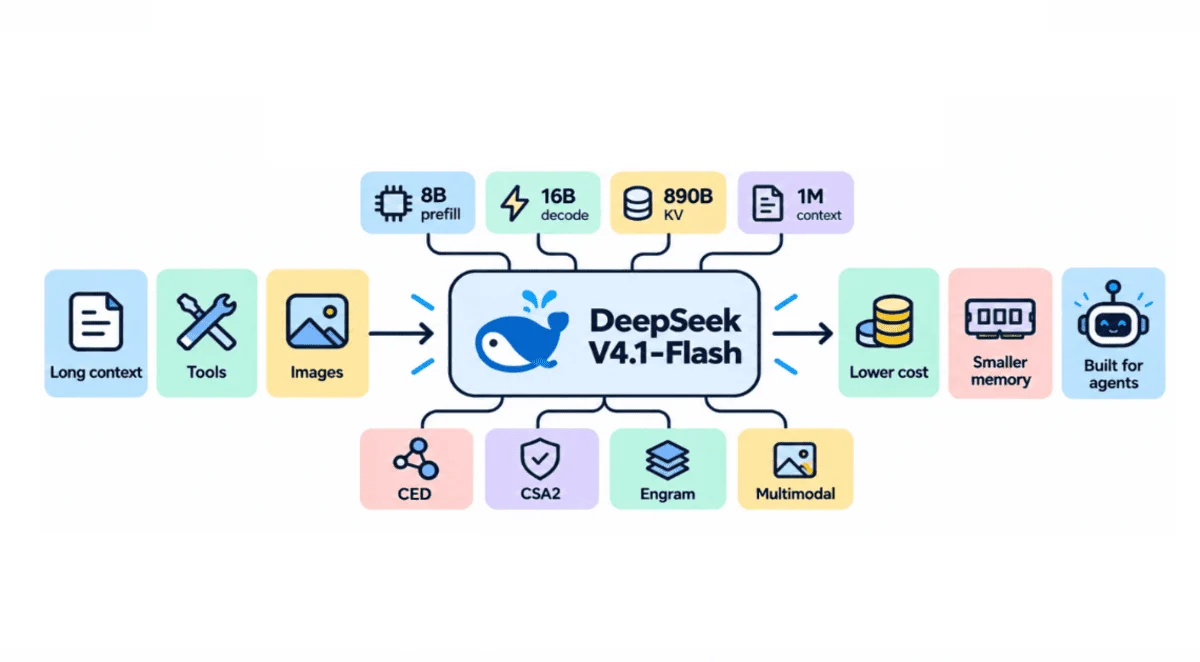
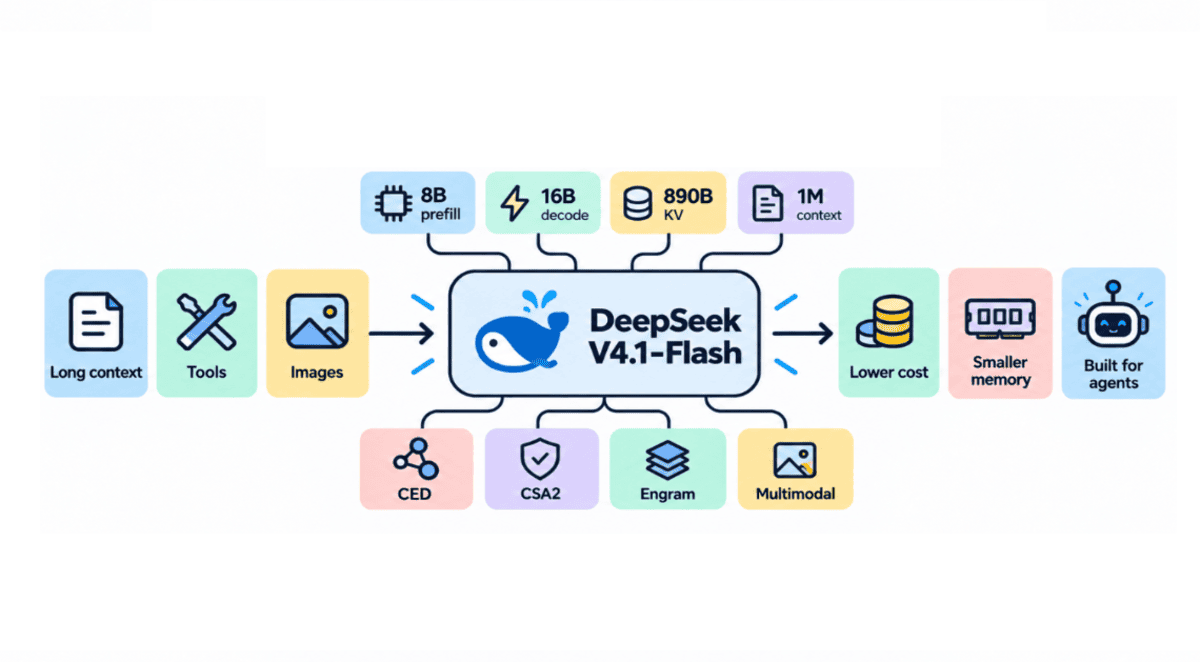
The landscape of large language models (LLMs) has reached a critical inflection point where raw parameter counts are no longer the sole metric of success. With the release of DeepSeek-V4.1-Flash, the industry is witnessing a strategic shift from monolithic scale toward architectural efficiency. This 552-billion-parameter Mixture-of-Experts (MoE) model represents a deliberate engineering effort to solve the "agentic bottleneck"—the high cost and latency associated with long-context processing. By optimizing prefill compute, reducing memory overhead, and implementing conditional memory components, DeepSeek is positioning its latest offering as a purpose-built engine for autonomous AI agents that require massive context windows and high-speed execution.
The Architectural Shift: Moving Beyond Scaling Laws
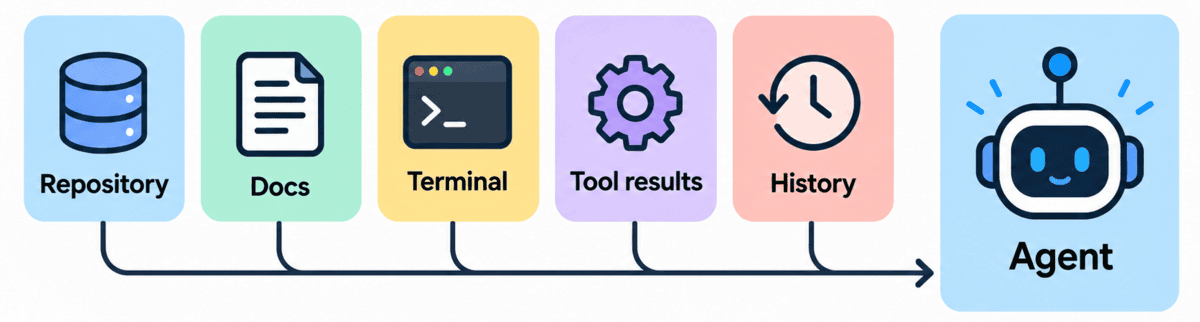
Traditional Transformer architectures have long struggled with the asymmetric demands of modern AI agents. These agents often ingest hundreds of thousands of tokens—spanning entire codebases, technical manuals, or historical logs—before generating a concise, actionable output. Standard decoder-only models, which treat prefill and decoding with largely similar computational intensity, struggle to maintain efficiency under these conditions.
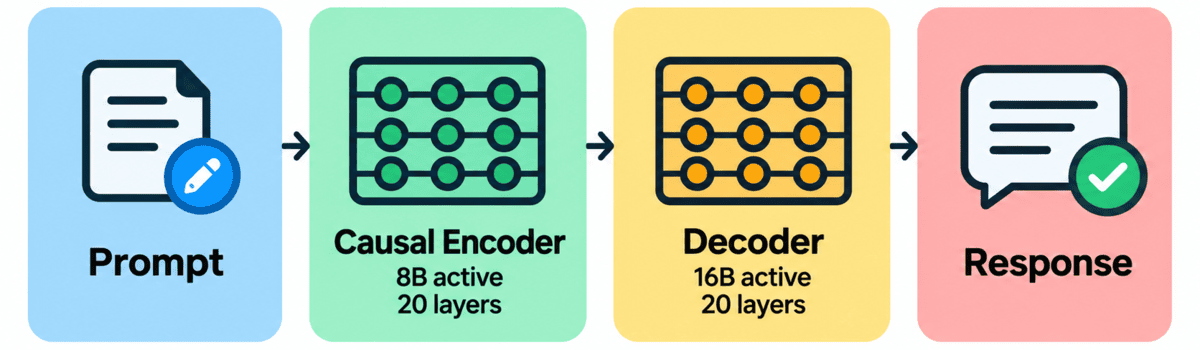
DeepSeek-V4.1-Flash addresses this by introducing a Causal Encoder-Decoder (CED) architecture. By separating the model into a 20-layer causal encoder and a 20-layer decoder, the model effectively decouples the ingestion of long prompts from the generation of responses. The performance metrics are striking: the model operates with only 8 billion active parameters during the prefill stage, scaling to 16 billion during decoding. This asymmetry ensures that the model conserves computational resources during the data-heavy ingestion phase while ramping up its reasoning capacity precisely when it is needed most.
Technical Specifications and Infrastructure Efficiency
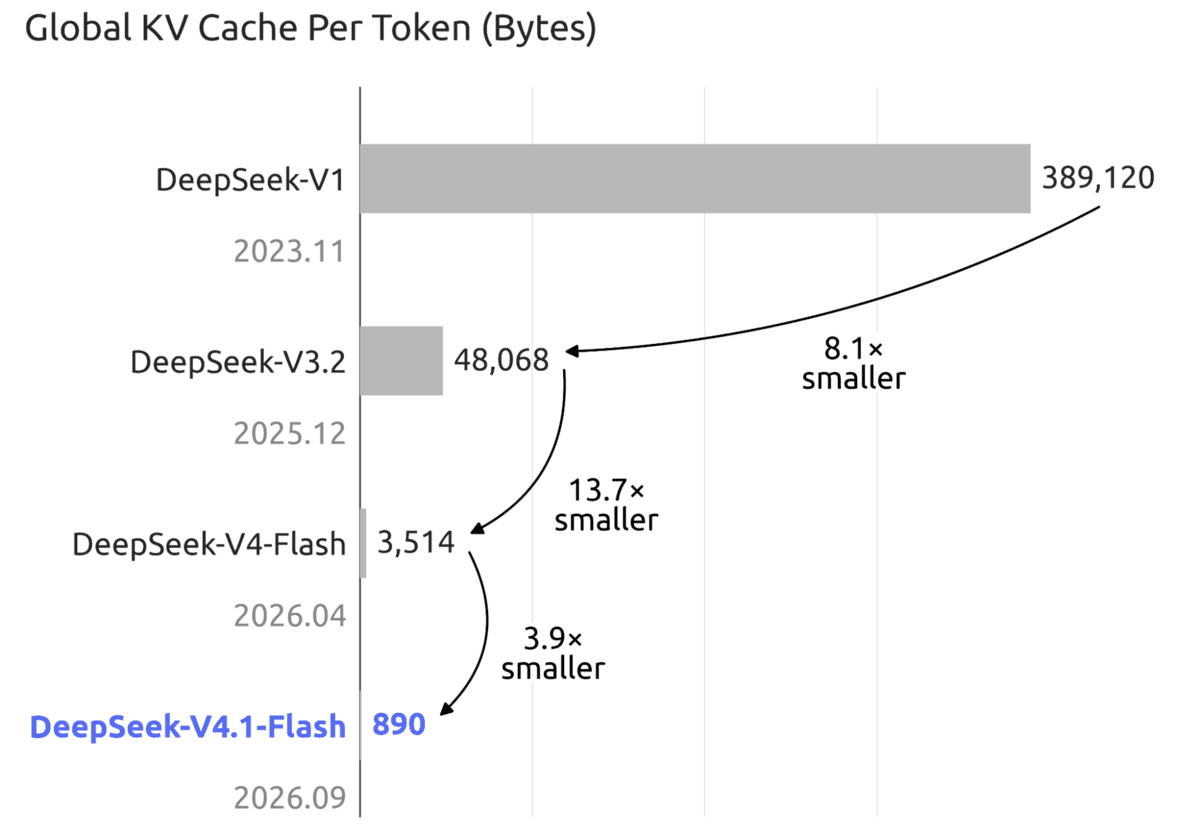
At the core of the V4.1-Flash release is a series of optimizations designed to address the "KV cache crisis." As context windows expand toward the 1-million-token limit, the Key-Value (KV) cache often consumes the majority of a GPU’s High Bandwidth Memory (HBM). DeepSeek has successfully compressed this footprint to a mere 890 bytes per token, a significant reduction that enables larger batch sizes and faster throughput on existing hardware.
The implementation of Compressed Sparse Attention 2 (CSA2) is central to this achievement. CSA2 utilizes a multi-mode approach—Full, Reindex, and Reuse—to mitigate redundant computations across layers. By employing a Hierarchical Sparse Indexer, the model avoids the exhaustive scanning of the entire context window, instead narrowing the focus of later layers to the most relevant information identified in earlier stages. When combined with FP4 KV caching and SWA (Sliding Window Attention) Bounded Replay, the model reduces its persistent memory storage requirements to approximately one-eighth of its predecessor, the V4-Flash.
Chronology and Development Trajectory
The release of V4.1-Flash follows a rigorous development cycle characterized by the training of 45 trillion multimodal tokens. DeepSeek’s roadmap has consistently favored iterative improvements in efficiency over brute-force scaling. Following the initial deployment of the V4 series, the engineering team focused on identified pain points in agentic workloads: high latency in terminal tasks, inefficiencies in automated coding environments, and the excessive cost of maintaining persistent state across long-running interactions.
By integrating the 196-billion-parameter "Engram" conditional-memory component, DeepSeek has provided the model with a form of long-term, sparse memory that acts as a lookup table rather than an active computation layer. This mimics biological memory processes, allowing the model to retrieve specialized knowledge without the overhead of activating the entire backbone network for every token generated.

Comparative Performance Analysis
The efficacy of these architectural changes is evidenced by the model’s performance on specialized benchmarks. In the realm of agentic tasks, where standard LLMs often falter due to the complexity of multi-step reasoning, V4.1-Flash demonstrates marked improvements. On the DeepSWE v1.1 benchmark, the model achieved a score of 74.2, a substantial leap from the 62.7 achieved by the V4-Pro. Similar gains were observed in CyberGym (88.1) and AutomationBench (54.8).
These results suggest that the "Flash" designation is not merely a marketing term for speed, but a functional description of the model’s utility in high-pressure, real-time environments. While some competing models may offer higher performance on static, broad-knowledge benchmarks, V4.1-Flash excels in the specific domains of terminal navigation, cybersecurity operations, and iterative software development.
Implications for the Open-Source Ecosystem
The decision to release DeepSeek-V4.1-Flash under the MIT license is a significant development for the open-source AI community. By providing transparent access to the inference code and the specific implementation of its sparse attention and conditional memory mechanisms, DeepSeek is effectively inviting other developers to build upon its architectural innovations.
The implications for the broader industry are twofold:

- Standardization of Efficient Inference: The methods pioneered here—particularly the asymmetric prefill-decode compute profiles—are likely to become industry standards. As infrastructure costs remain the primary barrier to the widespread adoption of autonomous agents, frameworks that can adopt these compression techniques will gain a competitive advantage.
- Reduced Hardware Barrier to Entry: By significantly lowering the KV cache footprint and optimizing memory traffic, DeepSeek has enabled more powerful models to be deployed on more modest hardware. This democratization is essential for the transition from cloud-centric AI to edge-based or local-private agentic systems.
Strategic Outlook: The Agentic Future
The development of DeepSeek-V4.1-Flash signals a transition in the AI lifecycle. We are moving away from an era where the focus was entirely on "how much data can the model ingest?" to one where the focus is "how efficiently can the model utilize that context?"
For industries reliant on AI agents—such as software engineering, where an agent might be expected to monitor a repository, run tests, and debug errors simultaneously—this efficiency is the difference between a prototype and a production-ready tool. The integration of DSpark speculative decoding further bolsters this capability by allowing the model to draft and verify multiple tokens in parallel, effectively cutting down on the latency that has historically hampered conversational agent performance.

Ultimately, the importance of this release lies in its departure from the "bigger is better" paradigm. By focusing on the granular mechanics of memory management and computational routing, DeepSeek has demonstrated that substantial performance gains can be unlocked through sophisticated engineering rather than just additional compute. As these techniques permeate the open-source community, the trajectory of AI development will likely shift toward more sustainable, performant, and capable models that can run more effectively in the complex, real-world environments for which they are designed. Whether this model remains the benchmark for efficiency or serves as the blueprint for the next generation of architectures, its influence on the trajectory of LLM development is already assured.