The phenomenon of the "technical freeze" is a pervasive challenge in the data science and analytics recruitment landscape. Highly qualified professionals, who demonstrate exceptional proficiency in their daily work environments, frequently underperform during live coding assessments. This discrepancy between day-to-day competency and interview performance is not necessarily a reflection of a candidate’s technical knowledge base, but rather a result of the specific, high-pressure environmental factors inherent in modern technical interviewing. As hiring practices for data roles become increasingly standardized around live SQL and Python assessments, understanding the mechanics of this cognitive bottleneck has become essential for both job seekers and hiring managers.
The Anatomy of a Technical Freeze
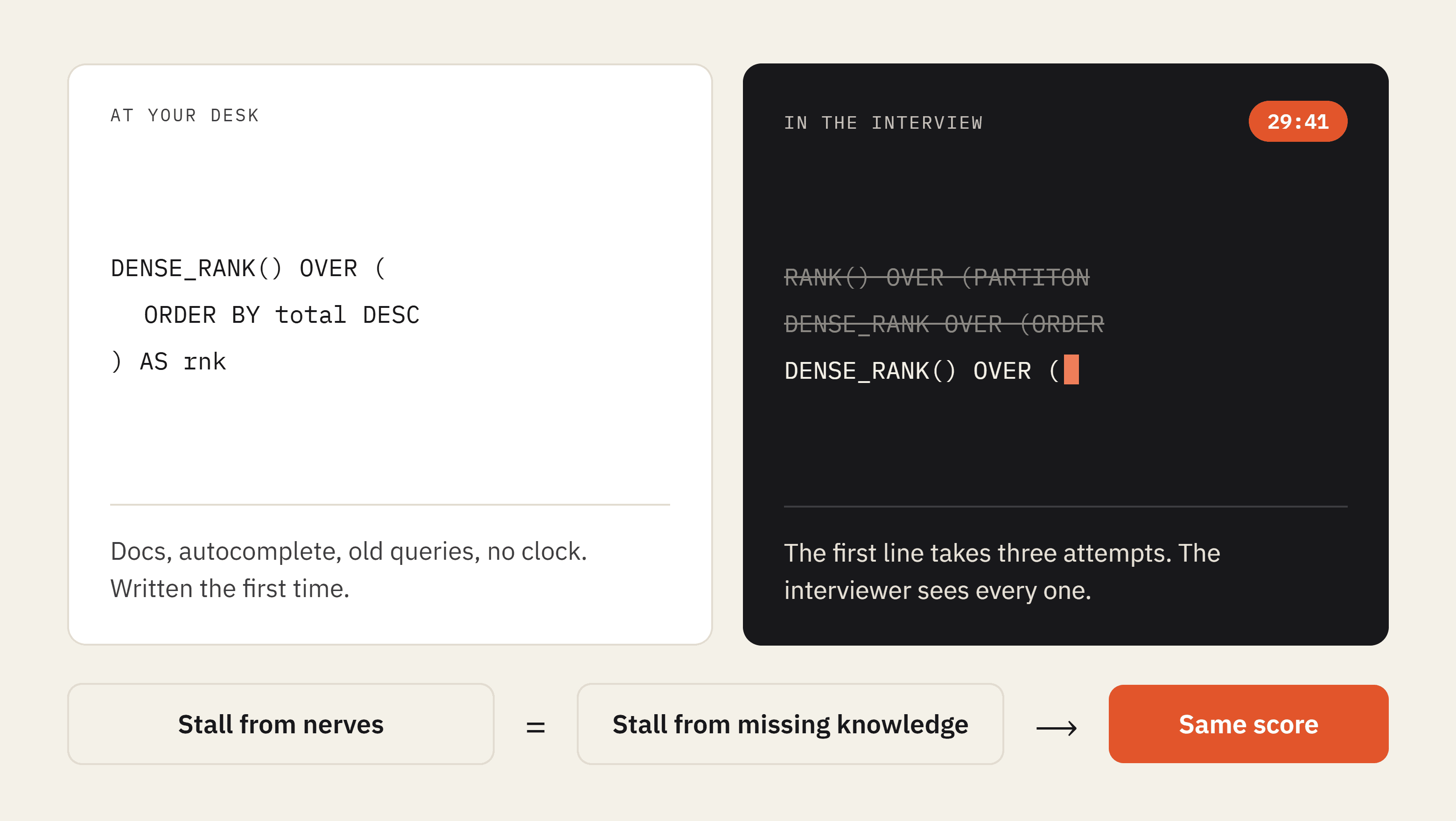
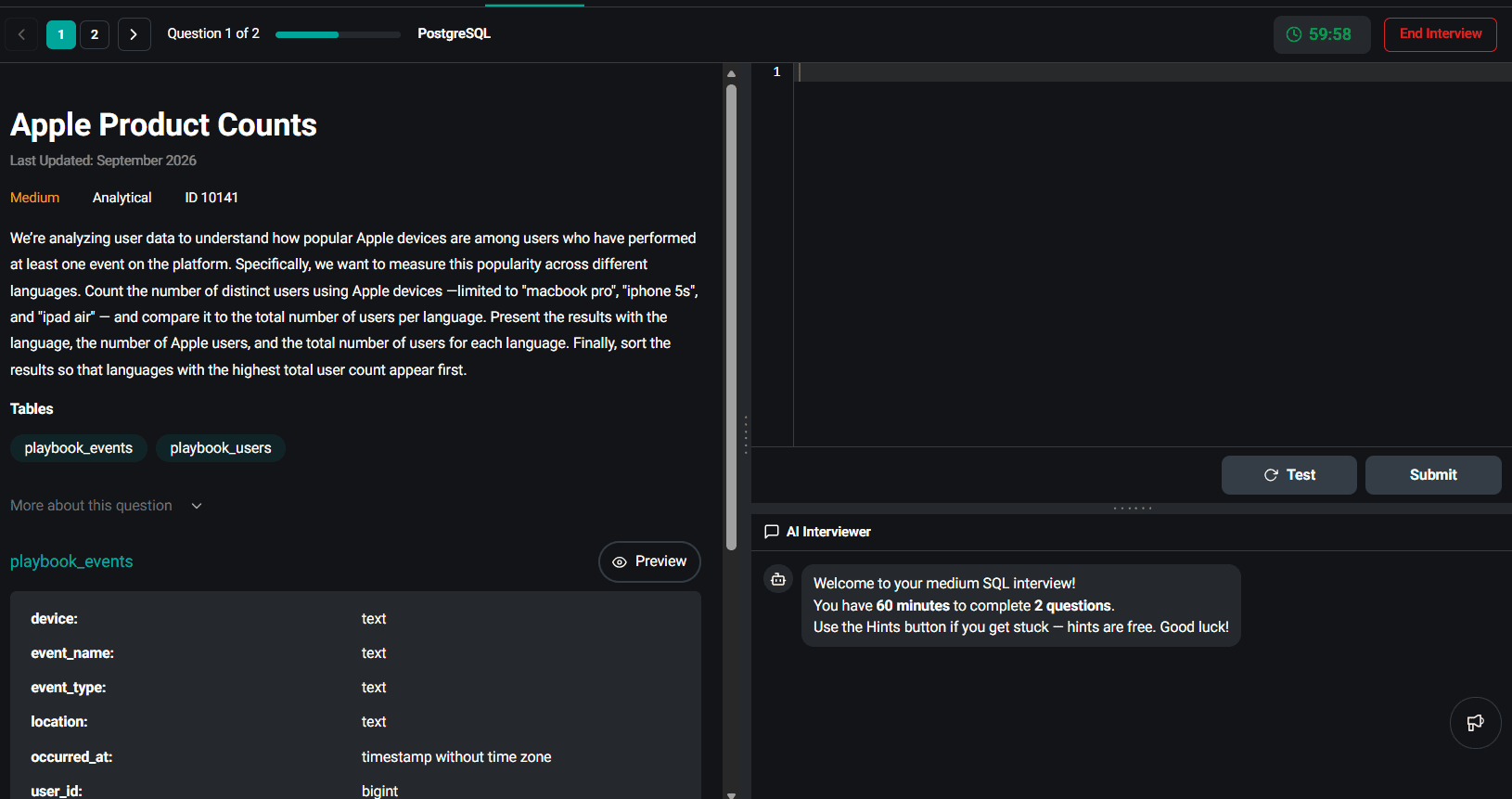
A typical technical interview for a data analyst or engineer involves a series of complex SQL problems that require logical synthesis, window function utilization, and syntactic precision. Under normal working conditions, a candidate has access to integrated development environments (IDEs) with autocomplete, real-time documentation, and the ability to iterate on code without external observation. When these resources are stripped away—replaced by a blank text editor, a countdown timer, and an evaluator—the cognitive load increases exponentially.
Research into human performance under pressure suggests that when the brain is forced to multitask—specifically, to perform complex retrieval of syntax while simultaneously communicating a problem-solving strategy—the prefrontal cortex can struggle to maintain focus. This leads to "cognitive tunneling," where the candidate becomes fixated on minor syntax errors while losing sight of the broader objective. From the perspective of an interviewer, this hesitation is indistinguishable from a lack of foundational knowledge. Consequently, talented candidates are often disqualified due to anxiety-induced performance deficits rather than a genuine lack of capability.
Five Core Conditions Influencing Performance
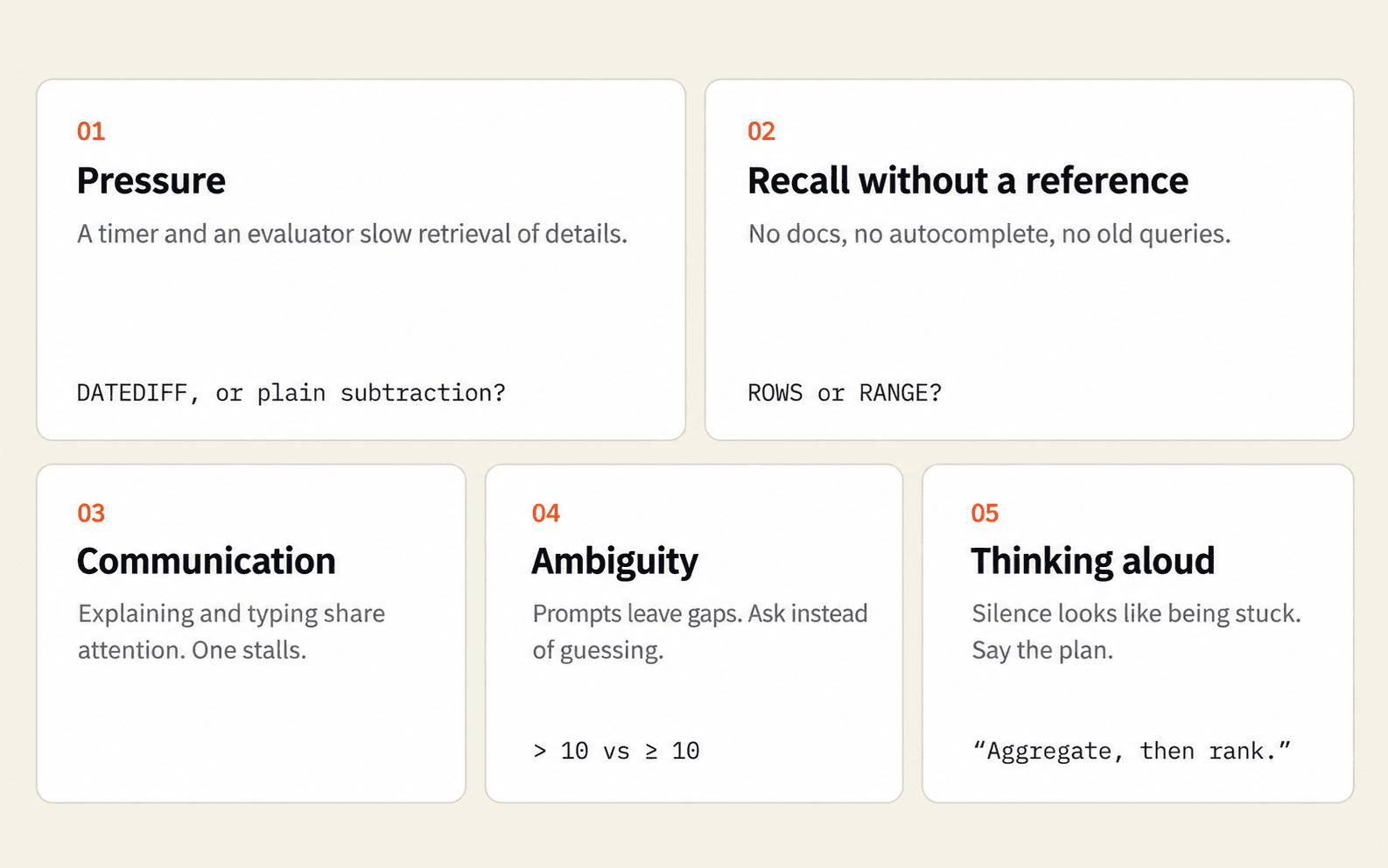
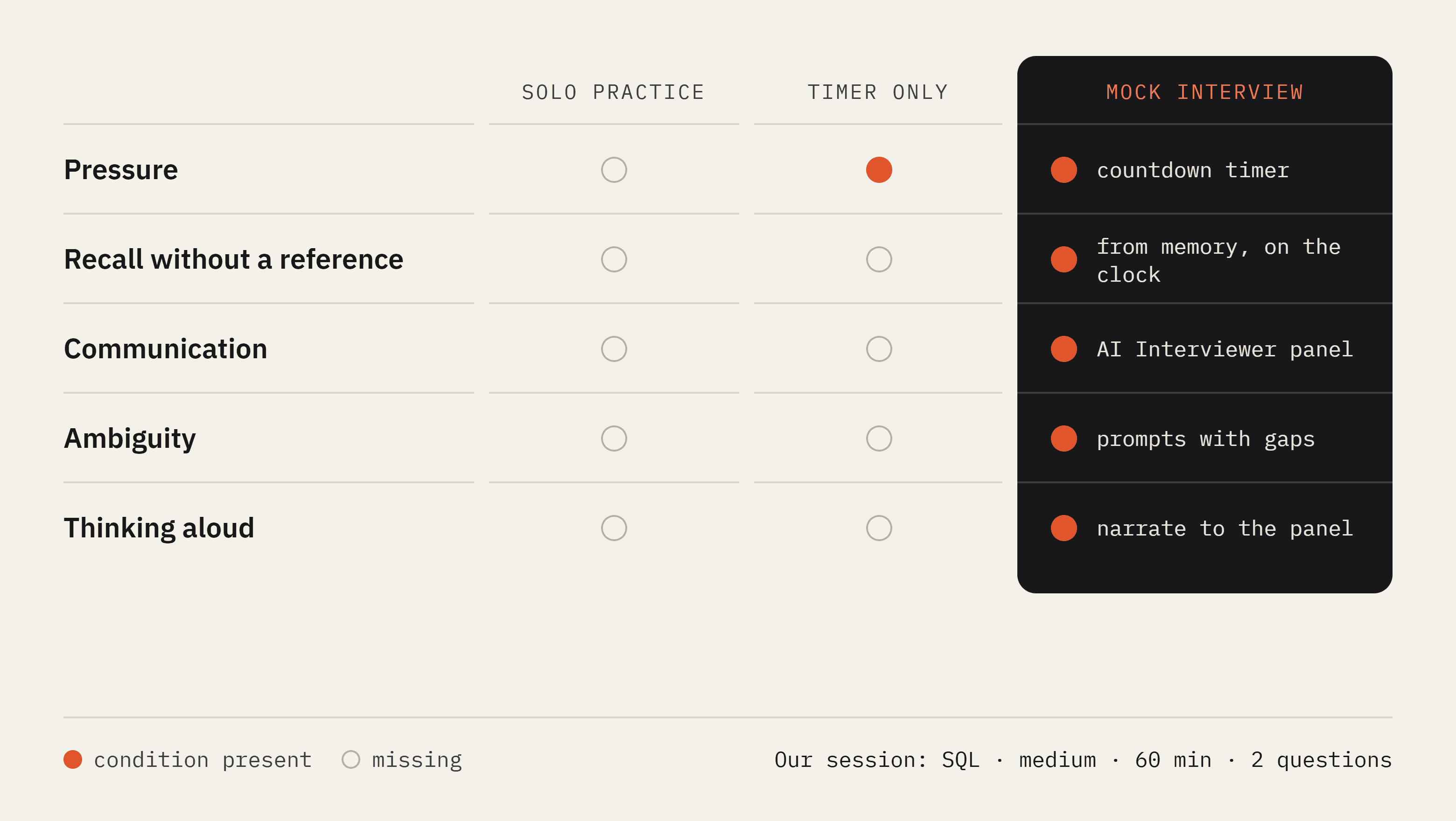
Five distinct factors contribute to the freezing effect observed during technical assessments. Understanding these is the first step toward mitigating their impact.
- Environmental Pressure: The introduction of a strict time limit and a direct observer creates a physiological stress response. This response is known to impair "working memory," the mental workspace required to hold and manipulate information. When under stress, the ability to recall specific function arguments—such as the difference between
ROWSandRANGEin a SQL window clause—diminishes significantly. - Loss of External References: In professional practice, data scientists rarely write code in a vacuum. The reliance on documentation and existing query libraries is standard. Interviews, however, test "cold" recall, which is a fundamentally different cognitive task than "cued" recall. Candidates who do not practice retrieving information without tools are at a distinct disadvantage.
- The Communication-Execution Conflict: Explaining one’s thought process while simultaneously typing code creates a dual-processing burden. Most individuals struggle to perform high-level verbal reasoning while managing the low-level syntactic demands of writing functional SQL, leading to long pauses or code that lacks logical structure.
- Ambiguity in Problem Definition: Technical prompts are often intentionally or unintentionally underspecified. Minor ambiguities—such as whether a business rule requires the inclusion or exclusion of tied values—can derail a candidate. Without the habit of explicitly clarifying these rules at the outset, candidates often make silent, incorrect assumptions.
- The Silence Gap: In an interview, silence is often interpreted as a lack of progress. When a candidate stops talking to focus on code, the evaluator is left without insight into the candidate’s logic. If the candidate is struggling, the lack of communication prevents the interviewer from providing the necessary guidance, leading to a breakdown in the collaborative aspect of the session.
The Role of Mock Interviews in Skill Acquisition
The industry has responded to this challenge by developing standardized mock interview platforms. These tools serve as controlled environments where candidates can simulate the specific pressures of a technical assessment. Data from recent pilot programs suggests that candidates who engage in structured mock sessions show a 40% improvement in time-to-solution metrics compared to those who practice in isolation.
A mock interview is not merely a test of knowledge; it is a rehearsal of the "meta-skills" required for success. These include the ability to state assumptions out loud, manage a clock, and structure a multi-step solution. By practicing these behaviors repeatedly, the candidate shifts the performance from a conscious, effortful process to an automatic, procedural one.
Case Study Analysis: Analytical SQL Challenges
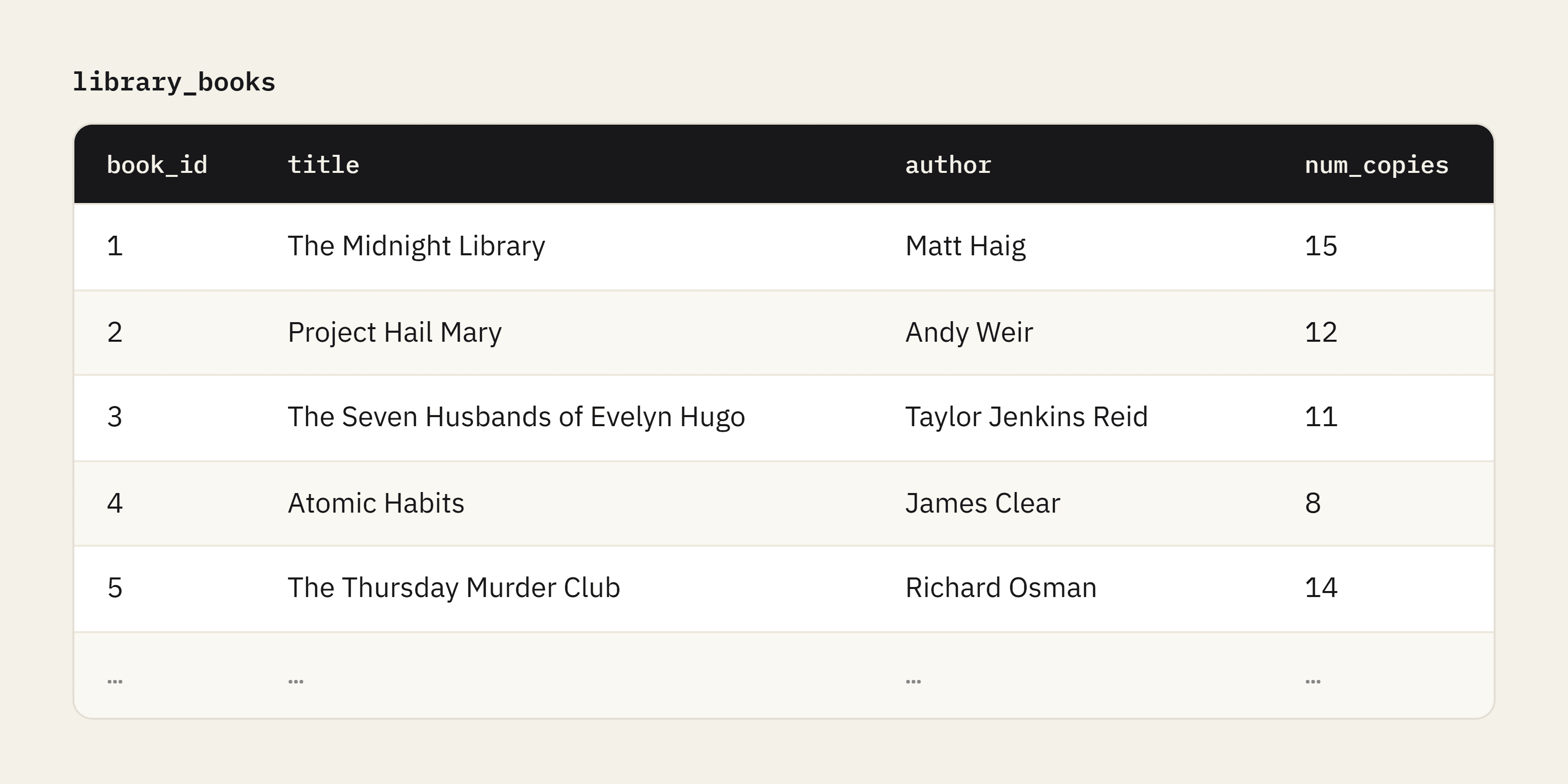
To understand how these conditions manifest, it is instructive to look at common SQL patterns. Consider a library database scenario where a candidate is tasked with ranking books by "lifetime value."
Scenario A: The Library Analytics Problem
The goal is to calculate the total duration of checkouts for books with more than 10 copies, ranking them while handling ties using DENSE_RANK. A common failure point occurs when the candidate fails to address the "more than 10 copies" constraint early on. By failing to voice this requirement, the candidate may write a query that includes incorrect data, leading to a recursive cycle of debugging under the pressure of the clock.
Scenario B: The Yelp Business Ranking Problem
This scenario tests the ability to handle ties using standard competition ranking (RANK). Candidates who have just performed a DENSE_RANK task often default to the same logic, failing to re-read the prompt for specific tie-breaking instructions. This highlights the danger of relying on muscle memory rather than analytical rigor.
Strategies for Improved Performance
To overcome these hurdles, candidates should adopt a rigid, repeatable framework for approaching technical problems. This methodology should be applied consistently during practice sessions to build "interview muscle memory."
- The Clarification Phase (3–5 minutes): Before typing any code, the candidate must verbally confirm the requirements with the interviewer. This includes defining how to handle nulls, how to manage ties (e.g.,
RANKvs.DENSE_RANK), and the specific filtering criteria. This phase serves two purposes: it ensures the candidate understands the problem, and it signals to the interviewer that the candidate is a systematic thinker. - The Planning Phase (5 minutes): Outlining the solution in logical steps—such as identifying which tables to join, what aggregations to perform, and what window functions are required—allows the interviewer to correct any fundamental misunderstandings before the candidate commits to a flawed query.
- The Execution Phase (15–20 minutes): With a clear plan, the candidate can focus on syntax. If a minor syntax error occurs, the candidate should acknowledge it calmly rather than spiraling into frustration.
- The Review Phase (2–5 minutes): The final step is to verify the output against the stated requirements. Checking for row counts and ensuring that tie-breaking rules have been correctly applied is critical.
Broader Implications for Talent Acquisition
The current reliance on "live coding" as a primary filter for technical talent has broad implications for diversity and inclusion within the data industry. Research into "stereotype threat" and test anxiety suggests that rigid, high-pressure environments may disproportionately exclude qualified candidates who perform exceptionally well in less performative settings.
For employers, the trend toward more structured, transparent interview processes—where candidates are given clear rubrics and the ability to ask clarifying questions—is proving to be a more effective predictor of on-the-job performance. By shifting the focus from "performance under fire" to "problem-solving capability," companies are better positioned to identify candidates who possess the analytical depth required for complex data roles.
As the industry matures, the standardization of technical interviews will likely continue. Candidates who treat the interview not as a high-stakes interrogation, but as a simulated work scenario that can be practiced and mastered, will find themselves at a significant advantage. The goal is not to memorize every possible syntax permutation, but to develop a resilient, communicative approach to problem-solving that remains stable, even when the clock is ticking.