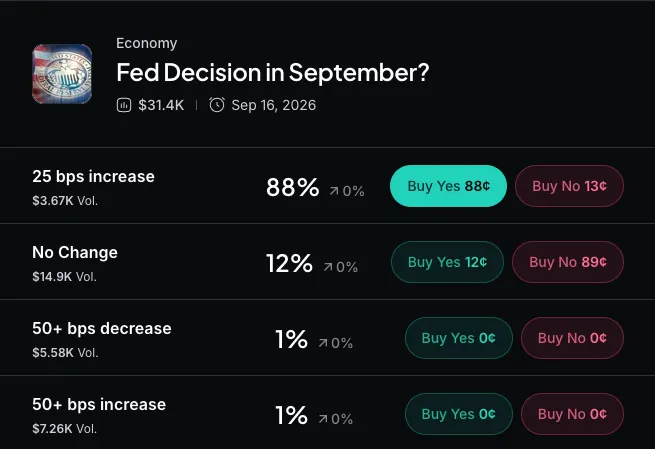
Wall Street financial institutions and global macro markets are actively positioning portfolios for a pivotal shift in United States monetary policy, as the Federal Open Market Committee prepares to conclude its crucial two-day policy meeting. Market participants are increasingly convinced that the central bank will enact a quarter-percentage-point increase to the federal funds rate, a move that would break a prolonged period of monetary policy stagnation that has held steady since late 2023. According to data tracked by the Chicago Mercantile Exchange’s FedWatch tool, the implied probability of an upcoming interest rate hike has surged dramatically to 94.5%, representing a sharp and sudden recalibration from expectations of under 50% just one month prior.
This dramatic sentiment shift reflects a broader consensus emerging across major financial institutions. A comprehensive survey published by the Wall Street Journal indicated that virtually every prominent global bank now anticipates a hawkish policy adjustment on Wednesday. Major financial powerhouses including Barclays, Citigroup, JPMorgan Chase, Morgan Stanley, and UBS have updated their baseline forecasts to price in a cumulative 50 basis points of total monetary tightening before the conclusion of the calendar year. Meanwhile, more hawkish institutions—specifically Bank of America, Deutsche Bank, and RBC Capital Markets—are projecting an even more aggressive tightening path, calling for a total of 75 basis points in rate increases over the remaining months of the year.
At the opposite end of the spectrum, Goldman Sachs remains comparatively dovish, maintaining a baseline expectation limited strictly to this week’s anticipated quarter-point increase with no subsequent hikes factored into their immediate outlook. Meanwhile, institutional outliers such as Jefferies and Oxford Economics are forecasting a contrarian trajectory, anticipating potential monetary easing or interest rate cuts arriving as early as December and extending into 2027.
The Mechanics of Quantitative Tightening and Market Repercussions
The fundamental economic mechanics of a Federal Reserve interest rate hike are designed to cool aggregate demand by increasing the cost of borrowing for both corporate entities and individual consumers. Higher borrowing costs naturally dampen consumer spending, cool housing and commercial real estate markets, and create substantial headwinds for risk-sensitive asset classes that historically thrive in low-interest-rate environments—most notably traditional equities and digital assets such as Bitcoin. Furthermore, higher interest rates elevate the yields available on low-risk government debt securities, systematically incentivizing institutional capital to rotate away from speculative investments and into guaranteed sovereign fixed-income products.
However, financial markets are rarely disrupted solely by the immediate implementation of a policy rate change; rather, they are acutely sensitive to policy uncertainty regarding the future trajectory of interest rates. Because market participants abhor policy ambiguity, asset prices undergo rapid repricing phases well in advance of official central bank pronouncements. This pre-emptive repricing has been prominently reflected across sovereign debt markets. The benchmark 10-year U.S. Treasury yield recently touched 5.04%, marking its highest level observed since July 2007, as bond traders aggressively priced in both the imminent rate hike and an extended macroeconomic horizon of elevated borrowing costs. Similarly, the two-year Treasury yield, which maintains a heightened sensitivity to near-term shifts in Federal Reserve policy, climbed to its highest point since July 2024.
Macroeconomic Catalysts Driving the Federal Reserve’s Policy Shift
The primary catalyst forcing the Federal Open Market Committee’s hand is persistent, sticky inflation that continues to outpace the central bank’s stated long-term objectives. Latest macroeconomic data releases show headline Consumer Price Index inflation running at an annualized rate of 3.4% in August, while core inflation—which strips out volatile food and energy sectors—stood stubbornly at 2.5%. Both metrics remain comfortably above the Federal Reserve’s official 2% target threshold, signaling that inflationary pressures have not been fully eradicated from the broader economy.
Compounding these domestic price pressures are international geopolitical developments. Crude oil prices have experienced renewed upward momentum, driven largely by ongoing military tensions and geopolitical conflicts involving Iran. These external energy shocks introduce an additional layer of cost-push inflation into global supply chains, creating an economic environment that neither legislative tariff policies nor premature monetary easing can easily neutralize.
The path toward this week’s anticipated policy tightening has been characterized by internal divisions among central bankers. When the Federal Reserve opted to hold interest rates steady within the target range of 3.50% to 3.75% during its July policy meeting, the decision passed by a remarkably narrow 9-3 vote. Three dissenting voting members openly advocated for an immediate rate increase at that time. This internal committee split, when combined with a surprisingly robust August employment report that demonstrated continued labor market resilience, ultimately tilted the balance of the committee toward a hawkish policy pivot heading into the September meetings.
Political Friction and the Independence of the Central Bank
The impending monetary policy adjustment places Federal Reserve Chair Kevin Warsh in an exceptionally delicate political position. Appointed to lead the central bank by President Donald Trump in January, Warsh was publicly urged by the administration during his swearing-in ceremony in May to maintain absolute institutional independence while simultaneously receiving clear signals that the executive branch expected lower borrowing costs.
The realization of a rate hike has consequently strained relations between the central bank and the executive branch. Over the preceding two weeks, President Trump, Vice President JD Vance, and Treasury Secretary Scott Bessent have engaged in unprecedented public lobbying campaigns urging the Federal Reserve to lower interest rates. President Trump went so far as to publicly threaten trade retaliation against nations maintaining significant trade surpluses with the United States should domestic interest rates fail to decline. In response to these pressures, Chair Warsh has consistently maintained that the executive branch exerts zero influence over independent monetary policy decisions formulated by the committee.
The political optics of the decision are further complicated by its timing, landing just two months ahead of the pivotal November midterm elections. Public opinion polls consistently indicate that voter frustration regarding elevated consumer prices and high borrowing costs remains a dominant political concern. Ironically, a significant driver of the current inflationary pressures prompting the Federal Reserve’s rate hike stems from the trade tariff policies and geopolitical energy shocks actively championed by the administration itself.
Impact on Digital Asset Markets: Bitcoin and Altcoin Vulnerabilities
Cryptocurrency markets are navigating this macroeconomic turning point while recovering from a series of localized regulatory and structural setbacks. Bitcoin recently traded near the $75,700 threshold, representing a single-day decline of approximately 3.2%. This downward pressure followed closely on the heels of a legislative defeat in the United States Senate, where the long-anticipated market structure legislation known as the Clarity Act failed to clear a critical cloture vote. Consequently, Bitcoin prices have retreated significantly from their monthly peak levels achieved near $82,000 in September.
Market technicians have identified $73,200 as a crucial psychological and technical support line for Bitcoin. A confirmed daily close beneath this threshold could potentially trigger accelerated sell-offs, opening a path toward lower support zones at $71,000 and subsequently $66,900. Such a downward break would effectively invalidate the bullish technical momentum that previously sparked Bitcoin’s recent golden cross formation.
Conversely, not all market analysts interpret an impending rate hike as an exclusively bearish development. A segment of macroeconomic strategists argues that a modest quarter-point rate increase—framed primarily as a technical measure to anchor long-term Treasury yields rather than a severe tightening of broad financial conditions—could leave the medium-term outlook for digital assets largely intact. From this perspective, market volatility will depend primarily on whether the official policy statement and Chair Warsh’s post-meeting press conference deliver surprises relative to expectations already baked into asset prices.
Higher-beta altcoins are widely anticipated to experience magnified percentage price swings relative to Bitcoin, driven by thinner market liquidity and elevated leverage ratios across derivatives exchanges.
Outlook and Official Schedule
The official policy statement and the highly anticipated updated economic projections dot plot are scheduled for release by the Federal Open Market Committee at 2:00 p.m. Eastern Time on Wednesday. This will be followed immediately by Chair Kevin Warsh’s live press conference at 2:30 p.m. Eastern Time. Global financial markets will scrutinize these communications for definitive guidance on whether central bank officials anticipate only a solitary additional rate hike for the remainder of the year, or whether they are leaning toward the more aggressive path of multiple subsequent rate increases currently modeled by institutions such as Bank of America, Deutsche Bank, and RBC.