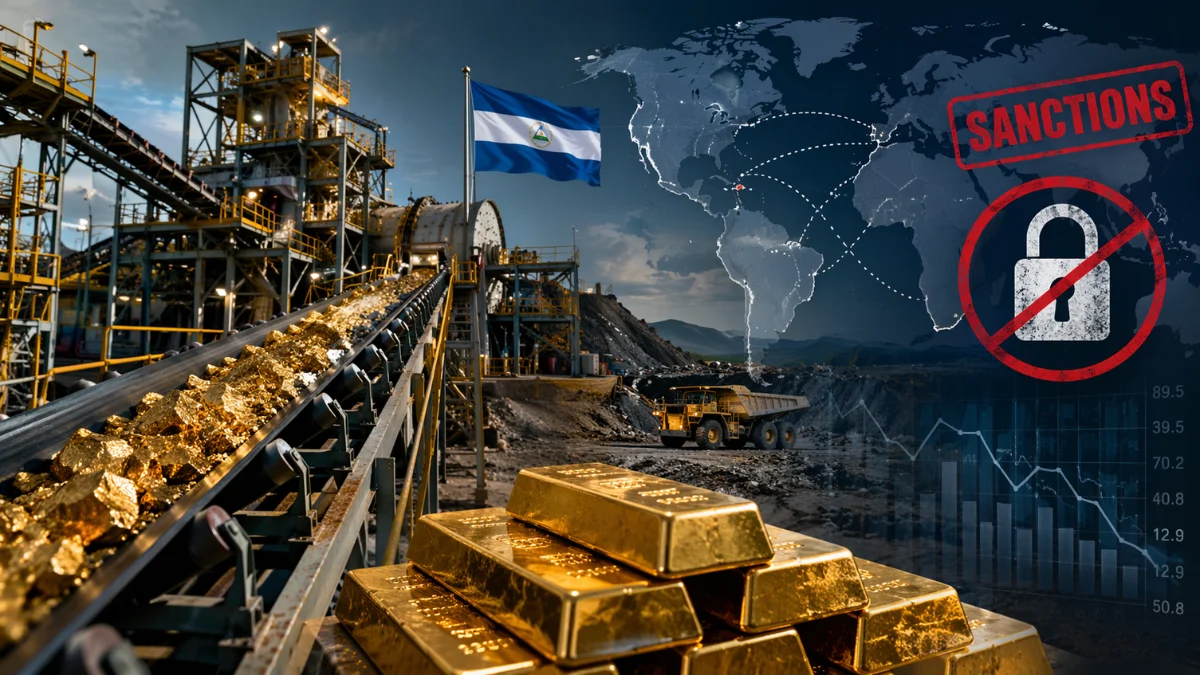
The United States Department of the Treasury has significantly escalated its economic pressure on the Nicaraguan government by announcing a comprehensive new round of sanctions targeting key figures and corporate entities within the nation’s lucrative gold sector. This strategic move, orchestrated by the Office of Foreign Assets Control (OFAC), is designed to disrupt the financial networks that the Biden-Harris administration alleges are being used to sustain the authoritarian rule of President Daniel Ortega and Vice President Rosario Murillo. By targeting the gold industry—a cornerstone of the Nicaraguan economy—Washington aims to limit the regime’s ability to finance internal repression and maintain its grip on power through the exploitation of natural resources and the illicit seizure of private assets.
The sanctions represent a targeted strike against the inner circle of the Ortega-Murillo family, specifically naming two of the presidential couple’s sons, Maurice Facundo Ortega Murillo and Daniel Edmundo Ortega Murillo. In addition to these high-profile individuals, the Treasury Department has blacklisted several major mining and export firms, including Zhong Fu, Santa Rita Mining Co., Exportadora de Metales Sociedad Anonima (EMSA), and Grupo Minero Xiloa S.A. These entities are accused of facilitating the processing and international sale of gold, often through opaque channels intended to bypass international oversight and enrich state-aligned insiders.
The Catalyst: Asset Seizures and the BHMB Mining Incident
A primary driver for this latest diplomatic and economic escalation is a specific incident involving the BHMB Mining Nicaragua S.A. facility. According to the U.S. Treasury, the Nicaraguan government engaged in what officials described as a "forced seizure" of a gold processing plant that had significant foreign investment from a United States-based company. The takeover of the BHMB facility is viewed by Washington as a clear violation of international property rights and a signal that the Nicaraguan government is increasingly willing to nationalize or expropriate private industry to secure its own financial longevity.
U.S. Treasury Secretary Scott Bessent emphasized that such actions are a direct threat to the regional investment climate and the rule of law. "The forced seizure of private assets, particularly those involving American investment, is an unacceptable breach of international norms," Bessent stated in a briefing accompanying the announcement. "By taking control of these facilities, the Ortega-Murillo regime is not only stealing from private investors but is also consolidating its control over the country’s most valuable export to fund its campaign of domestic repression."
The gold sector has seen exponential growth in Nicaragua over the last decade, transitioning from a secondary industry to the country’s primary source of foreign exchange. However, U.S. officials allege that the benefits of this growth are not reaching the Nicaraguan population. Instead, the profits are reportedly being funneled into the pockets of "private partners" and political insiders, while also providing the necessary liquidity to fund the police and paramilitary groups responsible for silencing political dissent.
Profiles of the Sanctioned: The Ortega Inner Circle
The inclusion of Maurice Facundo Ortega Murillo and Daniel Edmundo Ortega Murillo in the sanctions list underscores the U.S. strategy of targeting the "dynastic" nature of the Nicaraguan leadership. These individuals have long been suspected of managing the family’s vast business interests, which span media, energy, and now, the mining sector. By placing them under sanctions, the U.S. effectively freezes any assets they may hold under American jurisdiction and prohibits any U.S. person or business from engaging in financial transactions with them.
The corporate targets are equally significant. Zhong Fu and Santa Rita Mining Co. are major players in the extraction and processing landscape. Exportadora de Metales Sociedad Anonima (EMSA) and Grupo Minero Xiloa S.A. are alleged to be the primary conduits for moving Nicaraguan gold into the global market. The Treasury Department alleges that these companies have utilized the U.S. financial system to move funds, often attempting to disguise the origin of the capital to make it appear as legitimate commercial revenue.
Santiago Hernan Bermudez Tapia, another individual named in the sanctions, is identified as a key operative in the logistics of the gold trade. His role, according to investigators, was to ensure that the gold produced in sanctioned or seized facilities reached international buyers, thereby bypassing the traditional regulatory frameworks that govern the global precious metals trade.
Chronology of Escalation: From 2018 Protests to 2025 Sanctions
The current state of U.S.-Nicaragua relations is the result of a steady decline that began in earnest in April 2018. To understand the gravity of the current sanctions, it is necessary to examine the timeline of the conflict:
- April 2018: Nationwide protests erupt in Nicaragua, initially sparked by social security reforms but quickly evolving into a broader movement against the Ortega administration. The government responds with a violent crackdown, resulting in hundreds of deaths and thousands of injuries.
- Late 2018 – 2019: The United Nations and the Organization of American States (OAS) release reports detailing "systematic human rights violations," including extrajudicial killings, torture, and arbitrary detentions. The U.S. begins imposing targeted sanctions on top police officials.
- November 2021: Daniel Ortega secures a fourth consecutive term in an election that the U.S., the EU, and several Latin American nations describe as a "sham." Prior to the vote, the government imprisoned nearly all viable opposition candidates.
- 2022 – 2023: The regime intensifies its crackdown on civil society, closing over 3,000 non-governmental organizations (NGOs) and targeting the Catholic Church. Several high-ranking clergy members are arrested or forced into exile.
- 2024: The Nicaraguan government begins targeting the mining sector more aggressively, leading to the reported seizure of the BHMB Mining facility. The U.S. responds by expanding the scope of Executive Order 13851, which provides the legal framework for sanctions related to the situation in Nicaragua.
- 2025 (Current): The U.S. Treasury Department issues the current round of sanctions, specifically focusing on the gold industry as the regime’s "financial lifeline."
Economic Data: The Strategic Importance of Gold
The focus on gold is not incidental. Data from the Central Bank of Nicaragua indicates that gold exports have become the nation’s top earner of foreign currency. In recent years, annual gold exports have neared the $1 billion mark, accounting for a significant percentage of the country’s total export value.
For a nation with a GDP of approximately $15 billion, the gold sector represents a critical vulnerability. The United States has traditionally been the largest market for Nicaraguan gold. By imposing these sanctions, Washington is effectively attempting to close the door on the primary destination for Nicaraguan exports. This forces the Ortega government to seek alternative, often less profitable, markets in regions with less stringent financial regulations, such as Russia or parts of the Middle East and Asia.
Furthermore, the "chilling effect" of these sanctions cannot be overstated. Even companies not directly named in the Treasury’s list may now reconsider their operations in Nicaragua due to the risk of "over-compliance" by international banks. Global financial institutions are often hesitant to process any transactions involving a country where the primary industry is under heavy U.S. sanctions, fearing secondary penalties.
Official Responses and Global Implications
As of the time of publication, the Nicaraguan government has not issued an official rebuttal to the specific allegations regarding the BHMB Mining seizure or the sanctions against the Ortega Murillo brothers. Historically, however, President Ortega has dismissed such measures as "imperialist aggression" and "economic warfare" designed to destabilize his "sovereign government."
In Washington, the sentiment remains one of bipartisan resolve. Lawmakers have argued that the gold industry provides the "oxygen" for the regime’s survival. Human rights advocates have also welcomed the move. "The gold sector in Nicaragua is stained with the blood of political prisoners and the tears of those forced into exile," said a spokesperson for a leading human rights monitoring group. "Targeting this industry is a necessary step to ensure that the regime cannot continue to profit from the suffering of its people."
The implications of these sanctions extend beyond the borders of Nicaragua. They serve as a warning to other governments in the region about the consequences of expropriating foreign assets and dismantling democratic institutions. For the global gold market, the removal of a significant portion of Nicaraguan gold from the formal Western supply chain may cause minor fluctuations, but the primary impact will be felt within Nicaragua’s domestic economy.
Analysis of Potential Outcomes
The success of these sanctions will depend on several factors, including the effectiveness of U.S. enforcement and the ability of the Nicaraguan government to find "sanction-busting" partners. If the U.S. can successfully block the majority of Nicaraguan gold from entering the international financial system, the regime may face a severe liquidity crisis. This could potentially force a return to the negotiating table or, conversely, lead to an even more desperate and repressive internal policy as the government competes for dwindling resources.
Moreover, the focus on the gold sector highlights a shift in U.S. foreign policy toward "sectoral sanctions"—targeting specific industries rather than just individuals. This approach is intended to maximize economic pressure while theoretically minimizing the direct impact on the general population, although in practice, the contraction of a major industry often has broad socio-economic consequences.
As the situation develops, international observers will be watching closely to see if other nations, particularly in the European Union and the OAS, follow the U.S. lead. For now, the gold sector remains the central battlefield in the ongoing diplomatic and economic struggle between Washington and Managua, with the future of Nicaragua’s political landscape hanging in the balance.