In the wake of the Second World War, observers noted that the scale of destruction rendered the concept of "victory" obsolete, a sentiment often summarized by the maxim that there are no winners in modern warfare. While this was once viewed through the lens of moral philosophy, in the 21st century, it has evolved into a rigorous systems analysis. In an era defined by strictly capped carbon budgets and a finite supply of critical minerals, the global military-industrial complex and the urgent transition to renewable energy have emerged as rival claimants for the same pool of limited resources. As geopolitical tensions escalate, the global community faces a zero-sum game where the expansion of the war economy directly undermines the viability of a sustainable planetary future.
The Material Conflict: A Zero-Sum Resource Game
The transition to a low-carbon economy is fundamentally a material-intensive endeavor. Technologies such as wind turbines, solar arrays, electric vehicle (EV) batteries, and resilient electrical grids require vast quantities of copper, lithium, cobalt, and rare earth elements. However, these same materials are indispensable to modern weaponry. Every ton of copper diverted into the production of artillery shrapnel is a ton that cannot be used for the high-voltage wiring necessary to modernize aging power grids. Every kilogram of lithium utilized in the batteries of loitering munitions—drones designed to hover before striking—represents a loss for the stationary storage systems required to balance intermittent renewable energy sources.
Analysts suggest that the "cannibalization" of these resources is not a peripheral issue but a central barrier to climate goals. For instance, a single F-35 fighter jet requires approximately 920 pounds of rare earth materials; the same materials are critical for the permanent magnets in offshore wind turbines. As defense budgets across the North Atlantic Treaty Organization (NATO) and other global powers climb toward and beyond 2% of GDP, the procurement of military hardware is increasingly outcompeting the green sector for mineral off-take agreements. This competition drives up prices, creates supply chain bottlenecks, and slows the pace of decarbonization, thereby deepening climate risks for all nations, regardless of their military success.
The Carbon Footprint of Modern Warfare: Data and Dimensions
The environmental impact of war extends far beyond the immediate destruction of life and property. Recent data indicates that the carbon emissions associated with major conflicts are staggering. The ongoing war in Ukraine, for example, has produced greenhouse gas emissions on the scale of a mid-sized industrial economy. According to the Initiative on Greenhouse Gas Accounting of War, the first 24 months of the conflict resulted in at least 175 million tonnes of carbon dioxide equivalent (tCO2e). This figure exceeds the annual individual emissions of countries like the Netherlands or Venezuela.
These emissions originate from several distinct sources:
- Direct Combat Operations: The fuel consumption of tanks, fighter jets, and transport vehicles remains one of the most carbon-intensive activities on Earth.
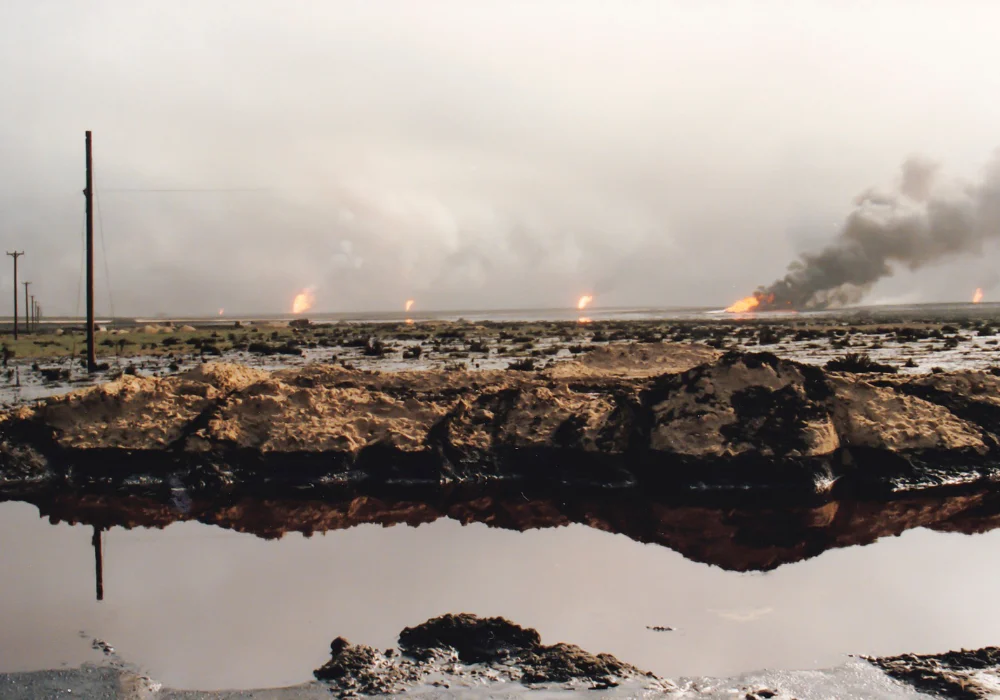
- Fires and Destruction: The bombing of oil refineries, chemical plants, and depots releases massive plumes of carbon and toxic pollutants. In Ukraine, the destruction of the Nord Stream pipelines in 2022 resulted in the largest single release of methane—a potent greenhouse gas—ever recorded.
- Landscape Degradation: Artillery fire and scorched-earth tactics turn carbon-sequestering forests into smoke and ash. Furthermore, the use of thermobaric weapons generates intense firestorms that release black carbon, which can settle on distant glaciers, darkening the ice and accelerating melt rates.
- The Reconstruction Debt: Perhaps the most overlooked factor is the "carbon price tag" of rebuilding. The eventual replacement of destroyed infrastructure with new steel and concrete—two of the most carbon-heavy industries—will generate an enormous second wave of emissions.
A Chronology of Escalation and Environmental Neglect
To understand the current crisis, one must look at the timeline of how military activity has been treated within international climate frameworks:
- 1997 (The Kyoto Protocol): At the insistence of the United States, military emissions were largely exempted from reporting requirements, creating a "black hole" in global carbon accounting.
- 2015 (The Paris Agreement): While the blanket exemption was removed, reporting military emissions remained voluntary. Consequently, most nations continue to keep their defense-related carbon footprints "off the books."
- 2022 (The Invasion of Ukraine): This marked a pivot point where energy security became synonymous with national security. However, instead of accelerating the green transition, many nations responded by reopening coal plants and securing long-term liquefied natural gas (LNG) contracts, further entrenching fossil fuel dependence.
- 2023–2024 (Global Rearmament): Defense spending hit record highs globally, reaching $2.44 trillion in 2023. This surge in spending coincides with the hottest years on record, highlighting the disconnect between fiscal priorities and ecological reality.
The Economic Paradox: Profit vs. Planetary Stability
From a narrow financial perspective, the war economy appears to be a success story. As defense budgets rise, order books for missiles, shells, and air defense systems are reaching capacity. Major aerospace and defense contractors have reported record revenues, and their share prices have outperformed broader market indices. For shareholders with a quarterly horizon, war is undeniably "good for business."
However, economists warn that this model is parasitic. Militarization diverts public funds away from essential services such as healthcare, education, and climate mitigation. Furthermore, the volatility introduced by conflict scares off long-term investment in emerging green technologies in affected regions. The destruction of trade links and the weaponization of supply chains create a "balkanized" global market where transition minerals are hoarded as strategic assets rather than shared as a global lifeline.
Official Responses and the ESG Dilemma
The intersection of defense and climate change has forced uncomfortable questions onto the desks of policymakers and institutional investors. In recent years, there has been a push within the European Union and other jurisdictions to include defense exposure under the umbrella of Environmental, Social, and Governance (ESG) frameworks. Proponents argue that a strong defense is necessary for social stability.
Conversely, climate-aligned investors are questioning whether defense exposure is fundamentally incompatible with net-zero strategies. "Should governments that proudly report power-sector decarbonization be allowed to keep military emissions off the books?" asks Ralph Torrie, Director of Research at Corporate Knights. This sentiment is gaining traction among environmental advocates who demand that critical-mineral off-take agreements be judged not just on supply security, but on whether they prioritize uses that reduce net global risk.
Broader Impact and the Path Forward: Two Roads Diverged
The global community currently stands at a fork in the road regarding resource management. The first path treats transition minerals as the "new oil"—strategic assets to be fought over and weaponized. This path is already being paved by export controls, trade extortion, and violent incidents surrounding mines in the Global South. This trajectory ensures that even if one nation "wins" a resource war, the resulting delays in global decarbonization will lead to a climate collapse that respects no borders.
The second path treats these minerals as a common security interest. This would involve:
- Shared Stockpiles: International cooperation to stabilize mineral prices and ensure equitable access for decarbonization projects.
- Transparent Reporting: Mandatory disclosure of all military emissions to provide an honest accounting of the global carbon footprint.
- Apolitical Norms: Establishing international agreements that the primary use for critical minerals must be the energy transition, not military escalation.
Conclusion: Planetary Accounting in the 21st Century
The principle that "what you do unto others, you do unto yourself" is no longer just a theological or moral teaching; it is a description of a tightly coupled Earth system. When a refinery explodes or a forest burns due to conflict, the resulting carbon does not check passports or recognize sovereignty. The contaminants that enter the soil and water tables in war zones eventually propagate through global food webs and supply chains.
In the 21st century, the atmosphere is full, and the mineral supply is tight. The "planetary accounting" of our era dictates that any war, anywhere, threatens the stability of markets and states everywhere. The thin atmospheric envelope that makes any form of economy possible is being shredded by the very machines built to "protect" national interests. Ultimately, the war economy and the energy transition cannot coexist as equals; one must be prioritized to ensure the survival of the other. The choice made today regarding the allocation of our planet’s finite resources will determine whether the next century is defined by a successful transition or a catastrophic collapse.