The modern transition toward artificial intelligence is frequently analyzed through a lens of unprecedented disruption, characterized by anxieties over technological unemployment, algorithmic superintelligence, and profound societal reorganization. However, a rigorous historical framework suggests that the current cognitive revolution is not an isolated anomaly in human history, but rather the direct continuation of a 250-year-old economic and technological trajectory that began with the steam engine.
By bifurining human labor into physical and cognitive components, economic historians and technologists can trace a compelling parallel between the mechanization of muscle during the Industrial Revolution and the current automation of thought driven by neural networks. While the mechanics of this new era operate at a vastly accelerated pace, the foundational shifts in pricing, productivity, and labor demand follow a well-established historical blueprint.
The Two Pillars of Human Labor: Physical and Cognitive Work
Throughout human history, virtually all economically valuable output has required a combination of physical force and cognitive insight. Agriculture, one of humanity’s oldest enterprises, serves as a primary example. For millennia, cultivating the land required brute force—supplied by humans and domesticated animals—paired with intricate cognitive judgments, such as predicting weather patterns, managing soil nutrients, and selecting optimal seed yields.
Economically, both physical and cognitive labor share fundamental characteristics: they are scarce, they command a market price, and they are applied to fulfill specific societal demands. When technological advancements drive the marginal cost of either form of labor toward zero, the supply of that labor floods the market. Consequently, historical data demonstrates that economic demand rapidly expands to consume the newly abundant capacity, altering the nature of employment rather than eradicating it entirely.
The Mechanization of Muscle: A Two-Century Transformation
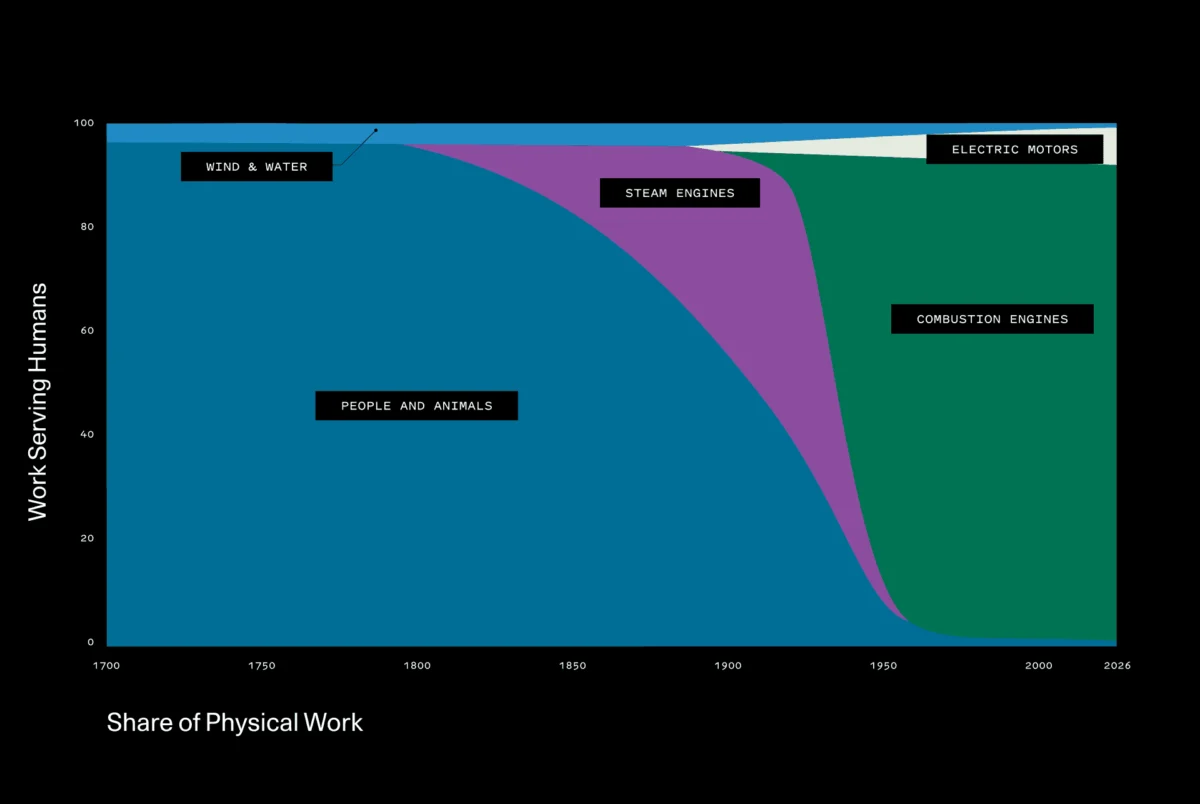
For the vast majority of human existence, physical work was executed almost exclusively by biological muscle. Historical economic data indicates that prior to the late 18th century, the global energy budget relied almost entirely on human and animal exertion.
The inflection point arrived during the late 1700s and early 1800s with the advent of the steam engine, subsequently followed by internal combustion engines and electric motors. Over the course of approximately two centuries, the foundation of physical work underwent a structural inversion, shifting from 99 percent biological execution to 99.9 percent machine execution.

This transition reshaped the global landscape. Today, human muscle represents a negligible fraction of the global energy budget. The manufactured goods of modern civilization—ranging from global supply chain logistics to mass-produced textiles and heavy infrastructure—are entirely the product of mechanized physical power.
The Onset of the Cognitive Revolution
A remarkably similar curve is now materializing in the realm of cognitive work. For centuries, complex thought, calculation, and decision-making were restricted to human biological intelligence, augmented only by rudimentary mechanical instruments such as clocks or mechanical calculators.
The introduction of electronic computation in the mid-20th century initiated a slow expansion of machine cognition, handling tasks from automated payroll processing to basic insurance underwriting. However, the contemporary emergence of neural networks and transformer-based algorithms has drastically amplified the scope of machine capabilities. Just as combustion engines catalyzed the industrial age, neural networks are accelerating the cognitive revolution.
Analysts project that within the coming century, the division of labor within the global economy—currently valued at approximately $120 trillion—will experience a profound rebalancing. While the physical half of the economy has spent two centuries mechanizing, the cognitive half is only beginning its transition, pointing toward an era where an overwhelming majority of routine computations and complex information processing will be handled by automated systems.
Economic Inputs, Cost Collapse, and Industrial Scale
The parallels between the two revolutions extend directly to their foundational inputs. The Industrial Age required the massive scaling of raw commodities, notably coal, iron, oil, and steel, processed through industrial innovations such as the Bessemer process. The titans of that era—industrialists like Andrew Carnegie and John D. Rockefeller—built their fortunes on the efficient extraction and refinement of these physical inputs.
In the current cognitive era, the equivalent foundational inputs are electrical grid capacity, high-performance compute hardware, and sophisticated algorithms. The contemporary equivalents of 19th-century industrialists are found in the semiconductor manufacturers, hyperscale data center operators, and specialized artificial intelligence laboratories driving advancements in neural network architecture. Furthermore, nations that once measured geopolitical power through oil refining capacity and steel output are increasingly evaluating strength based on computational infrastructure and domestic intelligence output.
Crucially, the historical trajectory of cost reduction dictates the pace of adoption. In the 19th century, the cost of a unit of mechanical work plummeted, transforming mass production from an elite luxury into a universal standard of living. Today, the cost of computation and intelligence per watt is declining at an exponential rate, falling by orders of magnitude annually. As the price of cognition collapses, enterprise and consumer demand will expand to consume unprecedented volumes of intelligence.

The Historical Precedent of Labor Displacement and Engels’ Pause
The primary source of anxiety surrounding artificial intelligence centers on workforce displacement. In 1800, more than 75 percent of the American workforce was employed in agriculture. With the mechanization of farming, that figure has dropped to roughly one percent today. By static economic logic, this transition should have resulted in catastrophic, permanent unemployment.
Instead, the Industrial Revolution eliminated specific categories of agricultural labor while simultaneously generating entirely new industries that could not have been named in 1800, ranging from aerospace engineering to software development. Historical data confirms that global employment levels and average wealth reached historic highs following these transitions.
However, historical analysis also reveals the human cost of rapid structural transitions. Economic historian Robert Allen documented the phenomenon known as "Engels’ pause" during the British Industrial Revolution between 1780 and 1840. During this period, output per worker rose significantly, but real wages stagnated for decades before finally catching up and surging in the latter half of the 19th century. Handloom weavers and traditional artisans experienced acute economic distress as their specialized crafts were automated, illustrating that while aggregate economic outcomes are ultimately triumphant, individual transitions can span generations of friction.
Modern economists emphasize that the primary challenge of the current cognitive revolution is not the ultimate destination, but the velocity of the transition. While the Industrial Revolution afforded societies decades to adapt workforce skills, the artificial intelligence transition operates on a compressed timeline, placing unprecedented demands on educational institutions, social safety nets, and continuous professional retraining programs.
Transforming Education, Healthcare, and Daily Infrastructure
Beyond labor markets, foundational societal institutions are undergoing structural redesign. The modern public education system was largely shaped by the Industrial Revolution, which required a literate, punctual, and standardized workforce capable of synchronized shift work. The architecture of traditional schooling—standardized testing, rigid bells, and batch processing by age—mirrored the factory floor.
The cognitive revolution challenges the viability of this industrial education model. Furthermore, it addresses long-standing economic constraints in fields like tutoring and personalized instruction. Historical educational research, such as Benjamin Bloom’s 1984 study on mastery learning, established that individualized tutoring dramatically outperforms traditional classroom instruction. Artificial intelligence systems are uniquely positioned to democratize low-cost, scalable tutoring, fundamentally altering the economics of global education.
In healthcare, the implications are equally profound. Drug discovery has historically been constrained by the vast complexity of biological systems, where evaluating potential therapeutic compounds requires exhaustive manual experimentation. Advanced machine learning models have demonstrated the capacity to predict protein structures at scale, transforming drug development from an empirical trial-and-error process into a high-throughput computational science. Similarly, clinical practice faces severe global physician shortages; the integration of accessible diagnostic tools is projected to shift the medical paradigm from reactive treatment toward proactive, scalable care.

The Evolving Definition of Human Value
As machines increasingly assume the burden of complex cognitive labor, societal apprehension invariably returns to a fundamental philosophical inquiry: What remains the unique domain of human agency?
History offers a reassuring precedent. The mechanization of physical labor did not result in the elimination of human physical activity; rather, it shifted physical exertion from forced subsistence labor to voluntary pursuits, competitive athletics, and recreational wellness.
Similarly, the automation of strategic calculation—exemplified by computers defeating human champions in chess and the ancient game of Go—did not destroy these disciplines. Instead, human participation expanded significantly, and human players utilized machine collaboration to discover novel creative strategies.
Ultimately, the economic value that remains uniquely human centers on intention, accountability, and interpersonal trust. While automated systems can synthesize data, draft legal agreements, and generate code, human actors retain the responsibility of choice and governance. By externalizing routine cognitive labor, societies are presented with an opportunity to elevate human focus toward higher-order creativity, strategic coordination, and interpersonal connection.