In just half a year, the role of artificial intelligence in corporate finance has shifted from an experimental curiosity to a cornerstone of modern operational strategy. In April, a foundational industry survey highlighted that the majority of finance departments were trapped in a “proof-of-concept” bottleneck, with AI tools relegated to the periphery of daily workflows. Today, the landscape has been fundamentally altered. Data collected in August 2026 reveals that 88% of CFOs have successfully deployed AI within their organizations, a staggering increase from the 17% reported only six months prior. This rapid transition signals that the finance sector has moved past the initial phase of AI skepticism and into an era of deep integration, where AI-native vendors are rapidly capturing market share from legacy ERP providers.
A Chronology of Rapid Adoption
The timeline of this shift is defined by a series of technological leaps that fundamentally changed the risk-reward calculus for finance executives. At the start of the year, the primary barriers to entry were model reliability and data readiness. CFOs expressed significant apprehension regarding the accuracy of generative models, with 71% of respondents in April citing model uncertainty as their primary deterrent.
The trajectory changed dramatically with the release of Anthropic’s Opus 4.7 model. This release provided a step-function improvement in reasoning capabilities, offering the precision required for high-stakes accounting tasks. By mid-summer, external benchmarks—such as the study released by Mercor—confirmed that AI models were successfully outperforming junior accountants on complex tasks like month-end reconciliations. This milestone served as a catalyst for widespread organizational trust.

As model reliability improved, the focus of the CFO suite shifted toward the infrastructure layer. Finance leaders recognized that AI could only be effective if it was fed by clean, unified data. Consequently, organizations began a concerted effort to dismantle fragmented, legacy tool stacks in favor of modern systems of record designed for the AI era. This transition moved the industry from theoretical experimentation to the implementation of agentic workflows, where software no longer just displays data but actively manages it.
The Shift from Horizontal to Vertical AI
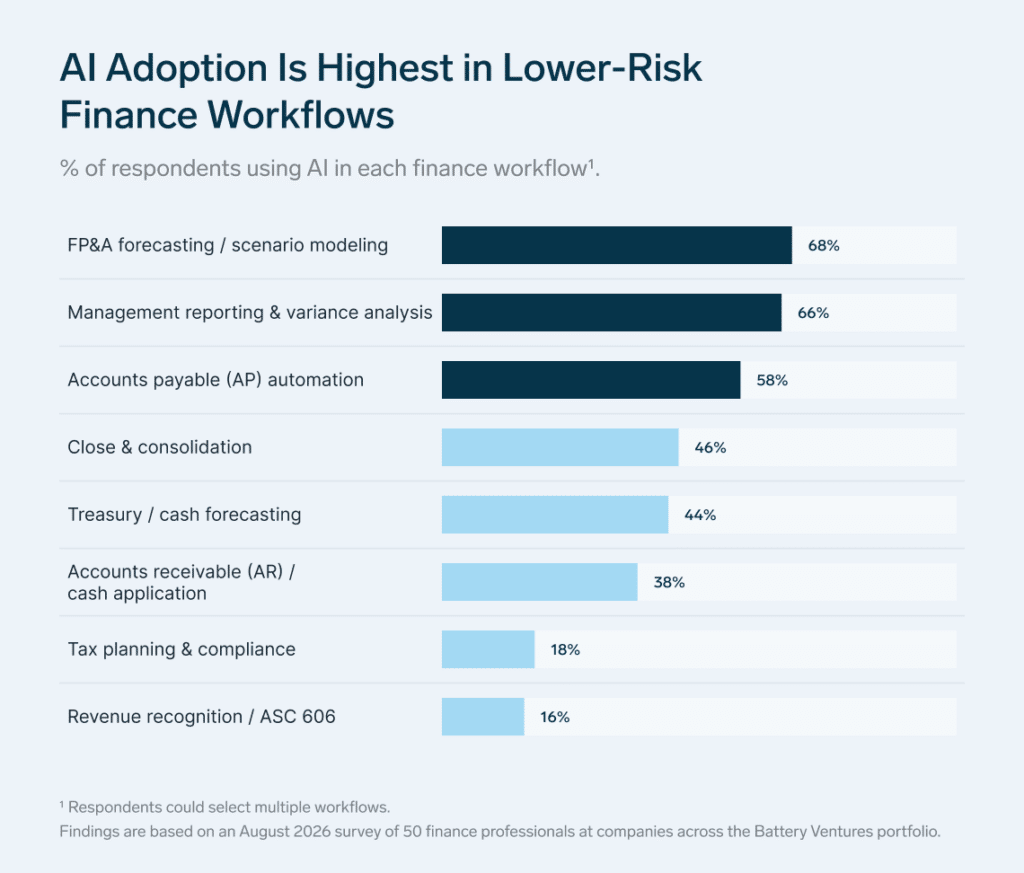
The current battleground in the enterprise software market is the race to own the "inference layer"—the process by which AI models analyze data and execute tasks. Initially, most finance teams relied on horizontal, general-purpose AI harnesses like ChatGPT or Claude. These tools were ideal for low-risk, high-volume tasks such as FP&A forecasting, management reporting, and accounts-payable automation.
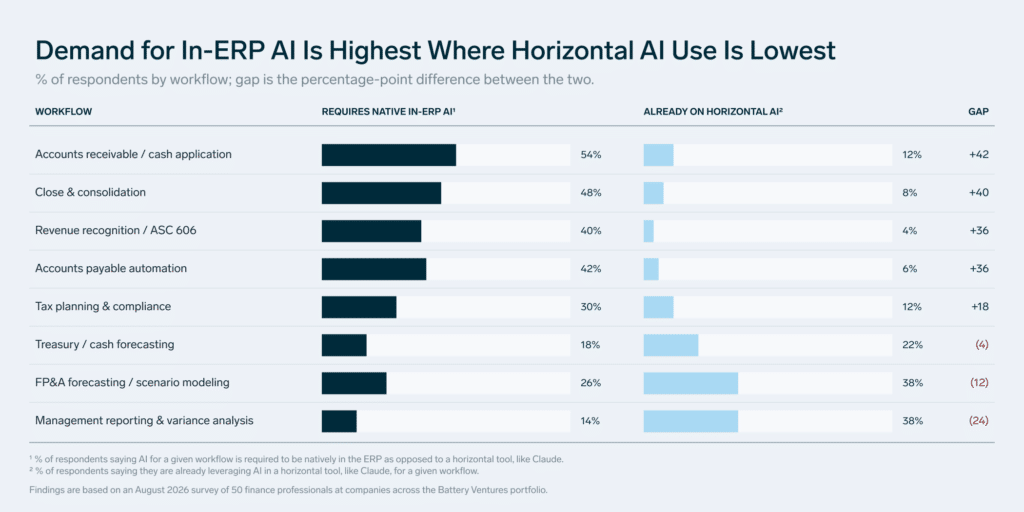
However, the survey data indicates a growing bifurcation in how these tools are utilized. While horizontal models excel in general workflows, they have seen limited penetration in sensitive, audit-bound areas such as revenue recognition, tax planning, and compliance. Finance leaders are increasingly demanding "native" AI, built directly into the ERP (Enterprise Resource Planning) system, to ensure that governance, control, and audit trails remain intact.
This creates a significant strategic opening for AI-native ERP providers. These companies are not merely layering an interface over existing databases; they are re-architecting the ledger to support autonomous agents. Eight percent of CFOs surveyed now consider these agents mission-critical, a figure that industry analysts expect to climb sharply by the end of the year. The ability to monetize "tokens"—the computational units of AI work—is replacing traditional seat-based software licensing as the primary revenue model for these next-generation platforms.
The Erosion of the Incumbent Moat
For decades, the standard advice for any financial executive was to favor established software giants. The prevailing wisdom was that "nobody gets fired for buying IBM," or in the context of modern finance, for choosing an industry-standard ERP like Oracle NetSuite or Sage Intacct. These incumbents relied on the "moat" of long-term stability, audit history, and the massive switching costs associated with migrating complex financial data.
The 2026 survey results indicate that this moat is not only being challenged but potentially ignored. The career risks associated with ERP management have undergone a complete reversal. Previously, the greatest risk was a failed migration; today, the greater risk is professional obsolescence. CFOs are now incentivized to prioritize modernism, as the ability to effectively leverage AI has become a critical performance metric for boards of directors.
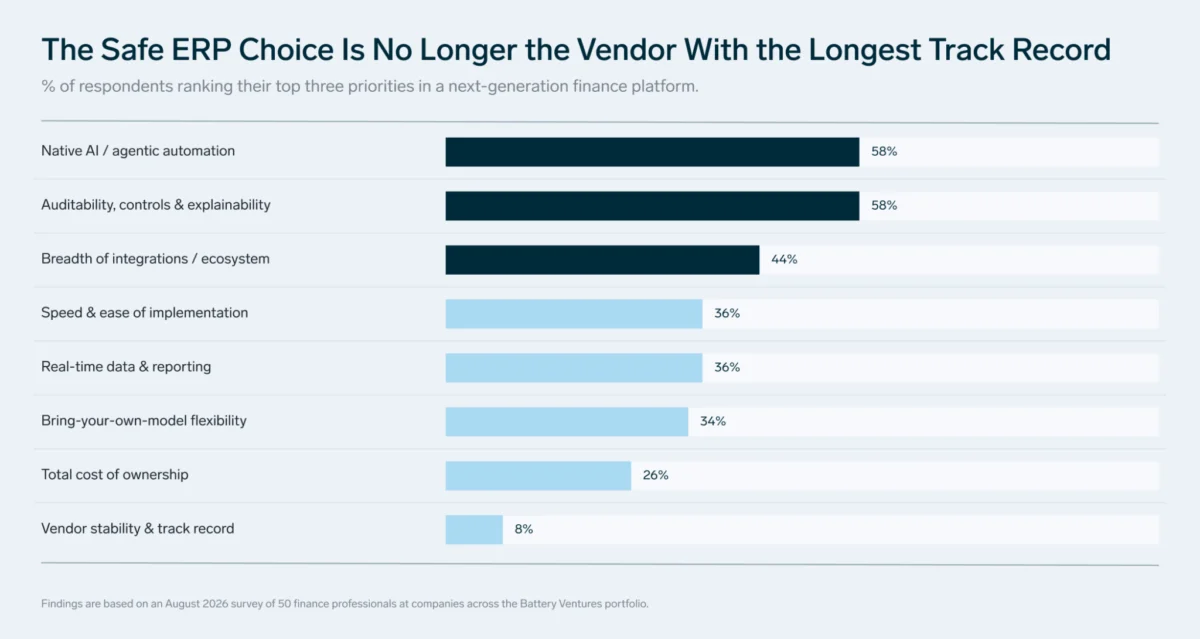
The data supports this shift in sentiment: 48% of those currently using legacy ERP systems report that they are likely to replace their platform within three years, compared to only 12% of those using AI-native solutions. Furthermore, when asked about their priorities for a new platform, "vendor stability and track record" ranked dead last, while "native AI capabilities" and "agentic automation" occupied the top spots. This suggests that incumbency is becoming a liability rather than an asset, with the age of a vendor’s technology often viewed as a proxy for its inability to adapt to the current AI-driven paradigm.
Operational Priorities and the Multi-Model Environment
The modern finance department is also evolving in its technical composition. The survey found that standardization at the model level is virtually non-existent; 84% of CFOs now utilize two or more distinct AI models, while 28% operate four or more. This polyglot approach allows firms to match the right model to the right task, prioritizing performance over vendor loyalty.
Cost management, interestingly, remains a secondary concern. While 86% of CFOs expect to be actively managing token costs within a year, only 16% currently prioritize cost-containment. For now, the primary selection factor is model capability (64%), followed by auditability (20%). This indicates that finance leaders are currently in a "capability acquisition" phase, willing to invest heavily in performance to gain the productivity gains promised by automation.
Broader Implications for the Finance Profession
The implications of this shift extend far beyond the software choices of the CFO. We are witnessing a fundamental change in the nature of the finance profession itself. For the past forty years, the spreadsheet was the primary tool of the financial professional, enabling speed and analysis but remaining fundamentally passive. AI agents are transforming the role of the accountant from a data gatherer into a "builder" of systems.
By automating the routine, high-volume tasks that previously consumed the bulk of a finance team’s time, AI is allowing for a focus on strategic value creation. However, this transition requires a new set of competencies. The modern CFO must now act as an architect of AI agents, ensuring that these autonomous systems are properly constrained, audited, and aligned with corporate governance standards.
The accelerated adoption observed over the last six months suggests that the "AI-native" organization is no longer a futuristic concept but a competitive necessity. As incumbents struggle to modernize their legacy architectures, and as AI-native vendors continue to deliver on their roadmaps, the gap between the two is likely to widen.
For the CFO, the mandate is clear: the pace of innovation in the AI space is not slowing down, and the cost of inertia is becoming prohibitively high. The next six months will likely see the maturation of agentic workflows, moving from simple, isolated tasks to complex, cross-functional processes that span the entire enterprise. As these systems become more deeply embedded in the core of financial operations, the distinction between "software" and "AI" will likely disappear entirely, leaving behind a new standard for corporate financial management.
Methodological Context
The findings presented here are derived from a comprehensive survey of 50 high-level finance executives, including CFOs and VPs of Finance, representing a diverse cross-section of the B2B software, healthcare, and life sciences sectors. The respondents were primarily drawn from mid-sized organizations with headcounts between 100 and 499, a demographic that is typically the first to adopt and scale high-impact, productivity-enhancing technology. The survey was conducted in August 2026, building upon the initial data set gathered in April of the same year, providing a direct longitudinal comparison of the rapid shifts occurring within the sector.
This analysis serves as a reflection of current market trends and the strategic decisions being made by leadership teams as they navigate a period of significant technological upheaval. It does not constitute investment advice or an endorsement of any specific firm, but rather highlights the shifting landscape of enterprise technology through the eyes of those responsible for the financial health of the modern firm.