

The landscape of American corporate finance is undergoing a profound structural evolution, driven almost entirely by the relentless expansion of artificial intelligence. Wall Street analysts have drastically revised their 2026 earnings projections upward, fueled by surging capital expenditures in AI infrastructure, cloud computing, advanced digital advertising, and high-performance data centers. According to the latest financial data and market tracking reports, full-year S&P 500 earnings are now anticipated to climb by 32%, a significant acceleration from the roughly 24% growth projected just prior to the commencement of the second-quarter reporting cycle.
This upward revision reflects a remarkable wave of corporate resilience and earnings outperformance. Market analysts tracking the broader economy note that the scale of this profit growth extends far beyond the traditional boundaries of major technology monopolies, permeating sectors as diverse as retail, consumer discretionary, communication services, and energy. As the economic implications of the artificial intelligence boom continue to materialize, financial institutions are recalibrating their long-term forecasts, setting historic benchmarks for corporate profitability and index valuations.
The Catalyst: A Historic Earnings Season
The impetus for these sweeping macroeconomic revisions stems from an overwhelmingly robust second-quarter earnings season. Data compiled by Bloomberg Intelligence and analyzed by financial publications such as The Kobeissi Letter reveals that an astonishing 86% of S&P 500 companies surpassed analyst profit expectations. Parallel reporting from LSEG corroborates this milestone, confirming that out of 492 reporting corporations within the index, 86% topped consensus estimates. This performance vastly exceeds the historical long-term average beat rate of approximately 67.5%, signaling that corporations have successfully navigated persistent macroeconomic headwinds, including elevated borrowing costs and cautious consumer spending patterns.
Nathaniel Welnhofer, an analyst at Bloomberg Intelligence, pointed to the ongoing buildout of AI infrastructure as the primary driver behind the enhanced 2026 outlook. However, Welnhofer and other market strategists emphasize that the financial benefits are no longer isolated to semiconductor manufacturers and specialized hardware providers. The revenue streams generated by artificial intelligence have rippled outward into enterprise cloud services, sophisticated digital marketing platforms, optimized data center operations, and substantial non-operating investment returns.
Sector-Specific Surge: Communication Services and Consumer Discretionary Lead the Way
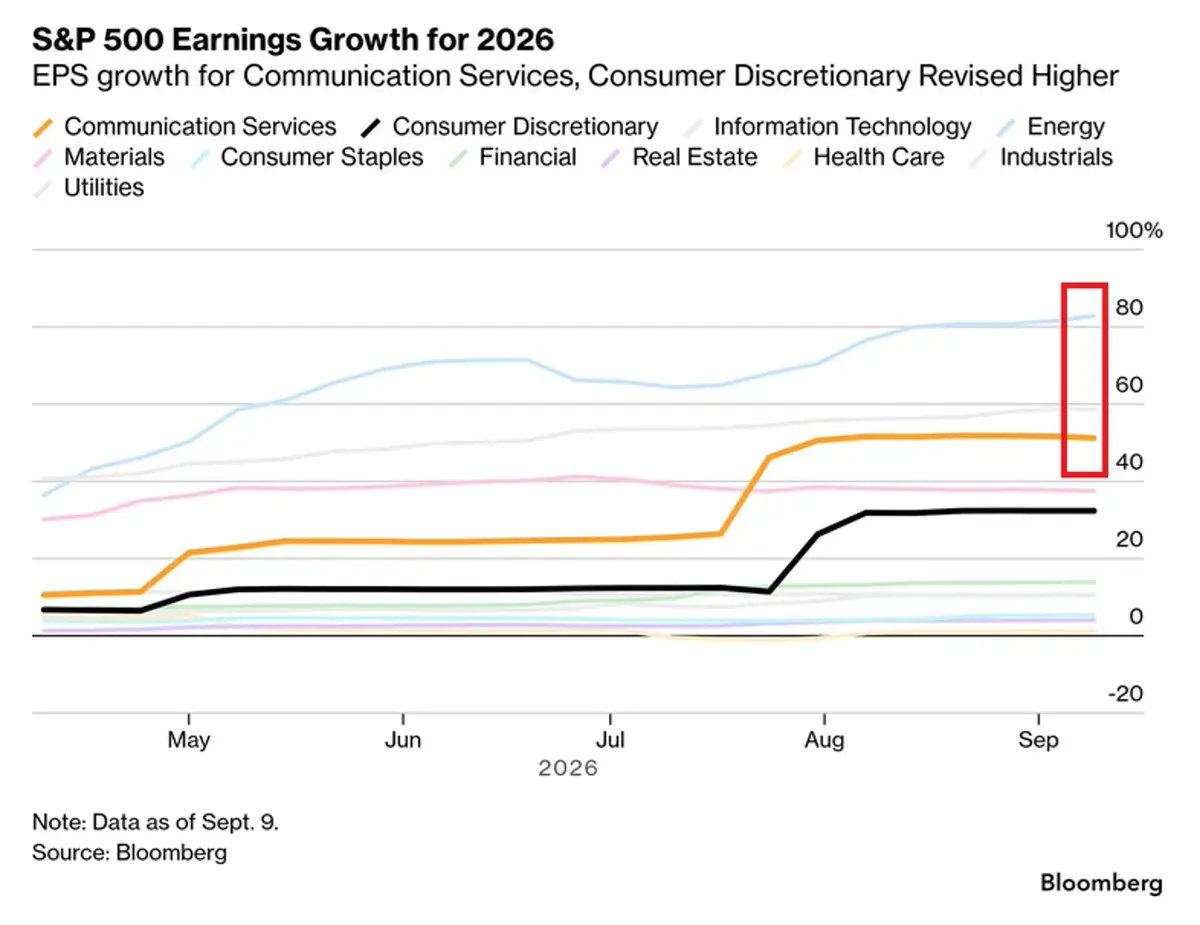
The breadth of the earnings upgrades is best illustrated by examining individual market sectors. Communication Services has emerged as the clear leader in upward revisions, with projected 2026 earnings growth surging to 51%, up dramatically from the 26% expectation held at the outset of the second quarter. Tech giants such as Alphabet have played a pivotal role in this expansion, capitalizing on enhanced advertising efficiency and successful commercial monetization of generative AI tools across their service ecosystems.

Similarly, the Consumer Discretionary sector has experienced a massive upward revision, with projected profit growth climbing from roughly 12% to 32%. Amazon was a central contributor to this sector-wide upgrade, delivering quarterly earnings that eclipsed market expectations by a factor of three. Traditional retail giants and consumer brands—including Walmart, Target, TJX Companies, Ross Stores, and Estée Lauder—also reported earnings that comfortably beat consensus estimates while concurrently raising their forward-looking corporate guidance.
Beyond the retail and tech sectors, the momentum is remarkably widespread. Current Bloomberg projections indicate that the Energy sector is positioned for an 83% surge in 2026 earnings, while Information Technology profits are forecasted to expand by approximately 59%. This cross-sector participation underscores a structural shift in how modern enterprises leverage technology to optimize operational margins and drive top-line revenue growth.
The Accounting Dynamic: Dissecting Non-Operating Gains
While core operational efficiency remains a cornerstone of the current market rally, financial analysts have closely examined the accounting mechanics behind the headline figures. According to Reuters, aggregate S&P 500 second-quarter earnings were tracking roughly 52% higher compared to the same period in the previous year. A significant portion of this explosive year-over-year growth, however, was amplified by large mark-to-market accounting gains booked by specific industry leaders.
Notably, Amazon recorded $53.4 billion in second-quarter non-operating pre-tax income, a figure largely attributable to strategic investments and equity valuations in entities such as artificial intelligence developer Anthropic. Alphabet similarly booked substantial unrealized investment gains during the period.
Even when analysts strip away these large mark-to-market gains to isolate pure operational performance, underlying S&P 500 earnings growth still registered at an impressive 33%. This core expansion rate represents the strongest pace of operational profit growth recorded since the post-pandemic economic rebound of 2021. Furthermore, economic research from Goldman Sachs estimates that companies directly involved in the AI infrastructure supply chain accounted for roughly one-third of total S&P 500 earnings-per-share (EPS) growth during the quarter, cementing artificial intelligence as a foundational pillar of modern corporate earnings.
Wall Street Responds: Index Targets Lifted to Historic Heights
The realization that corporate profits are expanding at a much faster clip than previously anticipated has compelled major financial institutions to revise their year-end and long-term equity index targets. Barclays, for instance, raised its 2026 S&P 500 earnings-per-share estimate to $365, up from its prior projection of $337. Concurrently, the firm elevated its year-end index price target to 7,950 from 7,800, citing sustained capital expenditures in artificial intelligence and resilient underlying economic activity as primary justifications.
Other leading global financial institutions have adopted an even more bullish posture. Major Wall Street entities including UBS, Goldman Sachs, and Citigroup have outlined year-end index projections targeting 8,000 or higher. These ambitious forecasts reflect a growing consensus that the productivity gains associated with artificial intelligence will continue to support high corporate valuations well into the future.
Identifiable Risks and Market Uncertainties
Despite the prevailing optimism, financial analysts and institutional strategists remain vigilant regarding several structural and macroeconomic risks that could temper this growth trajectory. Chief among these concerns is the escalating cost of specialized hardware, particularly rising memory and semiconductor component expenses, which are beginning to exert downward pressure on technology sector profit margins.
Furthermore, persistent macroeconomic uncertainties—including the trajectory of global interest rates, lingering inflationary pressures, and the potential for tighter monetary policy—could restrict multiple expansion across major equity markets. During recent advisory notes, Barclays explicitly highlighted the long-term capital expenditure sustainability of the artificial intelligence boom as a key variable to monitor. If enterprise clients fail to realize adequate return on investment (ROI) from their massive AI outlays, a subsequent tapering of spending could introduce volatility into tech-heavy portfolios.
Implications and Broad Economic Outlook
The dramatic upward revision of Wall Street’s 2026 earnings outlook marks a definitive turning point for the global financial markets. Artificial intelligence has transcended its initial categorization as a speculative market trend or a niche technological novelty; it is now an active, measurable force reshaping corporate balance sheets, sector-specific forecasts, and foundational profit expectations.
As corporations across consumer goods, logistics, energy, and communications integrate automation and machine learning into their operational frameworks, the efficiency dividends are becoming institutionalized. While monitoring structural risks such as hardware inflation and capital expenditure discipline remains essential, the empirical data from the reporting season demonstrates that corporate America is successfully converting the promise of artificial intelligence into tangible, bottom-line financial results.
