
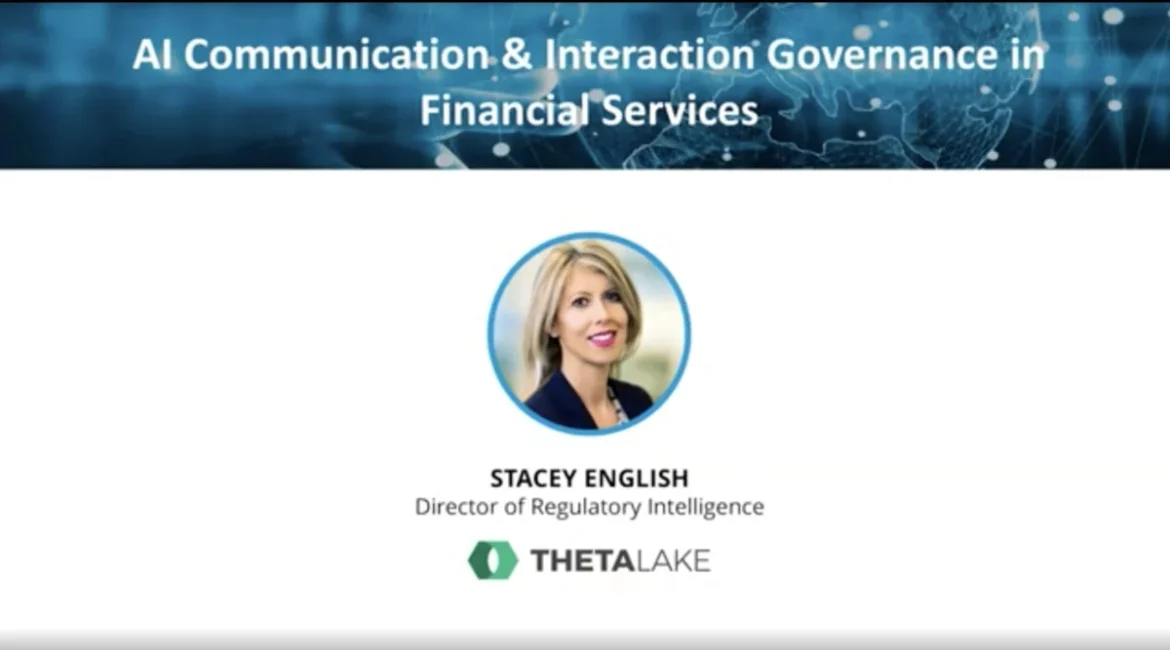
The rapid integration of artificial intelligence into the financial services sector has fundamentally transformed how institutions communicate, collaborate, and interact with clients. As digital communication tools have evolved from simple email clients and telephony into sophisticated, AI-enhanced collaborative ecosystems, regulatory bodies worldwide have intensified their scrutiny. Communication and interaction governance in the financial services space in relation to artificial intelligence is fast evolving, driven by the dual imperatives of fostering innovation and maintaining rigorous compliance standards. To gain deeper insights into this shifting regulatory paradigm, FinTech Global recently spoke with Stacey English, director of regulatory intelligence at Theta Lake, a prominent player in the digital communications governance and archiving market.
The conversation sheds light on the complex challenges financial institutions face as they attempt to balance the productivity gains offered by artificial intelligence with the stringent demands of global regulatory frameworks. Founded in 2017 and headquartered in California, Theta Lake specializes in cloud-native Digital Communications Governance and Archiving (DCGA). The company provides security, compliance, and risk detection solutions specifically tailored for modern, integrated workspace environments where text, voice, video, and AI-generated content intersect daily.
The Evolution of Digital Communications and Regulatory Oversight
To understand the current state of AI governance in finance, it is essential to examine the historical trajectory of digital communications within the sector. For decades, financial institutions operated in a relatively compartmentalized communications environment. Compliance departments focused primarily on archiving emails, recorded phone lines, and formal written correspondence. The global financial crisis of 2007-2008 triggered a massive wave of regulatory reform, resulting in frameworks such as the Dodd-Frank Act in the United States and the Markets in Financial Instruments Directive II (MiFID II) in Europe, which imposed strict record-keeping and surveillance mandates on financial communications.
However, the nature of work underwent a seismic shift over the next decade, accelerated dramatically by the COVID-19 pandemic beginning in 2020. Financial institutions rapidly adopted unified communications and collaboration platforms such as Microsoft Teams, Zoom, Webex, and Slack. These platforms integrated chat, video conferencing, file sharing, and internal social networking into single interfaces. Compliance officers were suddenly forced to monitor not just emails and phone calls, but multi-participant video meetings, ephemeral messaging, file annotations, and emojis.
By 2023 and 2024, the frontier of workplace technology shifted once again with the mainstreaming of generative artificial intelligence. Financial institutions began deploying AI assistants to transcribe meetings, summarize complex financial reports, draft client communications, and analyze market trends in real time. While these tools promised unprecedented operational efficiencies, they also introduced profound governance risks. AI models can hallucinate information, expose sensitive client data to external large language models, generate unmonitored advice, and obscure the audit trail required by regulators. Consequently, by 2026, communication governance transformed from a niche back-office function into a board-level priority.
The Core Challenges of AI-Driven Interactions in Finance
During the discussion between FinTech Global and Theta Lake’s Stacey English, several critical themes emerged regarding the friction points between modern AI adoption and regulatory compliance. Chief among these is the challenge of capturing and archiving dynamic, multimedia interactions that incorporate AI elements. Traditional archiving solutions are fundamentally unequipped to parse a recorded video meeting where an AI assistant has generated a chat summary, or where participants are interacting via virtual whiteboards and shared documents.
Furthermore, financial regulators—including the U.S. Securities and Exchange Commission (SEC), the Financial Industry Regulatory Authority (FINRA), the UK Financial Conduct Authority (FCA), and the European Securities and Markets Authority (ESMA)—have made it abundantly clear that the medium does not alter the mandate. Whether advice or market color is transmitted via a formal research report, a phone call, a chat message, or an AI-generated meeting transcript, financial institutions are legally obligated to supervise, capture, and retain those interactions.
Regulators have also cracked down heavily on unapproved communication channels, often referred to as off-channel communications. As employees increasingly rely on collaboration tools and mobile messaging applications, the temptation to use unmonitored channels for business communications has grown. The introduction of AI tools embedded within these applications further complicates the boundary between personal productivity enhancements and regulated business conduct. If an employee uses an unauthorized AI plugin to summarize a client call, the firm may be in direct violation of record-keeping rules.
The Role of Cloud-Native Governance and Archiving
Enterprises can no longer rely on legacy, siloed compliance technologies designed for a pre-cloud era. This reality underpins the market demand for specialized solutions such as those offered by Theta Lake. Founded with a vision to address the complexities of modern collaboration security, Theta Lake’s cloud-native DCGA platform provides comprehensive risk detection across video, voice, and chat.
Cloud-native architecture allows financial institutions to scale their compliance operations dynamically alongside their technology adoption. As firms integrate new AI copilots and collaboration platforms into their workflows, governance solutions must be capable of ingesting and analyzing these new data streams instantaneously. This involves utilizing advanced natural language processing, computer vision, and machine learning models on the compliance side to detect risks within the AI-generated communications of the enterprise.
For instance, compliance technologies must be able to flag potential instances of insider trading, market manipulation, suitability violations, or the sharing of non-public material information—regardless of whether that information was spoken aloud in a video conference, typed into a chat window, or summarized by an AI transcription tool. Moreover, modern governance solutions must capture the context of interactions, distinguishing between benign casual conversation and actionable financial advice.
Industry Perspectives and Regulatory Expectations
Regulatory bodies across major global jurisdictions have intensified their focus on how financial institutions govern their use of artificial intelligence. In recent regulatory guidance updates, authorities have emphasized that firms utilizing AI must maintain human oversight, ensure transparency in algorithmic decision-making, and uphold rigorous data governance standards.
Industry experts note that compliance is no longer merely a defensive posture aimed at avoiding regulatory fines; it has become a strategic enabler. Financial institutions that can securely and compliantly harness AI communication tools gain a distinct competitive advantage over peers that remain paralyzed by regulatory uncertainty. By partnering with specialized governance providers like Theta Lake, firms can implement robust risk detection frameworks that satisfy the stringent expectations of watchdogs while empowering employees to leverage cutting-edge productivity tools.
Statements and insights from regulatory intelligence leaders like Stacey English consistently underscore the necessity of proactive compliance frameworks. Rather than reacting to enforcement actions after the fact, forward-thinking financial institutions are embedding compliance by design into their AI deployment strategies. This involves cross-functional collaboration between Chief Information Security Officers (CISOs), Chief Compliance Officers (CCOs), and business unit leaders to ensure that every new AI tool is thoroughly vetted, monitored, and archived from day one.
Broader Impact and Implications for the Financial Services Sector
The ongoing evolution of AI communication and interaction governance carries profound implications for the broader financial services landscape. As artificial intelligence becomes deeply embedded in client onboarding, wealth management, investment banking, and customer support, the volume of digital interactions will continue to expand exponentially.
First, compliance budgets within financial institutions are projected to grow significantly as firms upgrade their legacy infrastructure to support comprehensive AI governance. The cost of non-compliance—measured not only in multi-million-dollar regulatory fines imposed by agencies like the SEC and FCA but also in reputational damage and loss of client trust—vastly outweighs the investment required to implement advanced cloud-native archiving and risk detection solutions.
Second, the talent profile within compliance departments is shifting. Traditional legal and auditing backgrounds are increasingly being augmented by professionals with deep technical expertise in artificial intelligence, data science, and cloud architecture. Compliance officers must now understand how large language models function, how prompts are structured, and how data flows through integrated workspace ecosystems in order to effectively govern them.
Third, standardization and interoperability will become critical battlegrounds for regtech providers and financial institutions alike. As the ecosystem of collaboration tools and AI applications fragments, the demand for unified compliance APIs and standardized archiving formats will intensify. Firms will seek out platform-agnostic governance solutions that can seamlessly integrate across diverse technology stacks without creating operational bottlenecks.
Conclusion
The intersection of artificial intelligence and digital communications governance represents one of the most dynamic frontiers in the modern financial services industry. As firms race to adopt AI-driven collaboration tools to enhance efficiency and client engagement, the regulatory imperative to maintain transparent, secure, and fully archived interactions remains absolute. Discussions with industry leaders such as Stacey English of Theta Lake highlight the vital role that cloud-native digital communications governance and archiving solutions play in bridging this gap. By embracing proactive compliance strategies, advanced risk detection technologies, and cross-functional oversight, financial institutions can successfully navigate the complexities of the AI era, ensuring sustainable innovation anchored in regulatory integrity.
