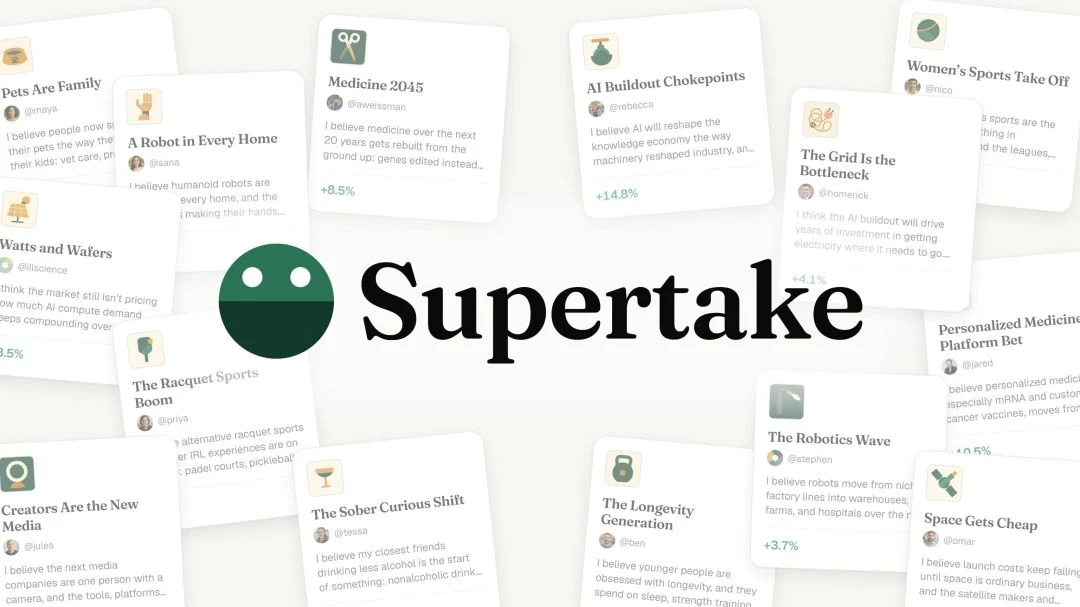
ake Secures $20 Million in Seed Funding to Revolutionize Agentic Finance with Natural Language Portfolio Creation
The landscape of retail investing is undergoing a profound structural evolution, driven largely by rapid advancements in artificial intelligence and the proliferation of autonomous agentic workflows. At the forefront of this shift is Supertake, an innovative AI-powered investing startup that allows users to transform qualitative market theses and personal beliefs into fully functional, real-world investment portfolios without the friction of manual stock-picking.
In the latest milestone for the young company, Supertake announced that it has successfully raised $20 million in a seed funding round. The financing was led by venture capital firm Adjacent, spearheaded by Nico Wittenborn, with significant participation from prominent institutional investors including Coinbase Ventures and Union Square Ventures (USV). The round also attracted a stellar roster of high-profile angel investors, featuring Nat Friedman, head of product at Meta Superintelligence Labs; Vercel CEO Guillermo Rauch; product manager Nikita Bier; investor Scott Belsky; and Nemil Dalal, a former Coinbase executive currently serving as a visiting partner at Y Combinator.
This robust infusion of capital follows an earlier $2 million pre-seed round, bringing Supertake’s total external funding to $22 million. The newly secured funds will be deployed primarily to accelerate product development, expand brokerage integrations, and scale the startup’s core engineering, design, and growth marketing teams across its operations in New York and Austin.
From Incubation to Autonomous Execution: The Founding Story

Supertake’s origins trace back to Union Square Ventures, where the startup was originally incubated by Michael Mignano, who now serves as the company’s founder and executive chairman. Mignano brings a proven track record of scaling consumer-facing platforms, having co-founded the podcasting giant Anchor, which was acquired by Spotify in 2019 for upwards of $150 million. Following the acquisition, Mignano led Spotify’s broader podcasting division as "Head of Talk" before transitioning into venture capital as a partner at Lightspeed, where he backed notable generative AI startups such as Suno and Granola. He also co-founded Oboe, an AI education startup, before officially rejoining USV as a general partner.
While Mignano conceptualized the vision for Supertake—democratizing institutional-grade investment capabilities by allowing everyday users to invest directly in their own insights—he has transitioned day-to-day operational control to a seasoned executive team recruited from the upper echelons of the fintech and cryptocurrency sectors.
Lincoln Murr assumes the role of Chief Executive Officer, while John Peterson serves as Chief Technology Officer. Prior to launching Supertake, both Murr and Peterson led AI product and engineering initiatives at Coinbase, where they oversaw the development and deployment of sophisticated infrastructure products, including Coinbase Advisor, Coinbase for Agents, and agentic wallet technologies. Their deep expertise in natural language processing and autonomous financial agents forms the technological backbone of Supertake’s platform.
Translating Natural Language into Investable Assets
The core value proposition of Supertake rests on a remarkably intuitive premise: rather than forcing retail investors to pore over financial statements, balance sheets, and technical charts, the platform leverages frontier AI models to translate conversational, natural language ideas into diversified portfolios.
To use the service, an investor inputs a broad thesis about how they believe global trends, consumer habits, or macroeconomic factors will shift over time. For example, a user might propose a thesis centered around the rising cultural and economic dominance of the "looksmaxxing" and longevity wellness movements. Through an iterative back-and-forth dialogue, Supertake’s AI analyzes the premise, stress-tests the logic, and curates an investable portfolio comprising equities from the pharmaceutical, biotechnology, and cosmetic sectors positioned to benefit from the trend.

Currently, Supertake integrates directly with major mainstream retail brokerages, including Coinbase and Robinhood, allowing seamless execution of trades generated by the AI. The company has articulated a roadmap to incorporate additional brokerages over time, thereby broadening its total addressable market.
Beyond standard equity selection, the startup’s leadership envisions expanding the platform’s transactional capabilities to encompass more complex financial instruments. Over the coming developmental phases, Supertake plans to introduce support for short positions, derivatives, perpetual contracts, long exposure strategies, and prediction markets through strategic partnerships with established third-party providers.
The Tech Stack and the Prediction Market Distinction
Under the hood, Supertake relies on a hybrid architecture that pairs state-of-the-art frontier AI foundation models with proprietary orchestration software. This proprietary layer is critical; it enforces rigid guardrails, defines behavioral boundaries, and dictates the specific parameters within which the autonomous agents are permitted to operate.
Despite the natural language "takes" often resembling directional bets on future events, co-founder Lincoln Murr is careful to distinguish Supertake from traditional prediction markets. While prediction markets typically settle on binary outcomes regarding specific, isolated events, Supertake focuses on translating overarching worldly theses into structured, underlying asset baskets designed for medium- to long-term wealth accumulation.
Nevertheless, the platform maintains enough flexibility to accommodate shorter-term strategies if a user’s thesis specifically targets an impending milestone, such as an upcoming election or a near-term corporate earnings announcement. However, the primary design philosophy centers on sustainable, thematic asset allocation rather than speculative, hyper-short-term wagering.

Navigating the Trust Deficit: Security and Guardrails
As artificial intelligence systems are granted increasing autonomy over real-world workflows, consumer trust remains the single greatest barrier to widespread adoption. Entrusting an AI model with discretionary control over personal financial assets represents a major psychological leap for retail investors.
To mitigate these concerns and protect users from catastrophic algorithmic errors or unauthorized actions, Supertake has engineered a robust suite of technical guardrails and security protocols. Among the key safety measures implemented by the platform are:
- Strict Capital Boundaries: The underlying AI agents possess zero capability to deposit or withdraw funds from a user’s brokerage account without explicit, manual authorization from the account holder.
- Asset Allow and Deny Lists: System-level restrictions govern which financial instruments the AI is permitted or forbidden to trade.
- Drift Limits and Portfolio Balancing: Automated mechanisms prevent portfolios from drifting excessively from their intended thesis parameters, ensuring continuous alignment with the user’s risk tolerance.
- Real-Time Behavioral Monitoring: Continuous system oversight detects anomalous trading activity or unexpected algorithmic loops.
- Credential Isolation: Autonomous agents are strictly barred from accessing or storing raw user login credentials for connected brokerage accounts.
Drawing an explicit parallel to the evolution of autonomous driving technology, Murr emphasizes that public perception of agentic finance is undergoing a natural maturation curve.
"We view it as somewhat analogous to self-driving cars, actually, where there is a spectrum here of both trust and technological innovations that are happening," Murr noted. "Where a few years ago you may not feel comfortable getting in a car that has lane assist, but today you get in a Waymo, and it’s like nothing. And we think that there’s a very similar progression happening with the agentic finance space, and we’re far further along in the technological spectrum than people think."
The Proof Is in the Portfolio: Founder Adoption

While Supertake’s public-facing application remains sheltered behind an exclusive waitlist during its ongoing beta testing phase, the founding team has signaled high levels of conviction by putting their own personal capital to work on the platform.
Testifying to the reliability of the system, Peterson and Murr have entrusted Supertake with thousands and tens of thousands of dollars of their personal funds, respectively. Meanwhile, Michael Mignano has taken an even more aggressive stance, utilizing the AI platform to manage hundreds of thousands of dollars of his personal wealth.
Broader Implications for the Wealth Management Industry
The emergence of agentic investment platforms like Supertake signals a generational evolution away from traditional, static robo-advisors. While the first wave of automated wealth management introduced algorithmic rebalancing and low-cost index fund allocation, it largely stripped away the personal narrative and intuitive hypotheses that drive individual retail investor enthusiasm.
By marrying natural language processing with autonomous execution agents, startups in the agentic finance sector are bridging the gap between passive indexing and active, thesis-driven trading. If Supertake can successfully navigate the stringent regulatory landscape surrounding financial services while maintaining rigorous cybersecurity standards, it could permanently redefine how retail investors interact with capital markets.
For now, the startup is focused on scaling its engineering infrastructure, refining its user experience, and gradually onboarding users from its waiting list as it prepares for a wider public launch.