Urban centers around the world are undergoing a profound paradigm shift, moving away from viewing trees merely as aesthetic ornaments and toward recognizing them as essential, functional infrastructure. This evolution is driven by the escalating challenges of climate change, specifically the urban heat island effect, rising average temperatures, and mounting energy demands. As municipalities confront these pressures, urban forestry has emerged as a cornerstone of modern climate adaptation strategies, offering multi-faceted benefits that traditional civil engineering cannot replicate.
Canada’s national strategy reflects this growing recognition. Earlier this year, the federal government partnered with the Federation of Canadian Municipalities (FCM) to announce a substantial investment of $67.8 million dedicated to urban forestry projects across the country. This funding is slated to support 165 distinct tree-planting initiatives. Notable allocations include approximately $4.9 million directed toward street trees designed to mitigate heat risks in vulnerable Vancouver neighborhoods, alongside $2.2 million earmarked for the vital reforestation of the Cooksville Creek watershed in Mississauga, Ontario.
This localized funding is part of a much larger federal commitment. The $67.8-million injection operates under the umbrella of the Green Municipal Fund’s Growing Canada’s Community Canopies initiative, a broader $291-million program designed to facilitate the planting of at least 1.2 million trees nationwide by the year 2031.
Municipal leaders have been quick to praise the long-term returns of such investments. Berry Vrbanovic, mayor of Kitchener, Ontario, and council chair of the Green Municipal Fund, emphasizes the comprehensive advantages of this approach. A single investment in urban trees delivers cleaner air, enhanced biodiversity, reliable carbon storage, and critical public health benefits that conventional infrastructure simply cannot provide, according to Vrbanovic. He notes that municipalities increasingly view urban forests as indispensable community assets, with ongoing federal initiatives successfully building the local capacity and strategic plans required to sustain this shift.
The Urgency of Climate Data and Energy Implications
The federal push for expanded urban canopies coincides with alarming environmental data. Environment and Climate Change Canada released its 2026 Canada’s Changing Climate Report, which confirms that average temperatures across the country have already risen by 2°C. The scientific assessment projects that these temperatures will continue to climb throughout the century, placing unprecedented strain on municipal energy grids as cities struggle to keep buildings cool while simultaneously striving to phase out fossil fuels.
Empirical research underscores the direct economic and energetic value of urban trees in mitigating these temperature spikes. A study conducted by researchers at the University of Ottawa combined high-resolution aerial imagery of the city’s urban canopy with detailed electricity consumption data from nearly 2,000 residential homes. The findings revealed that trees located within 12.5 meters of a home were directly associated with a 2.9 percent reduction in electricity consumption—primarily driven by lower demands for air conditioning—during the months the trees are in leaf.
This localized energy saving is mirrored on a macro level across the globe, as international urban centers rethink their spatial planning to harness the natural cooling and protective capabilities of extensive forest cover.
Global Case Studies: Pioneering Urban Forestry Models
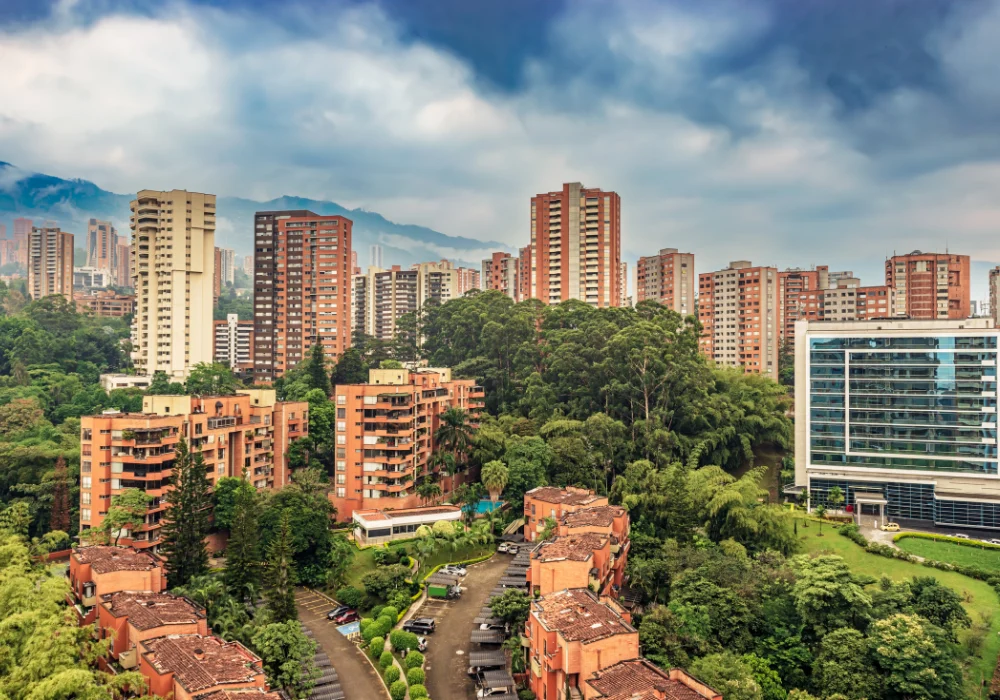
Medellín, Colombia: Combating the Urban Heat Island Effect
Following five decades of rapid and dense urbanization, the Colombian city of Medellín faced severe urban heat island intensity. In response, the municipal government launched an ambitious green infrastructure network in 2016, developing 56 ecological corridors covering more than 1.3 million square meters. Backed by an initial municipal investment of US$16.3 million, these green corridors have yielded measurable results. Data indicates that the initiative has successfully reduced citizen exposure to extreme high-temperature events by 2°C, with models predicting an additional decrease of 4°C to 5°C over the next two decades.
Medellín’s sustained commitment was recognized in 2025 when the city was inducted into the global network of Tree Cities of the World, a program endorsed by the Arbor Day Foundation and the United Nations Food and Agriculture Organization (FAO). To achieve this status, municipalities must satisfy rigorous criteria, including establishing clear public accountability for tree management, documenting annual financial commitments to planting and maintenance, and hosting public celebrations of their urban forests.
Sydney, Australia: Strategic Canopy Expansion
In Australia, the City of Sydney manages a robust urban forest comprising approximately 34,500 street trees, 14,000 park trees, and an estimated 40,000 private trees. Under its comprehensive 2021 Greening Sydney Strategy, the local government committed $377 million (US$262 million) toward expanding parks, green roofs and living walls, streetscape gardening, and overall urban forest health across its jurisdiction, which mandates the planting of at least 700 new trees annually.
Sydney’s leadership views these green assets through a strictly utilitarian lens. Lord Mayor Clover Moore has articulated that trees and green spaces are fundamental infrastructure, noting that effective and extensive canopy cover has the proven capacity to reduce ground-level temperatures by up to 10 degrees Celsius.
Stockholm, Sweden: Engineering for Subsurface Survival
Stockholm has taken a pioneering engineering approach to urban forestry, recognizing that trees in dense urban environments often struggle due to compacted soil and impermeable paved surfaces. In its 2025 municipal budget, Stockholm allocated 10 million krona (approximately US$1 million) explicitly for new tree plantings.
To ensure the longevity of these investments, the city developed the internationally recognized "Stockholm model" for planting beds. This specialized system combines structural stone with biochar—an organic, carbon-rich compost—providing tree roots with ample room to expand, retain essential moisture and nutrients, and allow stormwater to infiltrate the subsoil rather than overloading conventional municipal drainage systems. By extending the lifespan of urban trees, Stockholm effectively uses living flora as an integrated component of its climate-adaptation and stormwater-management frameworks.
New York City, United States: Equity and Ecosystem Services
New York City’s expansive tree canopy covers 23.4 percent of the municipality, encompassing more than seven million trees distributed across streets, public parks, commercial districts, and private properties. A major turning point in the city’s forestry management occurred with the launch of the MillionTreesNYC initiative in 2007. By 2017, the city successfully met its target of planting one million new trees, generating significant ecosystem services such as air pollution removal, stormwater absorption, carbon sequestration, and microclimate temperature regulation.
An analysis conducted by the U.S. Forest Service estimated that New York City’s trees reduce annual residential energy costs by US$17.1 million. Despite these successes, disparities persist. Tree canopy coverage in historically underserved and disadvantaged communities—such as parts of the eastern Queens borough—remains below 10 percent. Addressing these inequities has become a central focus for municipal leaders. Commenting on the need for equitable distribution, Mayor Zohran Mamdani stressed that growing the urban forest must be treated as a shared civic project reflecting a collective commitment to a healthier, more resilient, and more equitable city for all residents.
Singapore: The City in Nature Vision
Singapore maintains a global reputation as a premier "City in Nature," balancing intense urbanization with aggressive ecological planning. Building upon an existing inventory of seven million trees—six million of which are managed directly by the National Parks Board, with the remainder overseen by town councils, private landowners, and non-profit organizations—the government has pledged to plant an additional 170,000 trees in industrial zones by 2030.
This initiative is a critical component of Singapore’s broader OneMillionTrees movement. To foster a sense of shared stewardship, the government actively engages citizens through the Plant-A-Tree Programme, managed in partnership with the Garden City Fund. The program invites individuals and community groups to participate directly in tree-planting events by making a S$300 (US$234) donation to support ongoing tree care and maintenance.
Broader Implications and Future Outlook
The convergence of federal investments in Canada, municipal spending in major international capitals, and rigorous scientific research signals a fundamental transformation in urban planning. As climate change accelerates and urban populations densify, trees are no longer viewed as static, decorative additions to the urban landscape. Instead, they are recognized as dynamic, cost-effective engineering solutions capable of mitigating extreme heat, reducing energy consumption, managing stormwater runoff, and enhancing public health.
As global municipalities continue to scale up their forestry initiatives, the success of these programs will depend on sustained financial commitments, equitable distribution across neighborhoods, and innovative engineering practices that support tree health in harsh urban environments. Through these concerted efforts, cities are building a greener, more resilient foundation for the decades ahead.