
The cryptocurrency infrastructure landscape is undergoing a notable shift as traditional web3 boundaries continue to dissolve through strategic enterprise collaborations. Ripple, the enterprise blockchain and crypto solutions provider, has officially announced a high-profile partnership with Privy, a Stripe-backed web3 development firm. This collaboration aims to introduce embedded, programmable wallets directly to the XRP Ledger (XRPL). The integration is designed to drastically streamline the user onboarding process for decentralized applications (dApps) by removing traditional friction points such as manual private key management and separate external browser extensions.
This technological leap forward arrives at a critical juncture for the native digital asset of the ledger, XRP. While the broader cryptocurrency market grapples with pronounced downward pricing pressures, macroeconomic uncertainties, and localized selloffs, large-scale investors—commonly referred to in the crypto vernacular as "whales"—are charting a distinctly aggressive accumulation course. Market analysts and on-chain intelligence platforms have closely monitored these contrasting dynamics, observing how foundational network growth and protocol enhancements stack up against choppy market sentiment and fluctuating trading ranges.
Expanding the XRP Ledger Payment Infrastructure Through Privy Integration
The core mechanics of the Ripple and Privy partnership center on delivering robust, developer-friendly infrastructure tailored for financial applications built on the XRP Ledger. Announced officially in mid-October, the integration provides businesses with the tools necessary to effortlessly create programmable wallets, manage digital assets, and sign blockchain transactions under the hood without forcing end-users to navigate complex native wallet setups.
According to technical briefs released by Privy, the newly enabled infrastructure supports a wide array of digital assets native to or operating on the XRP Ledger. This includes XRP itself, the recently spotlighted Ripple USD (RLUSD) stablecoin, and various other tokens circulating within the XRPL ecosystem. A primary advantage of this embedded wallet architecture is that users can access seamless payment services and interact with sophisticated blockchain logic without manually grappling with private keys, though they retain the ultimate administrative right to export their credentials at any time.

Furthermore, the collaboration reaches beyond standard consumer-facing payments by extending support to automated, machine-driven commerce. Utilizing the x402 standard, the integration enables artificial intelligence (AI) agents to autonomously execute transactions via server-side wallets. This capability opens up novel use cases within the digital economy, allowing autonomous software agents to seamlessly pay for vital digital services, including on-demand data access, API calls, and heavy computing resources, all settled rapidly on the XRP Ledger.
Industry leaders have been quick to emphasize the strategic weight of this integration. Markus Infanger, Senior Vice President at RippleX, noted that Privy’s specialized infrastructure will significantly lower the barrier to entry for developers aiming to construct next-generation payment applications on the XRPL. This ecosystem expansion builds upon a mature foundation; the XRP Ledger has historically recorded massive operational milestones, boasting more than eight million funded accounts and processing over $1 trillion in cumulative economic value transferred since its inception.
The timing of the Privy integration also coincides with continuous technical hardening of the ledger. Earlier network developments featured crucial security updates, such as patches addressing token permission bugs that could otherwise complicate the issuance of new stablecoins. Looking ahead, Privy has outlined plans to further enrich its XRPL service suite by introducing advanced transaction policy controls and network fee sponsorship models, allowing enterprises to subsidize transaction costs for their customers.
Chronology of Events and Market Developments
To fully contextualize the current state of the XRP ecosystem, a chronological review of recent milestones highlights the intersection of technological advancement and market behavior:
- Mid-October: Ripple and Privy officially announce their strategic partnership to bring embedded wallets and AI-agent payment capabilities to the XRP Ledger.
- Early November: On-chain data reveals a surge in whale accumulation, with prominent crypto analyst Ali Martinez reporting that large wallet holders scooped up over 16.46 million XRP within a compressed five-day window.
- November 2 to November 6: Broad market liquidations and post-midterm selloffs impact digital asset exchange flows, yielding approximately $529,500 in net outflows for XRP exchange-traded funds (ETFs), signaling cautious institutional sentiment.
- November 7: Technical analysts flag potential chart formations, including an unconfirmed inverse head-and-shoulders pattern, while identifying crucial support thresholds and resistance barriers.
- November 8: XRP trades defensively around the $1.16 mark, retreating from weekly highs near $1.34 as market participants evaluate whether structural network upgrades can catalyze a broader price recovery toward psychological milestones.
- Late November (Projected): Asset manager GraniteShares prepares to launch its leveraged XRP exchange-traded products, following strategic scheduling adjustments that underscore ongoing institutional interest in derivative exposure to the asset.
On-Chain Dynamics: Whales Accumulate While Retail and ETFs Hesitate
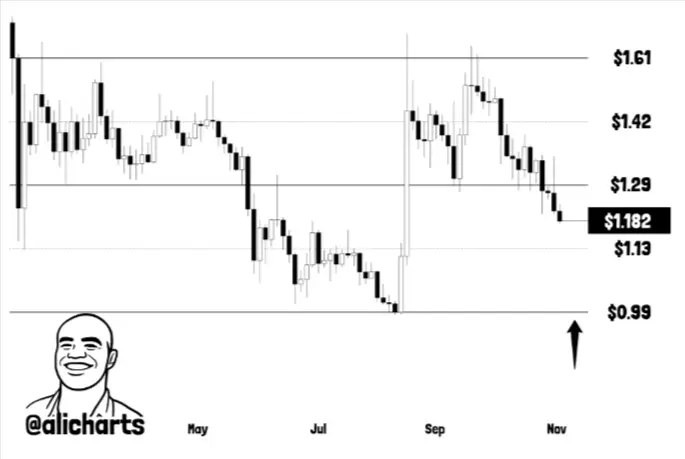
While the structural utility of the XRP Ledger expands through modern developer tooling, the market price of XRP continues to navigate a complex web of opposing forces. Following a sharp rejection from weekly highs of approximately $1.34, XRP consolidated near $1.16 by November 8, forcing traders and long-term investors to reassess near-term price targets and risk parameters.
Despite the lack of sustained upward momentum in the immediate wake of the broader market correction, on-chain metrics paint a fascinating picture of conviction among deep-pocketed investors. Data compiled by market intelligence platform Santiment and highlighted by independent analyst Ali Martinez revealed that whale addresses aggressively absorbed tokens during the dip. Specifically, over a five-day observation period culminating in early November, whales accumulated upwards of 16.46 million XRP tokens, signaling that high-net-worth market participants view current valuation levels as an attractive accumulation zone rather than an exit cue.
This heavyweight accumulation, however, contrasts sharply with institutional product flows and retail trading activity. Concurrently tracked net outflows for XRP-associated exchange-traded products registered roughly $529,500 between November 2 and November 6. This slight bleed in institutional products reflects a lingering hesitancy among traditional finance allocators who remain sensitive to macro regulatory headlines and broader cryptocurrency market volatility. Furthermore, product pipelines are seeing tactical shifts, such as GraniteShares’ decision to postpone the rollout of its leveraged XRP exchange-traded funds to late November, keeping institutional derivative demand on a temporary pause.
Technical Analysis, Resistance, and Support Levels
From a technical charting perspective, XRP sits at a crucial crossroad. Analysts monitoring the asset’s medium-term trajectory point to the $1.60 threshold as a formidable overhead resistance barrier that bulls must decisively conquer to invalidate the prevailing mid-term corrective channel.
Martinez and other technical strategists have identified the emergence of a potential inverse head-and-shoulders pattern on intermediate timeframes, a classic chart structure historically associated with bullish trend reversals. However, market technicians emphasize that this pattern remains purely speculative until a confirmed, volume-backed breakout materializes above the neckline. Should bulls manage to orchestrate a sustained recovery past the $1.60 resistance zone, market focus would rapidly shift toward the psychological $2.00 milestone. From its trading baseline near $1.16, achieving a run toward $2.00 would require a substantial price appreciation of approximately 72.4%.

Conversely, failure to defend immediate support zones could subject the asset to renewed downward pressure. Current market analyses isolate a firm support corridor resting between $1.04 and $1.16. If selling pressure intensifies and breaches the midpoint of the asset’s active trading channel, analysts warn that XRP could slide toward the next major psychological floor near $0.99. Such a descent would severely test the resolve of retail traders who purchased near local tops, even as whales quietly pad their holdings underneath the surface.
Broader Implications and Future Outlook
The convergence of enterprise-grade utility enhancements—such as the Ripple-Privy embedded wallet integration—and resilient on-chain whale accumulation points to a maturing ecosystem. While daily price action remains tethered to macroeconomic sentiment, regulatory developments, and broader crypto market cycles, the underlying architecture of the XRP Ledger is rapidly evolving to support the next generation of decentralized finance and autonomous agentic commerce.
By lowering the technical barriers for developers through programmable, non-custodial wallet infrastructure, Ripple is positioning the XRPL to capture a larger share of institutional payment flows and dApp deployment. Whether these fundamental advancements can act as the definitive catalyst to propel XRP back toward the coveted $2.00 threshold remains one of the most closely watched narratives in the digital asset space. For now, market participants remain locked in a tense standoff between the aggressive accumulation strategies of large-scale holders and the cautious, macro-driven hesitation of the broader retail and institutional investment community.