The North American Derivatives Exchange (Nadex), operating commercially as Crypto.com Derivatives North America, has formally self-certified a new suite of event contracts tied to the price of Shiba Inu (SHIB). Submitted to the U.S. Commodity Futures Trading Commission (CFTC) on November 10, the regulatory filing introduces derivative products designed to allow market participants to speculate on short-term price movements of the prominent meme-inspired cryptocurrency. This filing forms part of a broader expansion by major U.S. and international derivatives platforms introducing structured financial instruments for digital assets, signaling a continued integration of alternative cryptocurrencies into regulated financial frameworks.
According to regulatory documentation, the newly proposed product provides a rules-based binary outcome tied to whether the price of Shiba Inu will finish above or below a predetermined strike price at specific expiration intervals. While public exchange notices indicated an earliest possible listing date of November 13, official CFTC submissions pointed toward November 14 or later, reflecting standard self-certification timelines governed by federal regulatory procedures.

Mechanics of the Shiba Inu Event Contracts
The newly introduced event contracts function as cash-settled binary swaps, requiring no direct ownership of the underlying digital asset. Under the operational framework established by Nadex, traders take positions on whether the benchmark price of SHIB will settle above a specified threshold—the strike price—at the end of a designated time horizon.
The settlement value is determined using an aggregate benchmark price calculated from data feeds across multiple spot cryptocurrency exchanges during the final 60 seconds before contract expiration. If the settlement benchmark exceeds the established strike price at expiration, the contract buyer receives a fixed payout of $1 per contract. Conversely, if the benchmark remains at or below the strike price, the seller receives the $1 payout. Financial outcomes for individual market participants ultimately depend on their initial entry price, associated trading fees, and prevailing market volatility. For instance, a trader purchasing a contract for $0.40 prior to expiration stands to gain $0.60 per contract if the target condition is met, but risks losing the initial $0.40 outlay if the market moves unfavorably.
The filing outlines a diverse array of expiration windows, ranging from 15-minute and hourly intervals to four-hour, daily, and weekly schedules. To ensure initial market liquidity, Nadex noted that at least one designated market maker has committed to quoting prices, though exchange officials cautioned that such commitments do not guarantee sustained or robust trading volumes.

Regulatory Context and Self-Certification Under the CFTC
The introduction of these event contracts relies upon the self-certification process permitted under CFTC regulations. Under this framework, a registered entity may list a new product by certifying to the federal regulator that the contract complies with the Commodity Exchange Act and corresponding commission regulations. This process allows exchanges to bring products to market efficiently without awaiting affirmative prior approval from the regulatory agency, provided the exchange maintains compliance with anti-manipulation, transparency, and surveillance standards.
This development is part of an ongoing institutional push by Nadex into the digital asset derivatives sector. Historical CFTC records indicate that the exchange previously self-certified Shiba Inu event contracts in April 2026, following an even earlier rollout of SHIB-linked products in November 2023. However, the latest iteration incorporates updated pricing benchmarks and expanded expiration timeframes to accommodate shifting market demands and technological updates across data providers.
Market observers note that while these event contracts expand the availability of regulated financial tools for retail and institutional participants, they do not directly alter spot market liquidity. Because the products are cash-settled derivatives, trading activity within these event contracts does not inherently require the purchase or custody of underlying SHIB tokens on spot exchanges. Consequently, direct price impacts on the spot market remain contingent on broader macroeconomic factors, speculative sentiment, and external trading volumes.

Chronology of SHIB Derivatives and Regulatory Filings
The evolution of Shiba Inu derivatives reflects a broader maturation of the digital asset ecosystem over recent years. Below is a chronological overview of key milestones leading up to the latest Nadex filing:
- November 2023: Nadex introduces its initial suite of Shiba Inu event contracts, marking an early entry of meme-based digital assets into regulated binary options markets.
- April 2026: The exchange updates and self-certifies a revised series of SHIB event contracts featuring modified pricing benchmarks and expanded settlement timeframes.
- September 2026: Asset management firm T. Rowe Price files documentation regarding its multi-asset Active Crypto ETF, which lists Shiba Inu among eligible, though not immediately held, underlying investment assets.
- November 10, 2026: Nadex submits a formal self-certification notice to the CFTC for its latest round of price-linked event contracts covering Shiba Inu alongside a diverse basket of other digital assets.
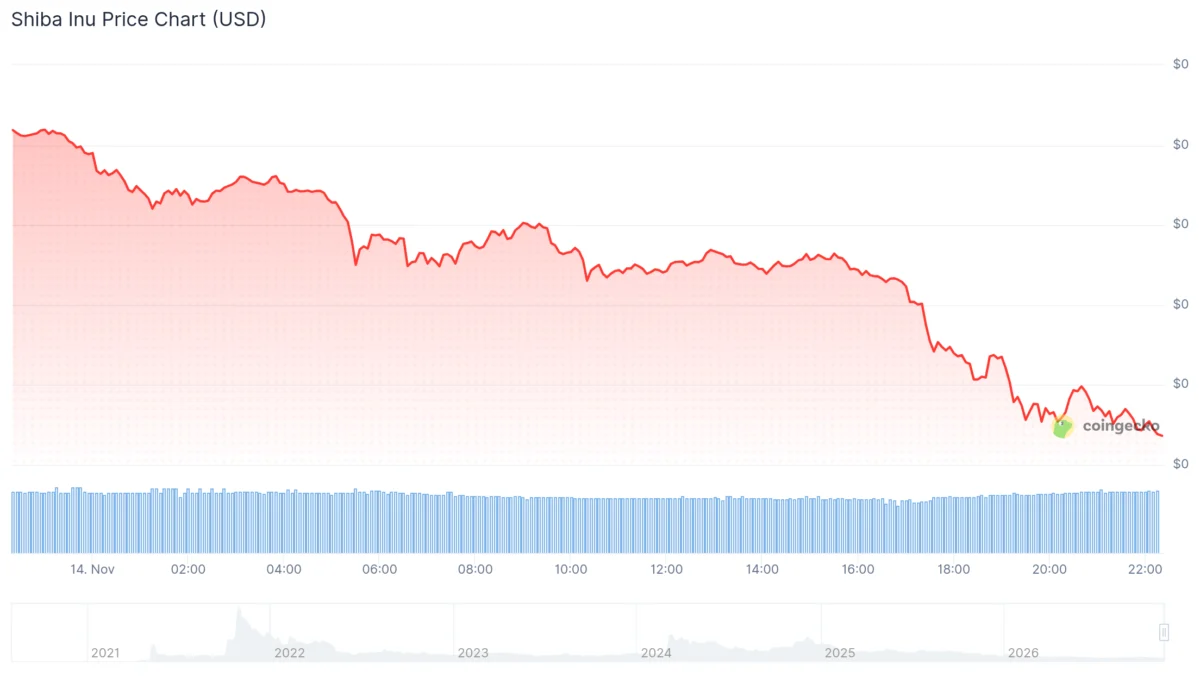
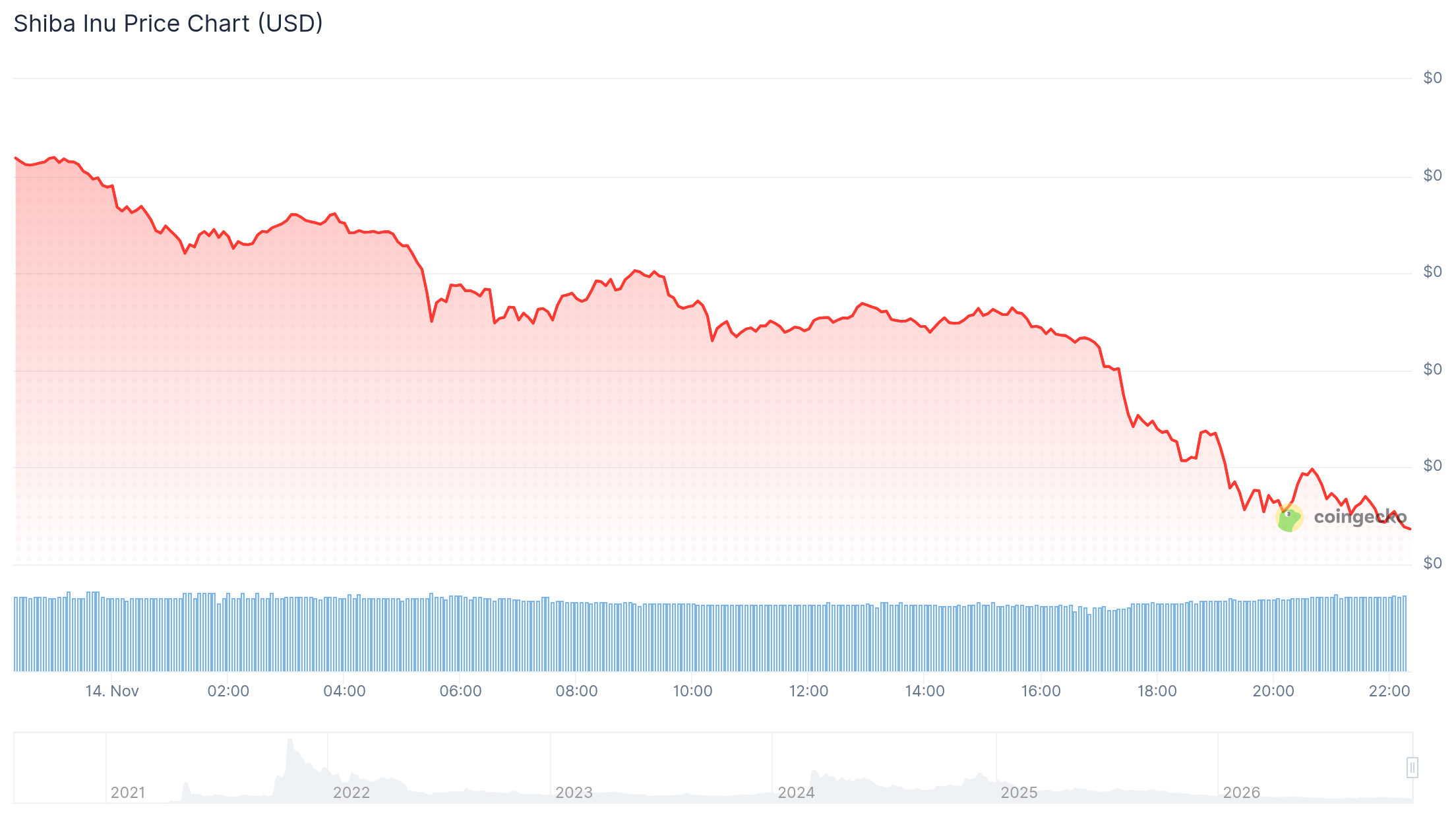
- November 13–14, 2026: Public and regulatory documentation establish the anticipated rollout window for the new derivatives, coinciding with a period of localized price consolidation for SHIB, which traded near $0.00000425 according to CoinGecko data.
Expansion Across Competing Platforms and Broader Market Implications
Nadex is not alone in expanding its digital asset derivatives offerings. The recent regulatory filing encompasses strike contracts for a wide array of cryptocurrencies beyond Shiba Inu, including XRP, Solana, Stellar, Dogecoin, Litecoin, Hedera, Ondo, and Polkadot. This multi-token approach underscores a strategic effort by derivatives exchanges to capture speculative and hedging interest across various market segments.
Simultaneously, competing platforms have introduced alternative derivative structures. Kalshi, another regulated financial exchange, has rolled out perpetual futures for Shiba Inu, offering traders continuous exposure without fixed expiration dates. Meanwhile, international platforms such as Robinhood have expanded their offerings of crypto perpetual futures in European jurisdictions, reflecting divergent regulatory approaches to high-leverage and perpetual trading products across global markets.
In the traditional investment fund sector, exposure to alternative digital assets continues to evolve through multi-asset vehicles. While dedicated exchange-traded funds (ETFs) for single-token meme coins remain largely absent from U.S. regulatory approvals, diversified active crypto funds—such as those proposed by institutional asset managers—have created pathways for indirect exposure, even if specific tokens like SHIB are held conditionally based on portfolio rebalancing strategies.
Fact-Based Analysis of Market Implications
The proliferation of regulated event contracts and perpetual futures for tokens historically classified as meme coins points to two competing industry trends: increased financialization and heightened regulatory scrutiny.
On one hand, the availability of CFTC-regulated event contracts provides risk-management tools for market participants seeking defined-risk exposure to volatile digital assets. Hedgers and speculators can utilize these binary contracts to express precise short-term views without taking on the custodial risks associated with holding spot tokens on unregulated or semi-regulated platforms. Furthermore, the reliance on transparent, multi-exchange benchmark pricing mitigates concerns regarding price manipulation on isolated spot order books.

On the other hand, analysts caution that the expansion of short-duration binary options may exacerbate intraday volatility as automated trading strategies and retail sentiment intersect around expiration windows. Furthermore, because event contracts settle in cash based on index pricing, their growth does not necessarily correlate with fundamental utility or long-term value accumulation for the underlying blockchain network.
As regulatory frameworks continue to adapt to the convergence of traditional derivatives and digital assets, the performance and adoption of products like the Nadex Shiba Inu event contracts will likely serve as a barometer for institutional appetite toward alternative crypto derivatives in regulated U.S. markets.