
In a significant move to address one of the most stubborn challenges in global industrial decarbonization, tech giant Meta has entered into a strategic, multi-year agreement with Fortera, a pioneer in sustainable building materials. The partnership centers on the purchase of Environmental Attribute Certificates (EACs) derived from Fortera’s innovative low-carbon cement production, marking a critical step in Meta’s broader strategy to reduce supply chain emissions. By providing long-term revenue visibility, this deal serves as a catalyst for the construction of Fortera’s new manufacturing facility in Ste. Genevieve, Missouri, effectively bridging the gap between innovative green technology and large-scale industrial deployment.
The Decarbonization Imperative: Addressing the Cement Crisis
Cement production is widely recognized as one of the most carbon-intensive industrial activities globally. According to data from the International Energy Agency (IEA) and various climate research groups, the sector accounts for approximately 8% of total global CO2 emissions. The process, which relies heavily on the chemical conversion of limestone into clinker—a process known as calcination—releases significant amounts of carbon dioxide both through the heating of kilns and as a chemical byproduct of the reaction itself.
For decades, the industry has struggled to find a viable, scalable alternative to ordinary Portland cement (OPC). Traditional methods of abatement, such as carbon capture and storage (CCS) at the flue, are often prohibitively expensive or logistically difficult to retrofit into existing, legacy infrastructure. This is where the California-based company Fortera, founded in 2019, seeks to disrupt the status quo.
Fortera’s Technological Breakthrough: The ReCarb Process
Fortera’s proprietary ReCarb technology represents a shift in how the industry approaches emissions. Rather than simply attempting to capture carbon and bury it underground, the company’s process captures industrial CO2 emissions and chemically converts them into a mineralized feedstock for its ReAct cement.
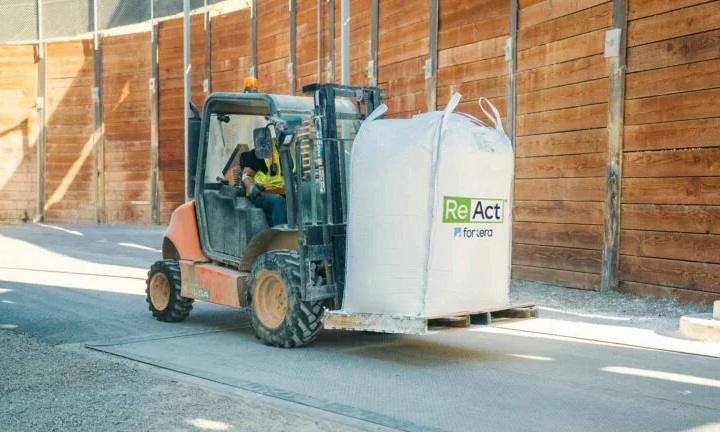
The resulting product possesses a carbon footprint roughly 70% lower than that of conventional OPC. A key advantage of this technology is its compatibility with existing infrastructure. Fortera’s systems are designed to be integrated into current cement and lime facilities. This allows manufacturers to preserve their existing kiln assets and established supply chain networks, significantly lowering the barrier to entry for adoption. Furthermore, the company asserts that its ReAct cement can be produced at cost parity with standard OPC, a vital metric for mass-market commercialization.
The Mechanism of the Deal: EACs as an Economic Engine
Under the terms of the agreement, Meta is committing to purchase EACs associated with approximately 200,000 tons of Fortera’s low-carbon cement. This financial mechanism is essential for the nascent green construction materials market.
By purchasing EACs, corporations like Meta can support the decarbonization of their supply chains without necessarily having to secure the physical product for every single construction project immediately. These certificates act as a proof-of-work mechanism, validating that a specific volume of low-carbon material has been produced. For developers like Fortera, these long-term contracts provide the "bankability" required to secure project financing, enabling them to move from pilot-scale production to industrial-scale facilities.
The agreement also includes provisions that allow Meta to utilize the physical low-carbon cement in its own future data center and infrastructure construction projects. Additionally, the contract includes options to scale the volume and duration of the partnership, signaling a long-term commitment to fostering a market for sustainable materials.
Strategic Implications: The Ste. Genevieve Milestone
The collaboration is directly linked to the development of Fortera’s upcoming plant in Ste. Genevieve, Missouri. The site is strategically positioned to serve as a hub for sustainable construction in the Midwest.

"A multi-year commitment is what gets a cement plant financed," noted Devon Lake, Head of Net Zero Strategy at Meta. "Our agreement helps Fortera move the Ste. Genevieve plant from plan to production, which means construction jobs and long-term manufacturing jobs in Missouri, and low-carbon cement available to builders well beyond Meta."
The choice of Missouri as a location for this facility is not accidental. By fostering domestic supply chains for green materials, companies like Meta are insulating themselves against future regulatory volatility and carbon pricing mechanisms that may be implemented at both the federal and state levels.
Market Analysis: Bridging the Gap in Industrial Supply Chains
The partnership between Meta and Fortera reflects a broader trend among major corporations with ambitious "Net Zero" targets. As Scope 3 emissions—those occurring in the value chain—become a primary focus for corporate reporting, firms are moving beyond simple carbon offsets (which have faced scrutiny regarding quality and permanence) toward "carbon removals" and "insetting" via the procurement of low-carbon materials.
Industry analysts suggest that the demand for low-carbon cement will likely outstrip supply for the remainder of the decade. The construction sector is under increasing pressure from building codes, municipal regulations, and investor mandates to reduce the "embodied carbon" of new structures.
Fortera’s CEO, Ryan Gilliam, highlighted the economic synergy of the project: "Using waste CO2 as a primary feedstock turns cement decarbonization into a new economic engine for the United States. We’re bringing a new technology to enable communities with economies built around cement and lime production to remain strong as the industry decarbonizes."

A Timeline of Green Construction Progress
The road to this announcement has been marked by a shift in investment philosophy toward "hard-to-abate" sectors.
- 2019: Fortera is founded with a focus on mineralization-based carbon capture.
- 2020-2023: Fortera refines its ReCarb process and secures initial pilot funding.
- 2024: Increased corporate interest in sustainable building materials leads to pilot testing of ReAct cement in commercial applications.
- Late 2025: Regulatory discussions regarding embodied carbon in building codes gain momentum, increasing market demand for alternatives to OPC.
- October 2026: Meta and Fortera announce the multi-year EAC purchase agreement, solidifying the financial foundation for the Missouri production facility.
Broader Impact and Future Outlook
The implications of this deal extend far beyond the two companies involved. By validating the commercial viability of low-carbon cement, Meta is effectively de-risking the technology for other market participants, including public infrastructure agencies, private developers, and regional construction firms.
If Fortera succeeds in bringing the Ste. Genevieve plant to full capacity, it will set a precedent for how tech-driven capital can accelerate the industrial energy transition. The ability to integrate carbon capture into existing kiln facilities is a significant technological hurdle that, if cleared at scale, could fundamentally reshape the economics of the global cement industry.
However, challenges remain. The scaling of any industrial process involves complex logistics, permitting, and regional labor requirements. Furthermore, as more companies enter the green cement space, the industry will need to establish standardized verification protocols for EACs to ensure that the carbon reductions are truly additional and transparent.
For now, the Meta-Fortera deal stands as a prime example of "demand-side pull"—where large, credit-worthy buyers use their purchasing power to guarantee the success of clean-tech startups. As the construction industry faces the urgent necessity of decarbonization, such partnerships are likely to become the standard blueprint for financing the infrastructure of the future. By tying environmental goals to tangible, local economic benefits, the companies involved are demonstrating that the transition to a low-carbon economy can be both a climate imperative and an engine for industrial growth.