A federal court has handed down significant prison sentences to two United States nationals for their roles in a sophisticated, multi-year conspiracy that enabled North Korean IT workers to infiltrate American companies. The scheme, which utilized a clandestine network of "laptop farms" and stolen identities, generated millions of dollars for the Democratic People’s Republic of Korea (DPRK), circumventing international sanctions and posing a direct threat to U.S. national security. Kejia Wang and Zhenxing Wang were sentenced to 108 months and 92 months in prison, respectively, marking a major milestone in the Department of Justice’s ongoing efforts to dismantle state-sponsored financial and cyber-fraud operations.
The convictions conclude an intensive investigation into a criminal enterprise that operated from approximately 2021 through October 2024. During this window, the defendants and their overseas co-conspirators successfully placed foreign IT workers into remote positions at more than 100 U.S. companies. These firms, which included Fortune 500 entities and a high-profile defense contractor, believed they were hiring domestic talent. In reality, the work was being performed by individuals located in Russia, China, and other regions, all directed by the North Korean government to funnel hard currency back to its weapons programs.
The Mechanics of the "Laptop Farm" Operation
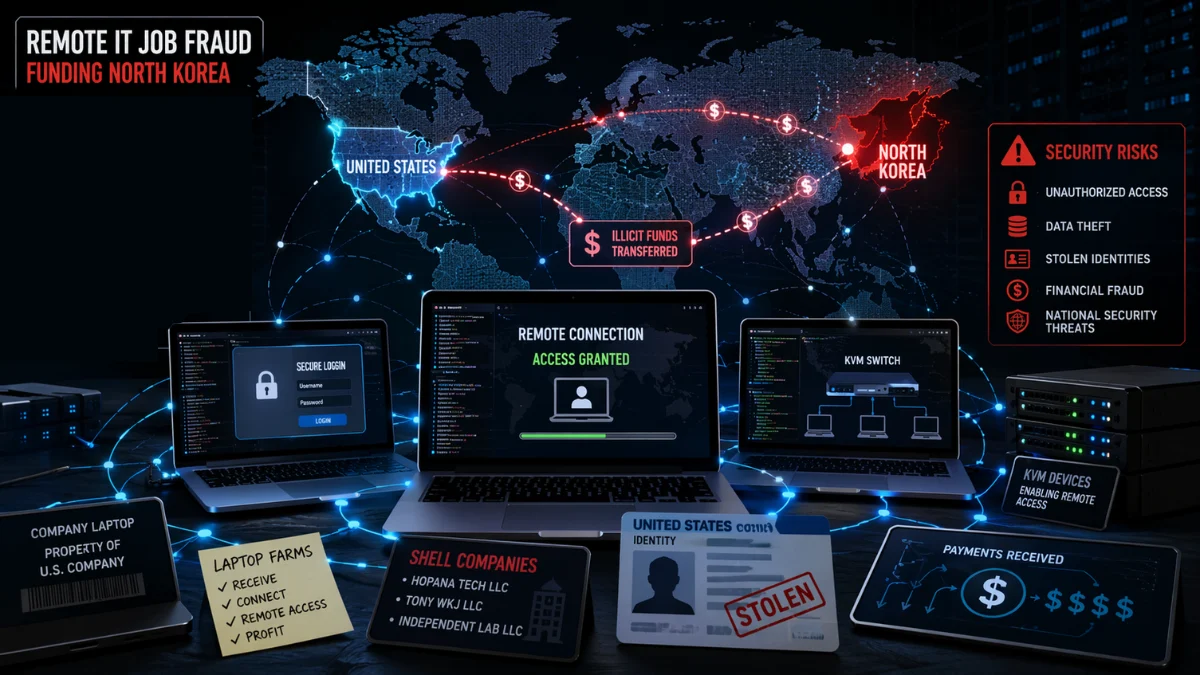
At the heart of the conspiracy was a technical workaround designed to deceive corporate security protocols. Most major U.S. employers require remote workers to use company-issued hardware and connect via secure networks that monitor geographic locations. To bypass these safeguards, the defendants established "laptop farms" within the United States.
When a North Korean worker, posing as an American citizen, successfully cleared the hiring process, the employer would ship a laptop to a U.S. address provided by the conspirators. Kejia Wang, acting as a primary manager of the domestic logistics, oversaw multiple facilitators who hosted these devices in their private residences. Zhenxing Wang was identified as one of these key facilitators, responsible for receiving, maintaining, and connecting the hardware.
The facilitators utilized Keyboard, Video, and Mouse (KVM) switches—hardware devices that allow a single set of peripherals to control multiple computers. By connecting the company-issued laptops to these switches and specialized remote-access software, the overseas workers could control the computers from abroad. To the employer’s internal IT department, the connection appeared to originate from a domestic IP address linked to the physical location of the laptop farm, effectively masking the foreign origin of the labor.
Stolen Identities and Corporate Deception
The success of the operation relied heavily on the exploitation of innocent Americans. Federal authorities confirmed that the group used the stolen identities of at least 80 U.S. citizens to facilitate the fraud. These identities—including Social Security numbers, dates of birth, and home addresses—were used to pass background checks, complete employment tax forms, and open bank accounts.
To further the illusion of legitimacy, the conspirators established a series of shell companies. These entities had no legitimate business operations or employees; their sole purpose was to act as financial conduits. When U.S. companies paid the "employees," the funds were deposited into bank accounts controlled by the shell companies. From there, the money was layered through various accounts before being transferred to overseas co-conspirators or converted into cryptocurrency to evade detection by the global financial system.
Evidence presented during the trial indicated that the scheme generated more than $5 million in total revenue. While the overseas workers and the North Korean state were the primary beneficiaries, the U.S.-based facilitators were well-compensated for their logistics support, receiving nearly $700,000 for maintaining the infrastructure that allowed the fraud to persist.
A Direct Threat to National Security
Beyond the financial fraud, the Department of Justice emphasized the profound national security implications of the case. By gaining employment at U.S. companies under false pretenses, North Korean actors obtained unauthorized access to sensitive internal systems, proprietary source code, and confidential data.
In one particularly alarming instance, the workers secured positions at a U.S. defense contractor. This allowed foreign nationals to access systems containing information subject to strict export control regulations. While the investigation did not publicly confirm the theft of classified military secrets, the potential for espionage was a central concern for federal prosecutors. The ability of a sanctioned adversary to place its agents inside the digital infrastructure of the U.S. defense industrial base represents a critical vulnerability in the era of remote work.
U.S. companies also faced direct economic harm. Combined losses are estimated to be at least $3 million, encompassing the costs of legal fees, comprehensive forensic audits, system repairs, and the significant administrative burden of responding to data breaches.
Chronology of the Investigation and Takedown
The dismantling of the laptop farm network was the result of a multi-agency effort involving the FBI, the Department of State, and various federal financial regulators.
- 2021: The conspiracy begins as North Korean IT workers scale up efforts to exploit the surge in remote hiring during the global pandemic.
- 2022–2023: The network expands across several U.S. states. Facilitators are recruited to host hardware in residential neighborhoods to avoid the suspicion associated with commercial data centers.
- Early 2024: Federal agents execute coordinated search warrants at multiple locations. They recover more than 70 laptops, KVM switches, and various remote-access devices.
- May 2024: Initial indictments are unsealed, and Kejia and Zhenxing Wang are taken into custody.
- October 2024: The sentencing phase concludes, with the court handing down prison terms that reflect the gravity of the threat to national security and the scale of the financial deception.
During the searches, authorities also seized numerous web domains used to manage the remote connections and froze several financial accounts linked to the shell companies. These actions were intended to not only punish the defendants but also to disrupt the broader infrastructure used by North Korean cyber actors.
Global Network and Fugitive Accomplices
While the sentencing of the Wangs marks a victory for U.S. law enforcement, the investigation has revealed a sprawling international network with several key figures still at large. The Department of Justice has identified several individuals connected to the scheme who are believed to be operating from outside the United States. These include:
- Xu Yongzhe
- Huang Jingbin
- Tong Yuze
- Zhou Baoyu
- Yuan Ziyou
- Zhou Zhenbang
- Liu Menting
- Liu Enchia
- Song Min Kim
The U.S. government has announced a reward of up to $5 million for information leading to the disruption of these financial networks. This reward program, managed under the "Rewards for Justice" initiative, targets the revenue streams that North Korea uses to fund its prohibited weapons of mass destruction (WMD) and ballistic missile programs.
Judicial Sentencing and Restitution
In addition to their respective prison sentences of 108 and 92 months, Kejia Wang and Zhenxing Wang were ordered to serve three years of supervised release. The court also focused on the financial recovery of illicit gains. A forfeiture order of $600,000 was issued, with authorities confirming that $400,000 has already been successfully recovered from accounts linked to the defendants. Additional restitution to the victimized companies is expected to be finalized in subsequent hearings.
Legal experts suggest that the length of the sentences serves as a deterrent to others who might be tempted to assist foreign adversaries for financial gain. The prosecution successfully argued that the defendants were not merely "low-level" helpers but essential cogs in a machine designed to undermine U.S. economic and security interests.
Broader Implications for the Remote Work Era
This case serves as a stark warning to the private sector regarding the risks of the remote-first employment model. As companies increasingly look to global talent pools, the difficulty of verifying the true identity and location of employees has become a primary vector for state-sponsored crime.
Security analysts point out that North Korea has specialized in this "shadow worker" tactic for several years. By earning high salaries from U.S. tech firms, these workers provide a steady flow of foreign currency to the Kim Jong Un regime, effectively bypassing the "maximum pressure" sanctions campaigns led by the United Nations.
To counter these threats, federal agencies recommend that companies implement more rigorous identity verification processes, including mandatory in-person video interviews, hardware-based multi-factor authentication that is resistant to remote manipulation, and more thorough background checks that cross-reference Social Security data with historical employment records.
The sentencing of Kejia and Zhenxing Wang underscores the reality that the frontline of national security has shifted. It is no longer confined to physical borders or military installations but extends to the residential homes and corporate servers that power the modern American economy. As the Department of Justice continues its pursuit of the remaining fugitives, the case remains a definitive example of the complex intersection between cybercrime, identity theft, and global geopolitics.