
When individuals embark on their investment journeys with Betterment, a cornerstone of the platform’s approach is the ability to define and meticulously plan for a multitude of financial aspirations. This personalized strategy allows users to establish distinct investment goals, each with its own specific time horizon and designated purpose. The platform prompts users to specify the anticipated timeframe for each goal and select from a predefined set of goal types, a crucial step in tailoring investment strategies. Beyond traditional investment goals, Betterment also facilitates the creation of dedicated cash reserves through its Cash Reserve offering and cryptocurrency investments via its Crypto ETF portfolio. While these specialized accounts offer unique avenues for financial growth, the core allocation advice methodology discussed herein primarily pertains to traditional investment portfolios.
The foundation of Betterment’s investment allocation strategy for all investing goals, with the notable exception of Emergency Funds, lies in the interplay between the anticipated time horizon and the chosen goal type. This information empowers Betterment to understand the user’s projected timeline for accessing the funds and their intended withdrawal strategy. For instance, a goal slated for a significant, one-time purchase will necessitate a different approach than funds earmarked for periodic withdrawals during retirement.
Emergency Funds, by their very nature, defy a predictable time horizon. While Betterment may assign a provisional timeframe to assist in initial saving and deposit guidance, this does not influence the recommended investment allocation. The inherent unpredictability of emergency expenses, both in timing and magnitude, necessitates a distinct allocation strategy. For such situations, Betterment maintains a conservative operational cash allocation within automated investment portfolios across taxable accounts, Health Savings Accounts (HSAs), and Individual Retirement Accounts (IRAs). Further details regarding these allocations are available within the specific disclosures pertaining to each portfolio.
For all other financial objectives, Betterment meticulously crafts recommended investment allocations by projecting a spectrum of potential market outcomes. The platform then averages the performance of various risk levels across the 5th to 50th percentiles of these projected scenarios. This data-driven methodology aims to identify the optimal risk-reward balance for each unique goal. In contrast, for Emergency Funds, the recommended allocation is designed to foster growth potential while simultaneously mitigating the risk of significant drawdowns that could jeopardize the essential buffer required for unexpected expenses.

Understanding Betterment’s Goal-Based Allocation Framework
Betterment categorizes investment goals into several distinct types, each influencing the recommended asset allocation. These categories, excluding Emergency Funds, are:
- Major Purchase: This category is designed for savings towards significant expenditures such as a down payment on a home, a new vehicle, or a substantial vacation.
- Education: Funds allocated for educational expenses, whether for oneself or dependents, fall under this goal type.
- Retirement: This encompasses long-term savings intended to provide financial support during one’s post-work years.
- Retirement Income: This specific goal type is for individuals who are already in retirement or nearing it and are focused on generating a steady income stream from their investments.
- General Investing: This broad category is for any investment objectives not covered by the more specific goal types, offering flexibility for a wide range of financial aims.
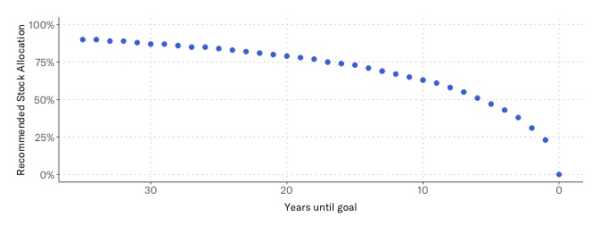
The recommended investment allocations for these goal types vary significantly based on their respective time horizons. For goals with a longer runway, such as Major Purchases or Education, where the time horizon extends to 33 years or more, Betterment may recommend an allocation as aggressive as 90% in stocks. This aggressive stance is predicated on the belief that longer timeframes allow for greater recovery from market volatility and the potential for higher long-term growth. Conversely, as the time horizon for these goals approaches zero, meaning the goal date is imminent, the recommended allocation shifts to a more conservative 0% in stocks, prioritizing capital preservation.
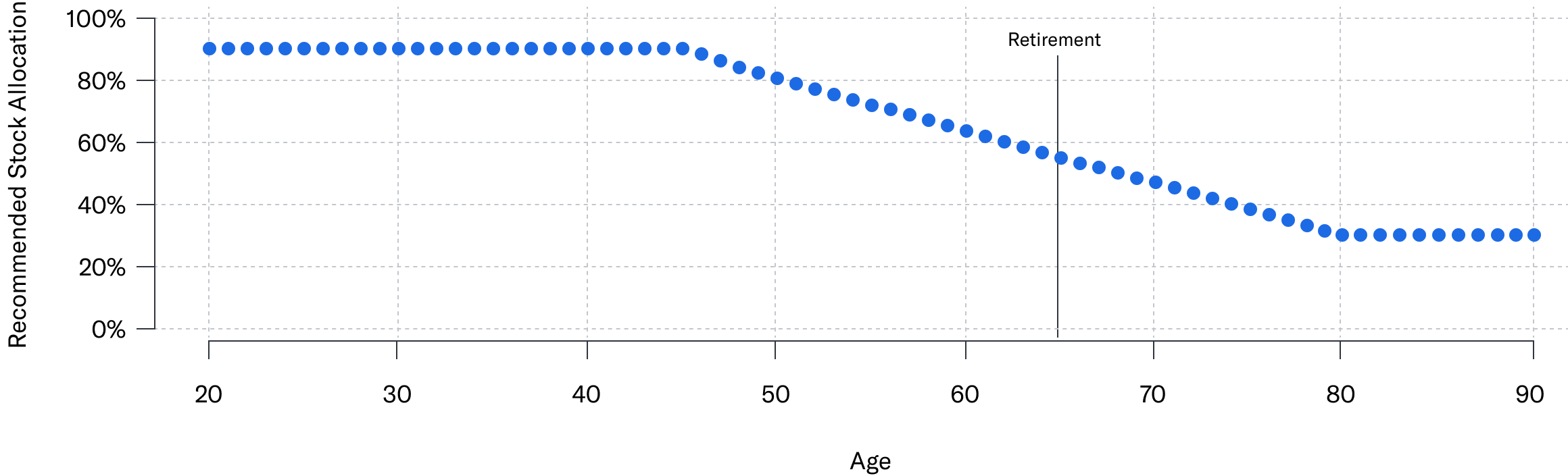
The Retirement goal type exhibits a similar principle. For individuals with 20 or more years until retirement age, an allocation of up to 90% in stocks might be advised. However, once retirement age is reached, the recommended stock allocation typically moderates to 56%. This adjustment acknowledges the shift from accumulation to distribution and the reduced capacity for risk as income needs become more immediate.
The Retirement Income goal type is particularly nuanced. For individuals with 24 or more years of remaining life expectancy, a more aggressive allocation of up to 56% in stocks can be recommended. This is because the investment portfolio is expected to sustain income generation over an extended period. As the remaining life expectancy shortens to nine years or less, the allocation becomes more conservative, with recommendations as low as 30% in stocks, to ensure a more stable income stream and reduced volatility in later years.
General Investing goals, which offer broad applicability, follow a similar trajectory. With a time horizon of 20 years or more, an allocation of up to 90% in stocks can be considered. However, upon reaching the intended time horizon for these goals, the allocation is typically adjusted to a more conservative 56% in stocks, reflecting a reduced need for aggressive growth and an increased focus on capital preservation.
The Glidepath: A Dynamic Approach to Risk Management
This dynamic adjustment of recommended allocations over time, based on the proximity to a goal’s completion, is what Betterment terms a "glidepath." Essentially, it’s a pre-defined trajectory that guides the investment portfolio from a more aggressive stance in its early stages to a more conservative posture as the target date nears. This strategy is designed to maximize growth potential during the accumulation phase while systematically reducing risk as the need for the funds becomes more immediate.
The visual representation of these glidepaths illustrates this principle clearly. For Major Purchase and Education goals, the glidepath typically shows a steady decline in stock allocation as the number of years until the goal is reached decreases. This ensures that by the time the funds are needed, the portfolio is predominantly composed of less volatile assets.
Retirement and Retirement Income goals often feature more complex glidepaths, particularly for individuals with longer life expectancies. These glidepaths may maintain a higher allocation to stocks for a longer duration, reflecting the need to sustain income generation over decades. The hypothetical example of a client retiring at age 65 and living until 90 highlights this, with the portfolio allocation adjusting to support income needs throughout their post-retirement life. It is crucial to note that such figures are illustrative and do not guarantee future performance, as actual client results can vary due to market fluctuations and individual account activity.
The glidepath for General Investing goals also demonstrates a gradual shift towards conservatism as the investment horizon shortens. This ensures that the portfolio’s risk profile aligns with the user’s evolving financial needs and proximity to accessing their funds.
Auto-Adjust: Automating the Glidepath
To further simplify the investment process and ensure adherence to these strategic glidepaths, Betterment offers an "auto-adjust" feature. This functionality automatically modifies a goal’s allocation to manage risk as the investment timeline progresses, becoming progressively more conservative as the goal date approaches. The platform implements incremental adjustments to the risk level, creating a smooth and consistent glidepath.
The auto-adjust feature is available for investing goals that have an associated time horizon, excluding Emergency Fund goals, the Target Income portfolio built with BlackRock, and the Goldman Sachs Tax-Smart Bonds portfolio. It can be applied to various portfolio types, including the Betterment Core portfolio, SRI portfolios, Innovation Technology portfolio, Value Tilt portfolio, and the Goldman Sachs Smart Beta portfolio. When users accept Betterment’s recommended allocation for applicable goals, they have the option to enable this auto-adjust feature. This sophisticated system utilizes both reactive and proactive rebalancing techniques to ensure that the portfolio’s allocation remains aligned with the recommended glidepath.
Adjusting for Individual Risk Tolerance
While Betterment’s recommended allocations and glidepaths are rooted in "risk capacity"—the ability of a goal to withstand financial setbacks based on its timeframe and liquidation strategy—clients are not bound by these recommendations. The platform empowers individuals to exercise their discretion and deviate from the suggested allocations if their personal risk tolerance differs.
To facilitate this, Betterment provides an interactive slider tool. This intuitive interface allows users to dynamically adjust the allocation between stocks and bonds, enabling them to visualize the potential range of growth outcomes associated with different risk levels. Users can toggle these allocations until they arrive at a portfolio composition that aligns with their comfort level for potential growth and volatility for each specific goal. Betterment categorizes risk tolerance into five distinct levels, offering a structured framework for users to self-assess and select their preferred investment approach.
The development of these allocation strategies is informed by extensive market research and financial modeling. For instance, studies by organizations like Vanguard have consistently demonstrated the long-term correlation between equity exposure and higher portfolio returns, particularly over extended periods. However, these same studies also highlight the increased volatility associated with higher stock allocations. Betterment’s methodology seeks to balance these competing factors, aiming to capture a significant portion of the market’s upside potential while implementing a systematic risk reduction strategy as goals draw nearer.
The implications of these personalized allocation strategies are far-reaching. By providing a structured yet flexible framework, Betterment aims to demystify investment planning and empower individuals to make informed decisions aligned with their unique financial circumstances and aspirations. The platform’s commitment to a data-driven approach, coupled with user-centric tools, positions it as a significant player in the evolving landscape of digital wealth management. As market conditions continue to evolve, the ability to dynamically adjust investment strategies based on individual goals and risk tolerance will remain a critical factor in achieving long-term financial success.