
Twetch, the pioneering BSV-based social network that initially garnered a dedicated following for its innovative on-chain posting and micropayment economic model, has triumphantly announced its return after a two-year shutdown. This unexpected resurgence, with all memes and tokens reportedly intact, marks a rare second chance for a social platform in a digital landscape where most defunct services fade into obscurity. The platform, which cultivated a distinct cult following from its inception in 2019 until its closure in June 2024, is currently operating in an invite-only beta phase, inviting previous users to reclaim their digital history and assets.
The Genesis of an On-Chain Experiment (2019-2024)
Twetch emerged in 2019, positioning itself as a radical alternative to mainstream social media giants like X (formerly Twitter). While its user interface bore a striking resemblance to its centralized counterpart, Twetch’s foundational architecture was entirely different. It was built atop the BSV blockchain, a fork of Bitcoin designed for massive scalability and low transaction fees. The core innovation lay in its economic model: every interaction—be it a post, a follow, a like, or a reply—was recorded as a transaction on the blockchain. Users engaged with the platform by making minute micropayments, often fractions of a cent, for these actions. In turn, a portion of these payments was directed to the content creators and users they engaged with, fostering a direct, peer-to-peer value exchange. This model was a direct challenge to the prevailing advertising and data-harvesting paradigms that dominate the internet, aiming to create a self-sustaining ecosystem where users were both consumers and direct economic participants.
During its initial run, Twetch attracted over 100,000 registered users, a respectable figure for a niche blockchain project. This community, though modest by mainstream social media standards, was highly engaged, developing a unique culture characterized by inside jokes, token trading, ironic trolling, and a self-deprecating "degenerate gambler" humor. Co-founders Billy Rose (known as "nondualrandy" on the platform) and Josh Petty ("coinyeezy"), alongside contributors like rodsirloin, were recognized for their acute understanding of internet culture and meme dynamics, which helped Twetch punch above its weight in terms of attention and cultural impact within the crypto space. The platform’s distinct numbered user accounts became a coveted status symbol, with lower numbers often traded or auctioned, underscoring the community’s perception of identity as both social status and a tangible asset.
The Inevitable Shutdown and the Promise of Permanence (June 2024)
Despite its innovative approach and cultural resonance, Twetch faced formidable challenges. In June 2024, co-founder Billy Rose announced the platform’s shutdown. The primary reason cited was the failure to achieve sufficient scale for the micropayment fee structure to sustain the business operations. While the concept of direct monetization for user interactions was compelling, the friction of paying for every action, however small, proved to be a significant barrier to widespread adoption, especially when mainstream alternatives offered similar services for "free" (subsidized by advertising and data monetization).
Rose also acknowledged technical liabilities, including Twetch’s proprietary NFT system and a "bloated databases and APIs" infrastructure, which likely contributed to operational inefficiencies and development hurdles. The company, despite its respectable user base, could not compete with the vast network effects of dominant short-form social networks.
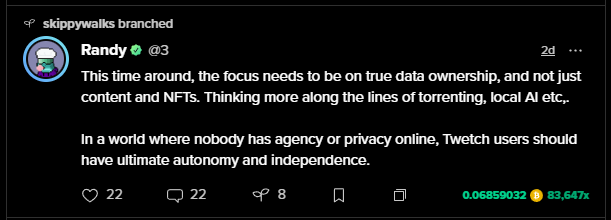
However, Twetch’s closure served as an inadvertent, yet powerful, demonstration of the inherent resilience of blockchain technology. Unlike centralized platforms where user data is controlled by the company and often disappears with its demise, Twetch’s content was permanently recorded on the public BSV ledger. This on-chain permanence meant that even when the platform’s front-end went dark, the underlying data—every post, like, and interaction—remained accessible. This concept was vividly illustrated when Treechat, another BSV-based social application, successfully resurrected the entire Twetch post archive. Leveraging the Bitcoin Schema protocol and JungleBus, Treechat transformed this historical record into a searchable stream, proving that data written to a public ledger can outlive the platforms that create it. This event underscored a critical lesson for the digital age: platforms may be ephemeral, but on-chain data can be eternal, fostering true data ownership and censorship resistance.

The Phoenix Rises: Details of the Relaunch (Current)
After two years, Twetch has returned from the brink, entering an invite-only beta mode. This "second act" allows previous users to recover their old usernames, wallets, and even digital assets, including NFTs. The development team is actively working to restore the full on-chain archive, signaling a commitment to continuity for its loyal community.
Early testers of the beta version report that core functionalities such as the built-in wallet, direct messages, groups, and the NFT marketplace are operational. However, the team has been transparent about the ongoing restoration efforts, acknowledging that "lots of things [are] still missing." In a July 9 post on X, the Twetch account stated its focus on "making sure everything is indexed for all our users," indicating the complexity of reassembling a platform built on a vast blockchain archive.
A crucial aspect of the relaunch involves the platform’s digital assets. Twetch’s built-in wallet remains central to the user experience, complemented by support for external BSV wallets like HandCash. The NFT marketplace is also a key feature of the revived platform. Interestingly, there are indications that the asset format may be shifting from Twetch’s earlier proprietary Sigil protocol-based collectibles towards a newer, more open standard, possibly 1Sat Ordinals. This potential move aligns with a broader trend in the blockchain space towards greater interoperability and open protocols, which could enhance the long-term viability and portability of user assets.
The return also brings back one of Twetch’s most distinctive cultural artifacts: the numbered user accounts. The prestige associated with lower account numbers, which often commanded value in trades and auctions, signaled to the community that the unique social economy and identity structure that defined original Twetch were being carefully reassembled.
Navigating a Crowded Landscape: Challenges and Competition
The task of launching, or in this case, relaunching, a social network in 2026 is inherently arduous. The challenge is magnified within the niche BSV ecosystem. Twetch must contend not only with global behemoths like X, but also with a growing array of BSV-based alternatives. Competitors such as Treechat (which played a pivotal role in preserving Twetch’s archive), my2cents.io, and BsvBsv.com are already vying for the attention of the limited addressable audience within the BSV community.
Adding to this competitive landscape is the recently launched Zanaadu platform. Zanaadu, while also rooted in the BSV ecosystem, adopts a different technical philosophy, emphasizing open-source overlays, BRC100 wallet compatibility, covenant-enforced identity numbers, and even timelocked posts. This contrasts with Twetch’s strategy of leveraging its established interface and existing community rather than pursuing a radical architectural redesign. The proliferation of these platforms within a relatively small ecosystem underscores the fervent belief in the potential of on-chain social media, but also highlights the intense competition for user attention and developer resources.
The fundamental hurdle for any social network is achieving critical mass and robust network effects. Users gravitate towards platforms where their friends and communities already reside. Twetch’s original closure was partly due to its inability to convert cultural momentum into a self-sustaining business model at scale. The platform’s unique model, which charges users for every interaction, faces the perennial challenge of justifying these micro-costs when numerous alternatives offer a "free" (albeit ad-supported) experience. Persuading users to pay, even infinitesimally small amounts, requires delivering an exceptionally high value proposition that transcends the perceived "cost."

The BSV Ecosystem and the Promise of On-Chain Permanence
Twetch’s journey is inextricably linked to the capabilities of the BSV blockchain. BSV, with its focus on massive scaling and ultra-low transaction fees, provides the foundational infrastructure for micro-transactions and immutable data storage. The ability of projects like Treechat to resurrect Twetch’s entire post archive using protocols like Bitcoin Schema and tools like JungleBus is a testament to the power of open, public ledgers. This demonstrates that content written to a blockchain is not beholden to the longevity of a specific platform or company. It remains accessible and recoverable, fostering a new paradigm of data ownership and digital history.
This concept of on-chain permanence offers a compelling counter-narrative to the fragility of digital content hosted on centralized servers. In an era where platforms frequently alter terms of service, censor content, or simply disappear, the idea that one’s digital footprint can be immutable and independently verifiable holds significant appeal, particularly for those concerned about censorship resistance and data sovereignty.
Rethinking the Business Model: Micropayments and Value Exchange
The return of Twetch reignites the debate surrounding alternative monetization models for social media. Its micropayment-based economy represents a stark departure from the advertising-driven models of mainstream platforms. The advantages are clear: direct compensation for creators, elimination of intrusive ads, and a potential reduction in data harvesting. However, the economic challenges remain. User adoption of paid interactions, even small ones, is a significant barrier. Psychologically, users have become accustomed to "free" online services, making the transition to a pay-per-interaction model difficult, regardless of how beneficial it might be for content creators or data privacy.
For Twetch to succeed this time, it must demonstrate that the value derived from its unique economic model—such as direct creator support, enhanced community engagement, and data ownership—outweighs the friction of micropayments. This might involve refining the payment experience, introducing more compelling incentives for engagement, or even exploring hybrid models that balance paid interactions with other value-added services. The "honest math" suggests that the market for such a model is still relatively small, necessitating a focused approach rather than a broad appeal.
Statements and Community Reaction (Inferred)
While official statements from the Twetch team regarding their refined strategic vision for this second act have been limited to operational updates, the very act of relaunching speaks volumes. Co-founder Billy Rose’s previous candid assessment of the initial shutdown indicates a team keenly aware of the hurdles. Their current efforts to meticulously restore user data and assets reflect a deep respect for their original community.
The reaction from the BSV community has been a mix of excitement and cautious optimism. Long-time users, who cherished the platform’s unique culture and economic model, are undoubtedly thrilled at the prospect of reclaiming their digital identities and reconnecting. However, there’s also an understanding that the underlying challenges of scaling and user adoption persist. Industry observers suggest that Twetch’s success will hinge on its ability to leverage its existing cultural capital and technical improvements to create a demonstrably superior user experience that justifies its distinct economic model. The transparency around missing features and ongoing restoration efforts is likely to be appreciated by a community that values the open nature of blockchain.
The Path Forward: Deepening the Niche vs. Broadening Appeal
The most compelling argument for Twetch’s continued existence is not its potential to directly rival X, but its capacity to serve as a fertile ground for social media models that larger, centralized platforms are structurally incapable of replicating. Features such as monetized engagement, on-chain permanence, censorship-resistant archives, and portable identities are inherent strengths when built on a scalable, low-fee blockchain like BSV. Twetch proved these concepts could work in practice.
However, for this second iteration to thrive, a pragmatic approach is critical. The market for BSV-based social networks remains niche. Therefore, Twetch’s strategy will likely need to focus on deepening its existing niche rather than attempting to broaden its appeal as a generic X alternative. This means leaning even harder into the distinctive culture that defined its initial success—the memes, the token trading, the unique humor, and the direct creator-to-consumer economic alignment. By catering specifically to creators and traders who value these distinct incentives, Twetch could cultivate a self-sustaining ecosystem where economic and social motivations converge.
The platform’s return is a powerful reminder of the resilience enabled by BSV’s open protocols. Even if the platform itself faces future operational challenges, its content, by virtue of being on-chain, would remain accessible. The ultimate question facing Twetch now is whether its community and revamped business model can match the inherent durability of its blockchain-recorded data.
Currently, Twetch is alive again, undergoing private testing and rebuilding. This second chance is a privilege few social networks ever receive after a shutdown. The narrative of whether it can transform this rare opportunity into a lasting success is a story that continues to unfold, with every new interaction being indelibly recorded on the blockchain.
Watch: BSV Standards & Developer Empowerment at AWS Summit
The broader context for Twetch’s relaunch and the resilience of BSV-based applications is further illuminated by ongoing efforts within the BSV ecosystem to foster developer empowerment and establish robust standards. Events like the "BSV Standards & Developer Empowerment at AWS Summit" highlight the foundational work being done to create an environment where innovative projects like Twetch can build, scale, and integrate effectively. Such initiatives are crucial for providing the tools, infrastructure, and community support necessary for blockchain social networks to not only survive but potentially thrive by leveraging the unique capabilities of the BSV blockchain.