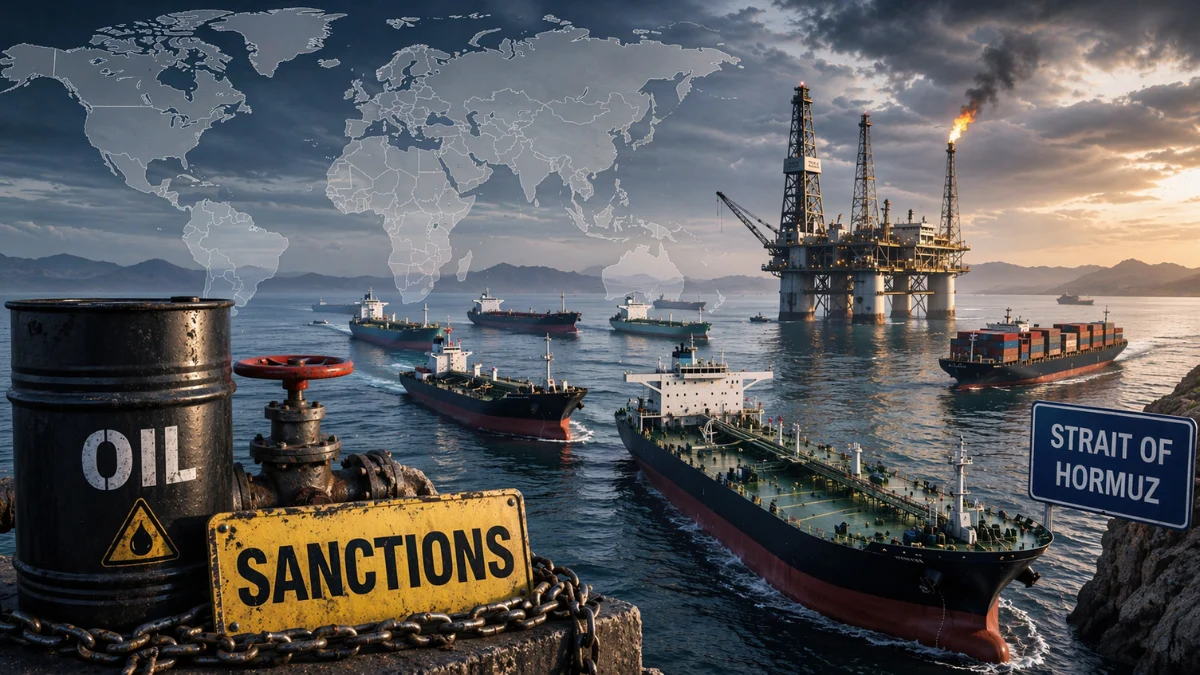
The United States government has significantly intensified its economic and military posture against the Islamic Republic of Iran, announcing a comprehensive suite of stricter sanctions targeting the nation’s vital petroleum industry. This aggressive policy shift follows Iran’s decision to maintain a blockade of the Strait of Hormuz, a move that has sent shockwaves through global energy markets and heightened fears of a broader regional conflagration. By targeting the financial arteries of the Iranian state and implementing a physical naval blockade around key ports, Washington aims to sever the revenue streams that fund Tehran’s regional influence and military operations. These measures represent a pivot toward a "maximum pressure" strategy 2.0, reflecting a growing consensus in Washington that economic diplomacy must be bolstered by direct maritime interdiction to address the ongoing volatility in the Middle East.
The centerpiece of this latest escalation is the systematic dismantling of the "shadow fleet" and the clandestine financial networks that have allowed Iran to circumvent previous international restrictions. US Treasury Secretary Scott Bessent confirmed that the new measures are specifically designed to dismantle elite networks that have profited from the illicit trade of Iranian crude. The sanctions are not merely a continuation of existing policy but a significant expansion, targeting more than two dozen individuals, corporate entities, and vessels identified as integral to Iran’s oil export infrastructure.
Dismantling the Shamkhani Oil Network and Shipping Operations
Central to the new sanctions is a sophisticated logistics and financial network allegedly managed by Mohammad Hossein Shamkhani, a prominent figure in the international oil shipping industry. According to US intelligence and Treasury officials, this network has been instrumental in moving hundreds of thousands of barrels of Iranian oil to international markets, often using deceptive practices to mask the origin of the cargo. The network is reportedly linked to the inner circles of Iranian power, specifically Ali Shamkhani, a senior security advisor to Supreme Leader Ali Khamenei and a former Secretary of the Supreme National Security Council.
The Shamkhani network operates as a multi-jurisdictional enterprise, with significant nodes located in the United Arab Emirates (UAE) and Iran. The Treasury Department identified several front companies that presented themselves as legitimate consulting firms and maritime shipping agencies. In reality, these entities served as conduits for money laundering and the coordination of ship-to-ship transfers in international waters. By frequently changing vessel names, disabling Automatic Identification Systems (AIS), and falsifying shipping documents, the network managed to maintain a steady flow of revenue to Tehran despite years of existing sanctions.
The aggressive nature of these new measures is highlighted by the inclusion of Seyed Naiemaei Badroddin Moosavi, a high-level financier accused of managing the complex financial architecture behind the oil trade. Moosavi is allegedly linked to militant organizations and has been instrumental in a "gold-for-oil" scheme. In this arrangement, Iranian petroleum was exchanged for physical gold bullion from third-party nations, a tactic designed to bypass the SWIFT banking system and the US dollar-dominated global financial market. This barter system, while inefficient, provided the Iranian government with a critical "black budget" to sustain its strategic objectives during the conflict.
The Strategic Importance and Closure of the Strait of Hormuz
The current crisis reached a breaking point when Iran effectively closed the Strait of Hormuz, the world’s most sensitive oil chokepoint. Located between the Persian Gulf and the Gulf of Oman, the Strait is a narrow waterway through which approximately 20% of the world’s total petroleum consumption passes daily. According to the US Energy Information Administration (EIA), roughly 21 million barrels of oil per day flow through this 21-mile-wide passage. It is the only sea route from the Persian Gulf to the open ocean, making it the lifeline for the economies of Saudi Arabia, Kuwait, the UAE, Iraq, and Qatar.
Iran’s decision to block the route is viewed by the international community as a direct retaliatory strike against US military actions and support for regional allies. By weaponizing its geography, Tehran has successfully injected a massive risk premium into global oil prices. In the days following the closure, Brent Crude and West Texas Intermediate (WTI) benchmarks saw sharp increases, sparking concerns about inflationary pressure in energy-dependent nations.
Washington has characterized the closure as an act of international economic sabotage. "The closure of the Strait of Hormuz is an attempt to hold the global economy hostage," a State Department spokesperson noted during a recent briefing. The US maintains that the freedom of navigation in international waters is a non-negotiable principle, and the Iranian move has necessitated a shift from purely economic sanctions to a combined approach involving maritime security operations.
Implementation of a Naval Blockade and Port Restrictions
In a significant departure from standard sanctions enforcement, the United States has reportedly initiated a naval blockade around several key Iranian ports. This military measure involves the deployment of carrier strike groups and littoral combat ships to monitor and restrict the movement of vessels entering or exiting Iranian waters. While traditional sanctions rely on financial penalties and blacklisting, a blockade represents a physical intervention to prevent the loading of oil and the offloading of essential supplies.
The blockade is designed to complement the Treasury Department’s financial "chokehold." By physically preventing tankers from docking at terminals such as Kharg Island—which handles the vast majority of Iran’s oil exports—the US aims to reduce Iran’s export capacity to near-zero. This escalation signals a high-stakes gamble by the US administration, as naval blockades are often interpreted under international law as an act of war, potentially leading to direct kinetic confrontations between the US Navy and the Islamic Revolutionary Guard Corps (IRGC) Navy.
Furthermore, the US has officially terminated a temporary waiver that previously allowed for the sale of Iranian oil already at sea. This "oil-at-sea" waiver had been a pragmatic tool used to prevent sudden supply shocks and keep global fuel prices stable. However, with the Strait of Hormuz closed and tensions at an all-time high, the US has prioritized the total elimination of Iranian revenue over short-term market stability. The expiration of this waiver means that any vessel currently carrying Iranian crude is subject to seizure and its owners to severe legal repercussions.
Chronology of the Conflict and Escalation
The current state of affairs is the result of a rapidly deteriorating security environment over the past several months. To understand the gravity of the new sanctions, a timeline of recent events is essential:
- Initial Outbreak: Following a series of regional skirmishes, the US increased its military presence in the Eastern Mediterranean and the Persian Gulf.
- Threats to the Strait: In response to heightened US presence, Iranian officials began issuing warnings that the Strait of Hormuz could be rendered "impassable" for Western-aligned nations.
- The Closure: Approximately two weeks ago, Iran conducted naval drills that transitioned into a semi-permanent closure of the main shipping lanes in the Strait, citing "security concerns" and "foreign interference."
- The India Shipment Anomaly: Shortly before the current crackdown, India reportedly received its first shipment of Iranian oil in seven years under a limited and brief sanctions relief window. This event now appears to be an outlier as the US has moved to close all remaining loopholes.
- The New Sanctions Rollout: The Treasury Department, led by Secretary Bessent, announced the targeting of the Shamkhani network and the Moosavi financial group, marking the start of the current "maximum pressure" phase.
- Naval Blockade Commencement: Within the last 48 hours, reports from maritime tracking services and regional defense analysts confirmed that US and allied naval assets have begun interdicting traffic near Iranian terminals.
Global Economic Data and Market Reactions
The data regarding the impact of these developments is stark. Market analysts at major financial institutions have warned that a prolonged closure of the Strait of Hormuz, combined with a total blockade of Iranian exports, could see oil prices surge toward $120 or even $150 per barrel.
- Price Volatility: Since the announcement of the blockade, oil futures have seen a 15% increase, reflecting the market’s fear of a sustained supply deficit.
- Trade Disruption: Over 30% of global liquefied natural gas (LNG) trade also passes through the Strait. Countries like Japan and South Korea, which rely heavily on Middle Eastern LNG, are facing an energy security crisis.
- The China Factor: China remains the largest buyer of Iranian "shadow" oil. The US has signaled that it may impose a 50% tariff risk on Chinese goods if Beijing continues to facilitate Iranian arms transfers or continues to purchase sanctioned oil through the Shamkhani network. This adds a layer of trade war complexity to the existing geopolitical conflict.
Official Responses and Diplomatic Outlook
The international community remains deeply divided over the US strategy. While European allies have expressed support for the principle of free navigation, there is palpable concern regarding the potential for a global recession triggered by high energy costs.
In Tehran, the government has remained defiant. A spokesperson for the Iranian Foreign Ministry described the sanctions and the naval blockade as "illegal acts of piracy" and "economic terrorism." Iran has signaled that it will not reopen the Strait of Hormuz until US military forces are withdrawn from the region and the sanctions are lifted.
In Washington, the sentiment is one of resolve. Treasury Secretary Scott Bessent emphasized that the US will continue to target the "economic elite" of Iran who benefit from the conflict while the general population suffers the consequences of the government’s foreign policy. "We are targeting the facilitators, the financiers, and the shippers who think they can hide behind shell companies in the UAE or elsewhere," Bessent stated.
Broader Implications and Fact-Based Analysis
The current situation represents a fundamental shift in how the United States utilizes its economic and military power. By blending Treasury-led financial warfare with Navy-led maritime interdiction, Washington is attempting to create a "total enclosure" of the Iranian economy.
The implications of this strategy are three-fold. First, it risks a significant spike in global inflation, which could destabilize developing economies that are sensitive to fuel and food price increases. Second, it pushes Iran closer to other sanctioned powers, such as Russia, potentially creating a "bloc of the sanctioned" that seeks to build an alternative global financial infrastructure. Third, the naval blockade sets a precedent for how the US might handle future maritime disputes in other parts of the world, such as the South China Sea.
As the conflict continues, the world’s attention remains fixed on the narrow waters of the Strait of Hormuz. The success or failure of the US’s stricter sanctions and naval blockade will not only determine the future of Iran’s economy but will also redefine the boundaries of international trade and maritime security in the 21st century. For now, the global energy market remains on a knife-edge, waiting to see if diplomacy can find a path forward or if the "maximum pressure" will lead to a maximum confrontation.