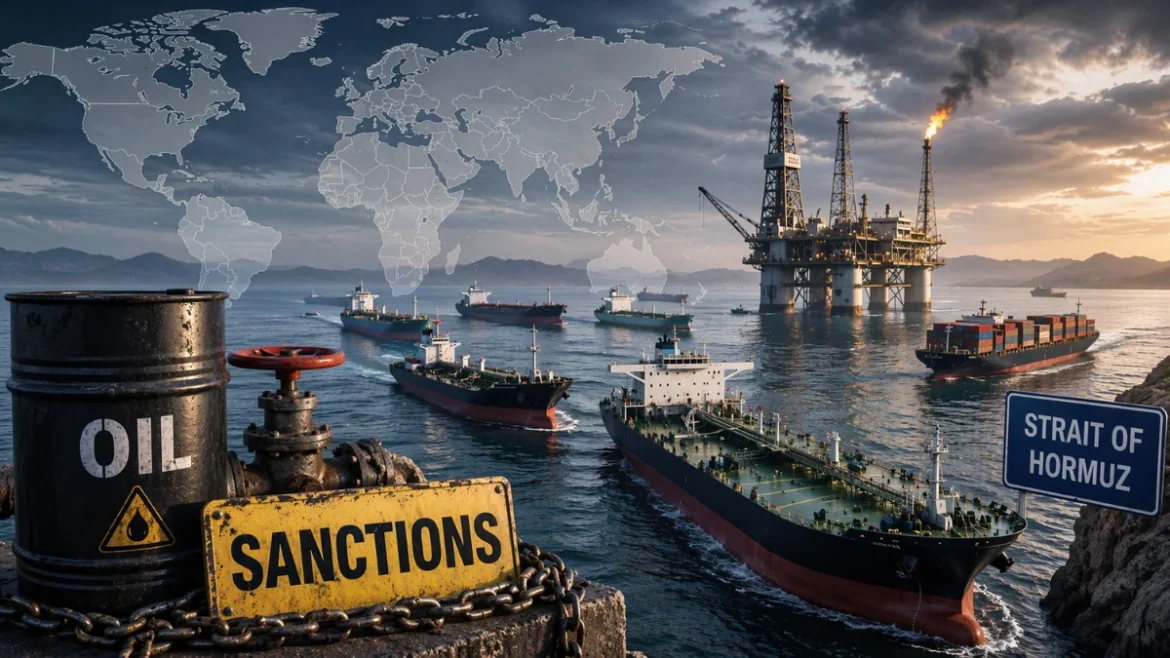
Polymarket traders have significantly adjusted their outlook on the "Strait of Hormuz traffic returns to normal by December 31?" contract, pushing its probability for a ‘Yes’ outcome down to 51.5% (with ‘No’ at 48.5%). This dramatic shift, observed across a substantial $5,749,184 in matched volume, signals a collective reassessment from a prior position of high confidence in normalization to a state of near coin-flip uncertainty. The repricing follows a wave of fresh escalation headlines emanating from the Gulf region, underscoring the acute sensitivity of global markets and public sentiment to geopolitical developments in this critical maritime chokepoint.
The Geopolitical Crucible: Understanding the Strait of Hormuz
The Strait of Hormuz is not merely a body of water; it is arguably the world’s most vital energy artery, a narrow passage connecting the Persian Gulf with the Arabian Sea and the open ocean. Geographically, it is a maritime chokepoint, only 21 nautical miles (39 kilometers) wide at its narrowest point, yet through it passes approximately one-fifth of the world’s total petroleum consumption and a significant portion of global liquefied natural gas (LNG) shipments. This translates to an estimated 21 million barrels of oil per day, making any disruption here a direct threat to global energy security and economic stability. Iran, with its southern coast bordering the Strait, holds a strategic position that has historically been a source of both leverage and tension. The country has repeatedly threatened to close the Strait in response to international pressure or sanctions, a threat that resonates deeply given the catastrophic potential impact on global oil prices and supply chains.
The strategic importance of the Strait is further magnified by its history of regional conflicts and geopolitical rivalries. Since the 1980s, the area has witnessed numerous incidents, including attacks on tankers during the Iran-Iraq War, confrontations between Iranian and Western naval forces, and more recently, a series of alleged attacks on commercial vessels and oil infrastructure. These events consistently highlight the fragility of peace and the constant underlying risk of escalation in a region already fraught with complex political dynamics.
A Chronology of Rising Tensions and Disruptions
The current state of heightened alert, reflected in the Polymarket contract, is the culmination of a weeks-long confrontation that has seen a disturbing pattern of attacks and counterattacks across the Gulf. The article notes that the Strait of Hormuz has been "effectively shut since late February," a phrase that, while not implying a complete physical blockage, certainly indicates severe disruptions, increased risk premiums, and a significant reduction in the normal flow of commercial traffic. This initial period of disruption likely involved a series of unreported or attributed incidents that led shipping companies to exercise extreme caution, thus hindering normal operations.
Subsequent developments have only exacerbated the situation. Reports have emerged detailing a new wave of retaliatory attacks, notably including a claimed hit on a telecommunications tower in Kuwait. While specific attribution for this incident remains contested, such events contribute to a climate of fear and uncertainty, often leading to a wider perception of a volatile operational environment. Furthermore, the persistent threat posed by Houthi rebels in Yemen, who have launched numerous attacks on Saudi tankers and infrastructure in the Red Sea, adds another layer of complexity. Although geographically distinct from the Strait of Hormuz, these Red Sea incidents are part of a broader regional proxy conflict that directly impacts maritime security and demonstrates the interconnectedness of various flashpoints in the Middle East.
The most recent and perhaps most impactful development, as highlighted in the article, is a report indicating that then-President Donald Trump warned of potentially launching the "largest strikes on Iran yet." Such a statement, whether a deliberate leak or a diplomatic signal, immediately elevates the perceived risk of direct military confrontation between the United States and Iran. Coming amidst a backdrop of ongoing skirmishes, this warning served as a potent catalyst for the market’s dramatic repricing on Polymarket, shifting the collective sentiment from a hopeful expectation of normalization to a stark recognition of imminent danger. The prospect of such strikes would undoubtedly plunge the region into a deeper crisis, rendering any return to "normal" traffic in the Strait of Hormuz highly improbable in the near term.
Polymarket’s Pulse: From Confidence to Uncertainty
The "Strait of Hormuz traffic returns to normal by December 31?" contract on Polymarket serves as a real-time barometer of collective sentiment regarding geopolitical stability. Polymarket is a decentralized prediction market platform where users bet on the outcome of future events, effectively crowdsourcing predictions by allowing participants to buy and sell shares corresponding to different outcomes. The price of these shares reflects the market’s perceived probability of an event occurring, often demonstrating a surprising accuracy that can rival or even surpass traditional polling or expert analysis, particularly in dynamic situations.
The contract’s precipitous 34 percentage point drop from an 85.5% ‘Yes’ probability to the current 51.5% ‘Yes’ underscores a profound shift in market confidence. This is not a marginal adjustment but a wholesale repricing, indicating a complete reset from "high confidence" to "high uncertainty." The near 50/50 split (51.5% Yes vs 48.5% No) signifies a market that has lost its clear directional bias, with traders now willing to take both sides rather than converge on a single narrative. This equilibrium, achieved on a substantial matched volume of $5.75 million, suggests that a significant number of participants are actively betting against normalization by year-end, reflecting a deep-seated concern about the trajectory of regional tensions. The binary nature of the contract simplifies the outcome: either traffic is judged "back to normal" by the December 31 resolution date, or it is not. The current pricing suggests that while a slight edge remains for normalization, the market is overwhelmingly acknowledging the severe risks that could prevent it.
The historical summary of the contract, flagging "moderate volatility with reversal_detected=true and a bearish trend," further supports the narrative of a market reacting sharply to news catalysts. Even though the 24-hour and 7-day changes might appear modest (-2.0 percentage points each), the broader tape demonstrates a market highly prone to rapid swings, with the 34pp drop being the most significant indicator of this sensitivity. This makes the contract a valuable tool for observing how global events are immediately absorbed and interpreted by a diverse group of participants, reflecting a nuanced understanding of risk that traditional news headlines might only partially convey.
Economic Repercussions: Oil Prices and Global Shipping
The geopolitical instability in the Strait of Hormuz has direct and severe economic repercussions, primarily impacting global energy markets and the shipping industry. The initial disruption in "late February" and subsequent escalations have already led to significant spikes in oil prices. Benchmark crude oil futures, such as Brent crude and West Texas Intermediate (WTI), typically react instantly to any perceived threat to supply from the Middle East. A major disruption in the Strait could easily send prices soaring, potentially pushing Brent crude well above $100 per barrel, triggering inflationary pressures across the global economy. This sudden increase in energy costs impacts everything from transportation and manufacturing to consumer goods, creating a ripple effect that can slow economic growth and reduce purchasing power.
Beyond the immediate price shock, the increased risk perception translates directly into higher operational costs for shipping companies. Insurers typically classify the Strait of Hormuz as a "war risk" zone, leading to substantial increases in war risk premiums for vessels transiting the area. These additional costs are inevitably passed on to consumers, further contributing to inflation. Moreover, some shipping lines might opt for longer, more expensive alternative routes, if available, to avoid the perceived danger, adding days or weeks to transit times and further disrupting global supply chains. The cumulative effect of higher oil prices, increased insurance costs, and potential shipping delays creates a formidable challenge for businesses reliant on global trade and for governments trying to manage economic stability. For major oil and gas importing nations, such as those in Asia and Europe, the vulnerability of the Strait of Hormuz underscores deep-seated energy security concerns and prompts consideration of strategic petroleum reserves and diversification of energy sources.
Wider Prediction Market Landscape
Polymarket’s value extends beyond individual contracts; it allows traders to triangulate positioning by observing related contracts that collectively paint a broader picture of geopolitical risk. The adjacent contract, "Strait of Hormuz traffic returns to normal by July 31?", is priced at an overwhelming 98.95% ‘No’ on a massive $19,946,401 volume. This indicates near-unanimous market consensus that normalization by mid-year is virtually impossible, reinforcing the severity and expected duration of the current disruptions. The stark contrast between the July and December contracts highlights that while short-term recovery is dismissed, a sliver of hope (or at least uncertainty) remains for a longer-term resolution by year-end.
Other contracts provide further insights into market expectations regarding the broader regional conflict. "Will the U.S. invade Iran before 2027?" sits at 70.5% ‘No’ with $46,459,882 matched. While a majority believes an invasion is unlikely, a 29.5% ‘Yes’ probability is remarkably high for such a drastic event, reflecting persistent concerns about military confrontation. For political continuity signals, "Iran leader end of 2026?" shows 72.15% ‘Yes’ on $34,181,422, suggesting the market largely expects the current Iranian leadership to remain in power, indicating a degree of perceived internal stability despite external pressures. Finally, the air-travel angle is reflected in "Iran full airspace closure by…?" at 60.5%, indicating a significant probability of airspace restrictions, a common consequence of heightened military tensions in the region that would further impact international travel and logistics. Collectively, these contracts illustrate a market grappling with complex interdependencies, where military escalation, political stability, and operational disruptions are all priced into various probabilities.
Official Responses and International Commentary
In times of heightened tension, official statements and international reactions play a crucial role in shaping perceptions and influencing the trajectory of events. Following reports of potential "largest strikes on Iran yet," the United States administration, particularly under President Trump, would have likely emphasized its commitment to protecting freedom of navigation, deterring aggression, and safeguarding its allies in the region. Such warnings often serve a dual purpose: to signal resolve and potentially deter further attacks, while also preparing domestic and international audiences for possible military action. The US typically maintains a robust military presence in the Gulf, underscoring its capacity to respond.
Iran, on its part, would invariably condemn any threats of military action as a violation of its sovereignty and a provocation. Iranian officials would likely reiterate their nation’s right to defend itself and issue warnings against foreign intervention, emphasizing their strategic capabilities, including naval assets and missile systems, to respond to any aggression. They might also deny responsibility for specific attacks, attributing them to regional actors or external forces seeking to destabilize the region.
Regional allies like Kuwait and Saudi Arabia, directly impacted by the attacks and geopolitical instability, would likely issue strong condemnations of the violence and call for international intervention to restore stability. They would emphasize their security concerns and potentially seek assurances of protection from their international partners.
The international community, including the United Nations and various diplomatic bodies, would undoubtedly call for de-escalation, restraint from all parties, and a commitment to diplomatic solutions. Concerns would be voiced regarding the potential for wider regional conflict, its humanitarian consequences, and the severe impact on global economic stability. Major trading partners reliant on Middle Eastern oil would likely urge for immediate steps to ensure the safety of maritime traffic through the Strait of Hormuz.
Looking Ahead: Pathways and Perils
The immediate future for the Strait of Hormuz remains clouded by profound uncertainty. The Polymarket contract’s near 50/50 split perfectly encapsulates this predicament. Traders are now watching whether the contract can reclaim a clear directional bias: a sustained move back above the mid-50s ‘Yes’ probability would imply renewed confidence in normalization by year-end, perhaps driven by successful de-escalation efforts or a significant diplomatic breakthrough. Conversely, slipping below 50% would firmly establish ‘No’ as the market’s base case, signaling a collective belief that the disruptions and tensions are likely to persist beyond the December 31 resolution window.
Several pathways lie ahead, each fraught with its own perils. A pathway to de-escalation would necessitate sustained diplomatic engagement, a halt to retaliatory attacks, and possibly renewed international efforts to mediate between the key players. This could involve direct talks between the US and Iran, or indirect negotiations facilitated by European or regional powers. Another scenario involves a sustained period of low-level conflict and heightened vigilance, where traffic continues but under significant risk and increased operational costs. The most dangerous pathway is that of full-scale military confrontation, which would have catastrophic consequences for the region and the global economy.
The continued relevance of prediction markets like Polymarket in these volatile times cannot be overstated. They offer a unique, real-time aggregation of diverse perspectives and information, providing a dynamic indicator of collective sentiment that complements traditional analysis. As events unfold, the shifting probabilities on these contracts will continue to offer a compelling insight into how the world perceives the risks and prospects for peace in one of its most critical geopolitical hotspots. The current pricing in the "Strait of Hormuz traffic returns to normal by December 31?" contract is a stark reminder that the world is holding its breath, awaiting clarity on the future of this indispensable maritime artery.