The intersection of traditional fintech brokerage services and blockchain-based financial infrastructure deepened significantly following a major joint announcement by Ripple and Robinhood. The two fintech giants have officially agreed to expand their collaborative framework to integrate Ripple’s native stablecoin, RLUSD, across institutional settlement, corporate treasury management, and prime brokerage financing operations. This comprehensive partnership directly connects the utility of RLUSD with Robinhood’s expansive brokerage ecosystem and the globally established Bitstamp exchange network, which Robinhood acquired in mid-2025.
Under the terms of the agreement, RLUSD is slated for immediate deployment on the Robinhood Chain and Bitstamp, while integration within the consumer-facing Robinhood mobile application is scheduled to roll out later in the year. The move highlights a broader industry trend where digital asset infrastructure is increasingly embedded into the backend architecture of mainstream financial services, bridging the gap between traditional fiat operations and decentralized ledger technology.
Chronology and Strategic Evolution of the Partnership
The foundations of this expanded partnership were laid through a series of multi-billion-dollar corporate maneuvers and strategic acquisitions that reshaped the digital asset landscape throughout 2024 and 2025. Ripple initially introduced its dollar-pegged stablecoin, RLUSD, in December 2024, entering a fiercely competitive market dominated by established assets like Tether’s USDT and Circle’s USDC. Over the subsequent 22 months, RLUSD scaled rapidly, crossing the $2.5 billion market capitalization milestone by late 2026.
Concurrently, institutional infrastructure supporting the digital asset economy underwent massive consolidation. In April 2025, Ripple announced its acquisition of institutional prime broker Hidden Road—subsequently rebranded as Ripple Prime—in a landmark $1.25 billion transaction. This purchase provided Ripple with robust institutional trading, clearing, and lending capabilities across dozens of digital assets. Shortly thereafter, in June 2025, Robinhood finalized its approximately $200 million acquisition of Bitstamp, a legacy cryptocurrency exchange renowned for its strong institutional client base and robust regulatory compliance framework across multiple global jurisdictions.
The culmination of these corporate developments created a natural synergy between Ripple’s expanding suite of financial products and Robinhood’s dual focus on retail accessibility and institutional-grade trading infrastructure. By connecting Ripple Prime, Ripple Treasury, and the XRP Ledger with Bitstamp and Robinhood’s backend systems, the partnership creates a unified pipeline for cash management, multi-asset clearing, and cross-border settlement.

Mechanics of the Integration: Settlement, Treasury, and Prime Brokerage
The scope of the Ripple-Robinhood agreement extends far beyond a standard token listing, encompassing three core pillars of financial operations: institutional settlement, treasury management, and prime brokerage financing.
-
Institutional Settlement via Bitstamp and XRP Ledger: The settlement component leverages RLUSD operating natively on the XRP Ledger to facilitate seamless, real-time institutional trades executed through the Bitstamp exchange. Because institutional clients generate the vast majority of Bitstamp’s trading volume, deploying RLUSD into this environment provides the stablecoin with immediate, high-utility operational demand from day one. While blockchain availability on the Robinhood Chain and Bitstamp is immediate, retail availability within the primary Robinhood consumer app will follow later in the year, deliberately separating institutional clearing infrastructure from consumer-facing retail exposure.
-
Ripple Treasury for Global Cash Management: Ripple Treasury will assume a vital role in managing Robinhood’s internal corporate operations, liquidity forecasts, and risk mitigation strategies. The platform’s advanced tools—such as intercompany netting, which automatically offsets financial obligations between corporate divisions to minimize costly physical currency transfers—will be extended to Robinhood’s global treasury infrastructure. This integration is designed to streamline cash flows and reduce frictional costs associated with multi-currency balance sheet management.
-
Financing via Ripple Prime: Ripple Prime will expand its existing relationship with Bitstamp by supplying enhanced lending, margin financing, and spot trading access across an array of digital assets. Furthermore, roadmap projections indicate that Ripple Prime will introduce perpetual futures trading on Bitstamp later in the year, giving institutional participants a comprehensive suite of derivatives and financing tools backed by robust liquidity management.
Official Statements and Industry Reactions
Executives from both organizations emphasized the transformative potential of embedding stablecoin rails directly into mainstream brokerage infrastructure. Johann Kerbrat, Vice President and General Manager of Robinhood Crypto, underscored the significance of the agreement during the rollout, noting that the collaboration grants Robinhood and Bitstamp vital access to institutional-grade stablecoin settlement. Kerbrat framed the development as a crucial step toward realizing a fully connected global financial system anchored by reliable stablecoin utility.
Similarly, official communications from Ripple highlighted the depth of the integration, playfully noting on social media channels that "Ripple is officially going under the hood." Company representatives stressed that combining stablecoins, prime brokerage services, and corporate treasury management allows firms to simultaneously optimize customer-facing applications and complex backend financial workflows.
Market analysts view the agreement as a strategic counterweight in the escalating battle for institutional stablecoin dominance. Circle, the issuer of USDC, has aggressively pursued a comparable institutional strategy through initiatives like the Circle Payments Network, which connects traditional financial institutions and payment providers for cross-border settlements. Meanwhile, Ripple’s legacy cross-border payments network, Ripple Payments, continues to scale globally as a faster alternative to traditional legacy messaging systems like SWIFT, supporting a multi-asset approach that incorporates XRP, USDC, and RLUSD.
Stablecoin Market Dynamics and XRP Technical Performance
The rapid scaling of RLUSD to over $2.5 billion in market capitalization reflects a broader structural shift within global finance. The aggregate stablecoin sector now exceeds $300 billion in total valuation. Because dollar-pegged digital assets operate continuously on decentralized blockchains, financial institutions increasingly rely on them for round-the-clock payments, liquidity management, immediate trade settlement, and risk mitigation. Consequently, securing robust institutional distribution channels has become a primary growth driver for stablecoin issuers.
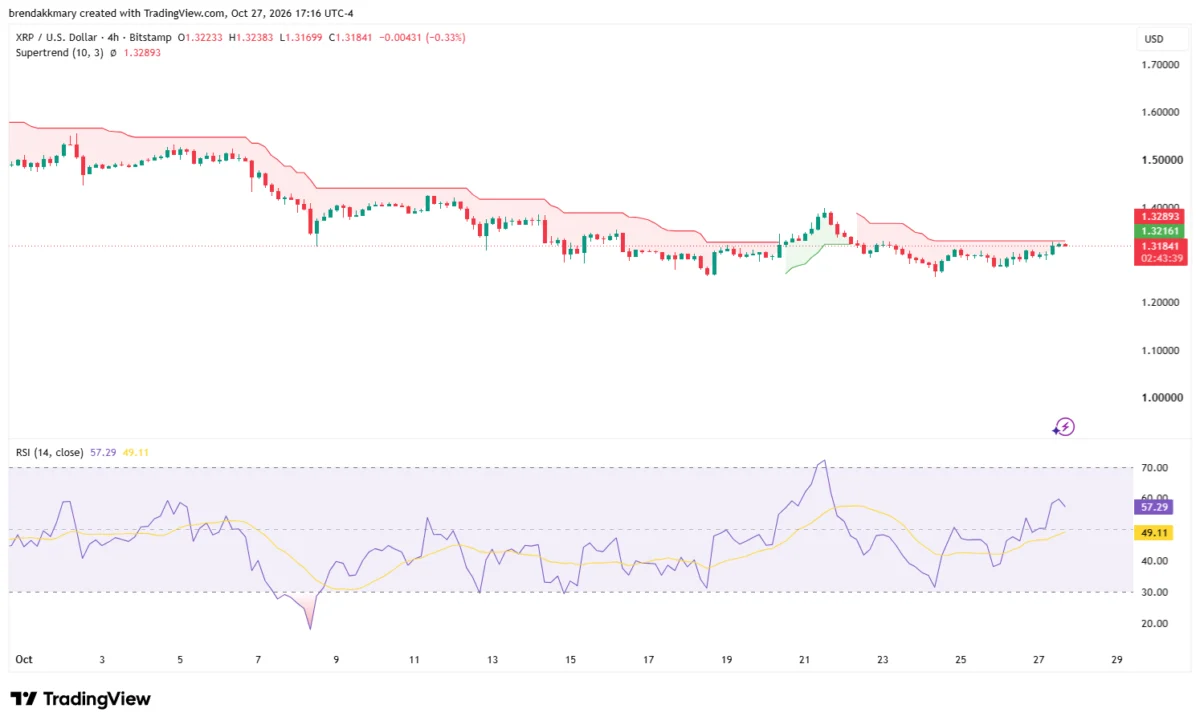
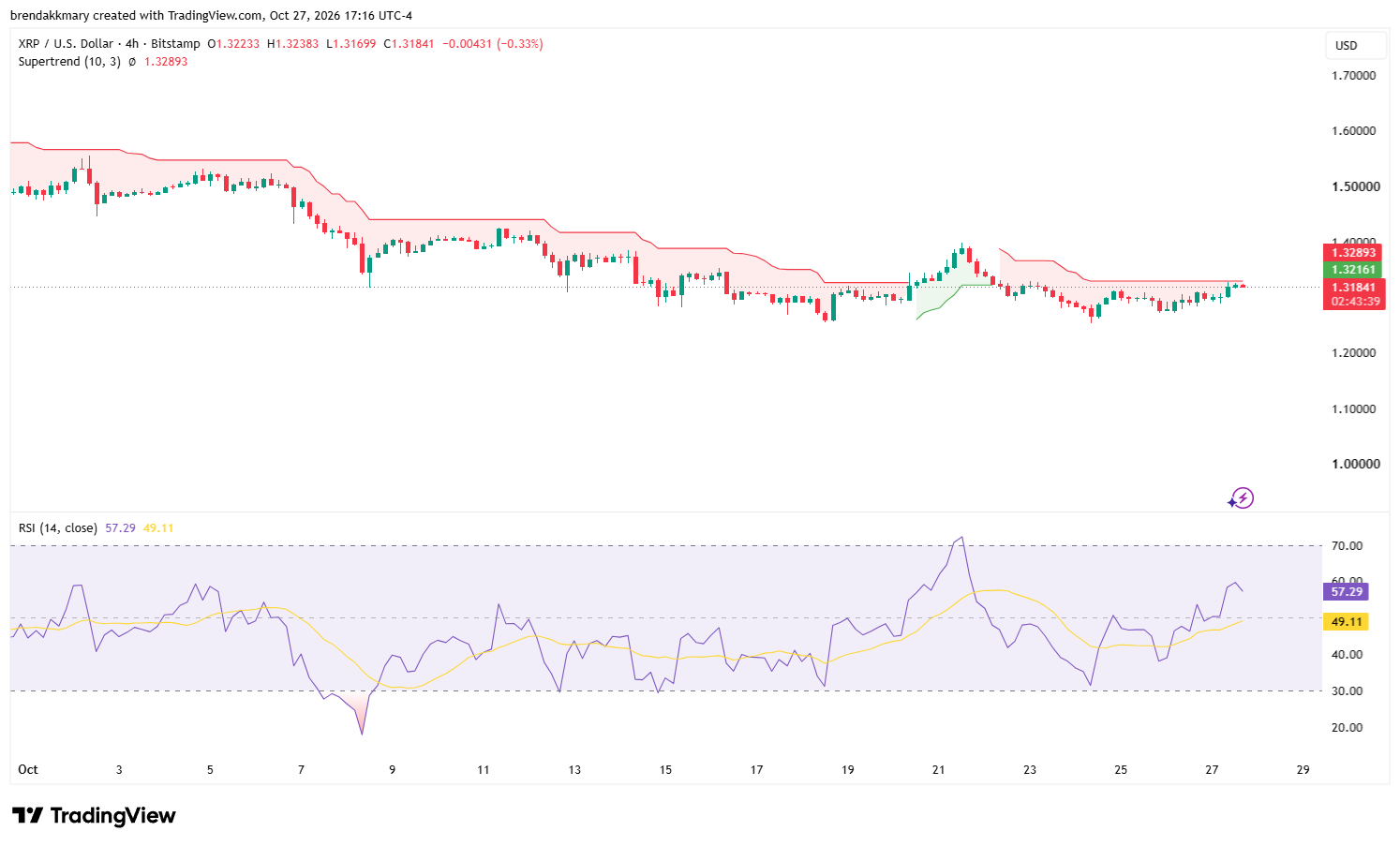
In the wake of the partnership announcement, market observers also monitored the price action and technical indicators of XRP. The token traded near $1.31, remaining relatively range-bound and showing little net change over a 24-hour window. However, technical analysis of the four-hour charts revealed strengthening underlying momentum, with the Relative Strength Index (RSI) climbing above the neutral 55 threshold.
On the resistance side, the Supertrend indicator remained mildly bearish near the $1.33 level, reinforced by a descending trendline resistance zone situated around $1.35. Market analysts suggest that a decisive bullish breakout above the $1.35 resistance barrier could open the door for a subsequent move toward the $1.38 to $1.40 price range. Conversely, immediate downside risk appears cushioned by a rising support level established near $1.28.
Broader Implications for the Fintech and Crypto Ecosystems
While the partnership ties institutional settlement tightly to the XRP Ledger and Ripple’s proprietary infrastructure, market analysts note that the core economic mechanism centers on the utilization of RLUSD rather than direct retail XRP token purchases. Because neither Ripple nor Robinhood disclosed expected transaction volumes or specific financial metrics associated with the deal, the immediate market impact remains qualitative rather than quantitative.
Nevertheless, the agreement signals a maturation phase for the digital asset industry. By embedding blockchain-native stablecoins directly into the institutional core of major retail brokerages and legacy exchanges, Ripple and Robinhood are successfully bridging the divide between experimental distributed ledger technology and enterprise-grade financial operations. As regulatory frameworks around stablecoins continue to clarify globally, initiatives of this scale lay the groundwork for a more integrated, efficient, and transparent future for international capital markets.