
Published August 19, 2026, the artificial intelligence landscape is undergoing a structural transformation. For the past several years, the race for AI supremacy was defined by user interfaces, workflow automation, and go-to-market strategies. Today, industry leaders, venture capitalists, and enterprise founders are pivoting toward a much deeper, more contentious battlefield: the intelligence layer itself.
This paradigm shift was recently brought into sharp focus by prominent industry figures. Palantir CEO Alex Karp publicly urged enterprises to "own the means of production," a call to arms echoing traditional manufacturing philosophies but applied directly to cognitive infrastructure. Shortly thereafter, Microsoft CEO Satya Nadella offered a blunt warning regarding reliance on third-party frontier labs. Nadella asserted that purchasing intelligence via external APIs extracts a dual payment: capital outlays matched by the surrender of proprietary organizational knowledge—insights systematically exposed to render general-purpose models useful for enterprise applications.
The central question now facing corporate boardrooms is definitive: Who should own the core intelligence driving modern business operations? While frontier APIs and proprietary agents remain vital for general workloads, a growing vanguard of companies is vertically integrating. These enterprises are actively shaping open weights to build custom, domain-specific AI capabilities into their core products.
The Genesis of the Movement: A Sequoia-Led Conclave
The momentum behind this tactical pivot crystallized weeks prior, when venture capital firm Sequoia Capital convened a specialized summit for AI founders, builders, and researchers. The event, dedicated entirely to the mechanics of owning the enterprise AI stack, served as a collaborative workshop examining the transition from renting external intelligence to cultivating internal cognitive architectures.

The conference featured technical briefings and case studies from market-leading startups. Legal AI pioneer Harvey provided a customer-centric perspective on scaling specialized agents, while infrastructure and tooling providers such as Mercor, LangChain, Trajectory, and Fireworks delivered deep dives into the technical requirements of the post-training stack.
Out of these discussions, a coherent enterprise playbook emerged. The consensus among the builders was unanimous: the technological and economic conditions favoring in-house model customization have finally reached critical mass.
Why Now? The Convergence of Open-Weight Maturity and Infrastructure
Two primary macroeconomic and technological catalysts explain why enterprises are moving aggressively toward stack ownership in 2026.
First, the open-weight frontier has evolved at a velocity that far outpaced initial industry projections. The release of highly capable open models—such as Kimi K3 and GLM 5.2—has fundamentally altered the calculus of development. Historically, tuning open-source models resembled running on a treadmill; engineering teams would invest months fine-tuning an architecture, only for a competing frontier lab to release a generalized model that instantly erased those performance gains. Today, open-weight baselines sit so close to the frontier that organizations can reliably customize models without fear of immediate obsolescence.
Second, the independent post-training ecosystem has achieved industrial maturity. Companies like Mercor and Fireworks now provide a comprehensive, modular technology stack that mirrors the capabilities once exclusive to well-funded frontier research laboratories. Encompassing everything from automated data curation and human-in-the-loop alignment to high-performance inference and online learning frameworks, this ecosystem enables open models to outperform general frontier models within targeted domains.

As recently as 2025, choosing open weights meant compromising on performance in exchange for cost or data privacy. By mid-2026, that compromise has evaporated, turning model ownership into an existential and strategic imperative.
Strategic Drivers: When Enterprises Should Make the Move
Transitioning from rented APIs to owned intelligence is not a universal mandate. Many operational workloads continue to benefit from generalized, off-the-shelf frontier models. However, corporate strategists have identified four specific operational thresholds where renting intelligence introduces severe constraints:
1. Economic Scale and COGS
As artificial intelligence applications achieve widespread commercial adoption, inference costs scale directly with user engagement. For high-volume applications, relying exclusively on external API calls creates an unsustainable cost-of-goods-sold (COGS) burden. Owning and serving optimized, smaller-footprint models locally offers the most reliable mechanism for protecting long-term operating margins.
2. Latency and Speed Optimization
In mission-critical domains such as real-time code generation (e.g., tab-completion engines) or high-frequency cybersecurity threat detection, processing speed is paramount. Massive general-purpose models often introduce unacceptable latency. A distilled, custom-trained model optimized for a narrow domain routinely outpaces larger counterparts while executing specific functions significantly faster.
3. Protection of Proprietary Data
Organizations operating in highly regulated or sensitive industries—such as legal, healthcare, and finance—frequently object to feeding enterprise feedback loops, evaluation datasets, and customer interaction logs back into third-party labs. Owning the intelligence layer ensures that proprietary domain data remains strictly within corporate boundaries.
4. Controlling Strategic Destiny
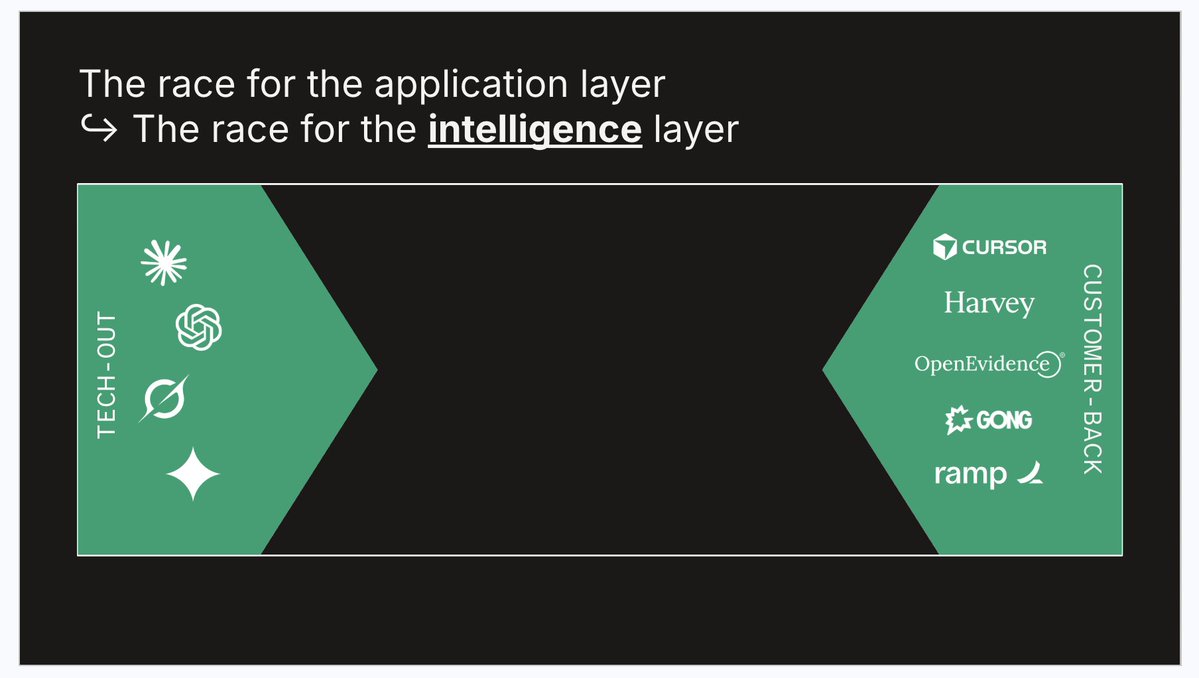
The historical boundary between the application layer and the intelligence layer is actively dissolving. Frontier labs are increasingly pushing upward into enterprise software products, while application-layer companies are pushing downward into the training loops that dictate how their products reason. Consequently, controlling the future of a software product increasingly requires direct ownership of its underlying learning loop and model weights—a trend exemplified by market leaders such as Harvey, RampLabs, Glean, and Factory.
The Roadmap to Owning Intelligence: A Four-Step Framework
For enterprises choosing to navigate this transition, execution requires a systematic, zero-to-one roadmap established across four core technical pillars.
Step 1: Establishing Rigorous Evaluations (Evals)
As Gabe Pereyra of Harvey famously noted, "If you don’t have a good benchmark, you can’t train models."
An evaluation framework consists of standardized tasks designed to measure whether an AI system performs work reliably. Each task integrates a prompt, relevant contextual data, and an automated or expert grader. While most evaluation frameworks begin as qualitative "vibe checks" conducted by founders, scaling requires transforming subjective judgment into repeatable, quantitative benchmarks.
Harvey’s development of its proprietary Legal Agent Benchmark illustrates this approach. The system translates complex legal workflows into more than 1,200 distinct agent tasks spanning 24 practice areas, evaluated against over 75,000 expert-crafted rubric criteria. Establishing rigorous evaluations prior to model selection shifts infrastructure decisions from speculative guesses to empirical certainty.

Step 2: Harness and Context Engineering
An AI agent comprises three foundational components: the core model, the contextual database, and the harness. The harness governs the procedural product logic surrounding the model, including semantic routing, retrieval-augmented generation (RAG), tool invocation, memory management, fallback protocols, and operational tracing.
As Harrison Chase of LangChain observed, the primary function of a harness is delivering the right context to the model at the exact moment it is needed. When tasks fall outside a model’s primary training distribution, off-the-shelf harnesses invariably fail. A robust, custom harness allows organizations to route tasks to the most efficient model, apply uniform evaluations across disparate architectures, and maintain full inspectability over tool calls and execution traces.
Step 3: Strategic Post-Training
Post-training encompasses a spectrum of techniques designed to adapt models to specific operational requirements. Selecting the correct technique depends entirely on the operational deficiency identified by system evaluations:
- Missing Facts: If a model lacks specific information, post-training is unnecessary; standard RAG or contextual augmentation should be utilized.
- Formatting or Behavioral Errors: Supervised fine-tuning (SFT) is deployed to correct structural outputs and adherence to operational rules.
- Product Taste and Alignment: Preference tuning aligns model outputs with subjective brand or user standards.
- Specialized Task Proficiency: Reinforcement learning (RL) is applied to dramatically elevate performance on complex, multi-step workflows.
- Performance Bottlenecks: Distillation techniques compress large, generalized models into smaller, high-speed architectures for cost-effective deployment.
The objective is always to deploy the lightest intervention necessary to shift evaluation metrics positively, subsequently measuring quality, latency, and operational cost through the application harness.
Step 4: Continuous Online Learning
The final phase of stack ownership involves establishing a continuous improvement loop in production. As Arjun Karanam has emphasized, while foundational models grow progressively more intelligent, every new user session essentially mimics a model’s first day on the job. Raw intelligence without domain-specific experience limits operational efficacy.

Modern architectures capture system trajectories—the complete record of context observed, tools invoked, sub-agents deployed, final outputs generated, and subsequent human edits or retries. Utilizing observability frameworks like LangChain’s LangSmith, development teams turn failed production tasks into new evaluation benchmarks, feed missing information directly into context memories, and refine harness logic based on poor tool responses.
Broader Implications and Industry Outlook
The transition toward enterprise intelligence ownership introduces significant strategic trade-offs. The closed-model paradigm offers simplicity: developers call a frontier model, integrate an out-of-the-box harness, apply basic prompt engineering, and ship the product. This approach establishes a high operational floor, but it permanently caps the product’s long-term performance ceiling.
Conversely, owning the AI stack demands substantial engineering commitment. It introduces a lower initial operational floor, but it unlocks an exponentially higher performance ceiling. The production stack expands to encompass open-source models, custom execution harnesses, proprietary tools, and dedicated context pipelines, while the development stack incorporates proprietary evaluations, domain-specific datasets, and closed-loop online learning systems.
Ultimately, industry observers note that the emergence of in-house model customization does not signal the obsolescence of frontier labs. The major AI laboratories will continue constructing massive foundational models that serve as general cognitive engines for the global economy.
In parallel, however, forward-thinking product companies are cultivating their own specialized intelligence engines—systems that are fast, opinionated, domain-obsessed, and precisely tuned to the unique workflows they encounter. As more organizations take direct ownership of their cognitive infrastructure, the broader technology ecosystem stands to benefit from a diverse renaissance of enterprise intelligence and individual technical sovereignty.