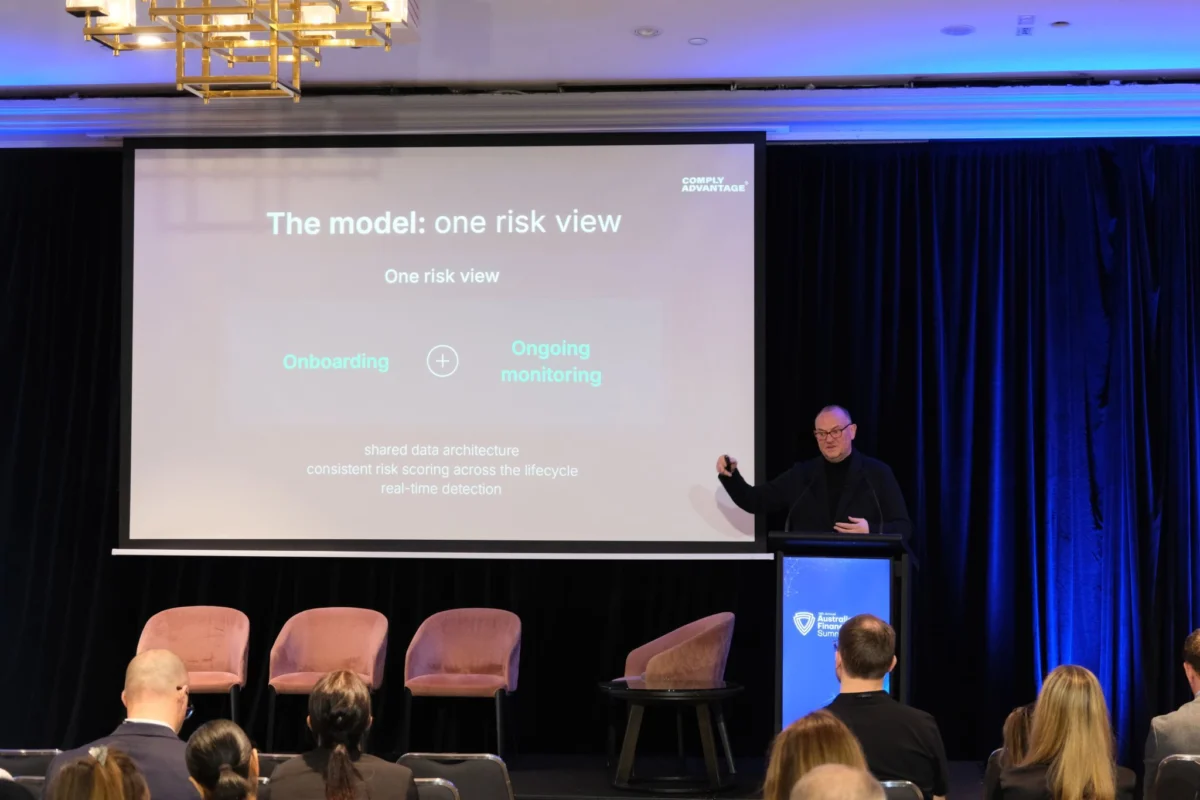
The concept of effectiveness has emerged as the primary metric by which regulators evaluate financial institutions, yet a critical operational disconnect remains the industry’s greatest liability. Speaking at the Australian Financial Crime Summit (AFCS) in Sydney on September 1, 2026, Andrew Davies, Global Head of Financial Crime Compliance (FCC) Strategy at ComplyAdvantage, argued that compliance teams are fundamentally unable to evidence their effectiveness so long as onboarding and ongoing monitoring processes reside in fragmented, siloed systems. This structural inefficiency is no longer merely a technical debt; it is a significant barrier to meeting the escalating demands of an increasingly complex global regulatory landscape.
The Australian financial sector is currently grappling with a confluence of record-high scam losses and shifting regulatory requirements. Data from the National Anti-Scam Centre (NASC) reveals that 2025 saw approximately $2.18 billion lost to scams, stemming from 274,577 individual reports. This environment of heightened criminal activity is mirrored by the findings in the AUSTRAC Money Laundering Update 2026, which details the adoption of advanced, AI-enabled document fraud techniques by sophisticated syndicates. These developments coincide with the July 1, 2026, implementation of Tranche 2 AML/CTF obligations, which have brought roughly 80,000 previously unregulated businesses into the compliance fold. Furthermore, the industry faces an impending deadline of March 31, 2027, when strict detection obligations under the Scams Prevention Framework become mandatory for banking, telecommunications, and digital platforms.
The structural fragmentation of compliance operations, where KYC (Know Your Customer) onboarding data fails to inform transaction monitoring systems, creates a vacuum of context. As Davies emphasized, if an organization cannot connect the dots between initial risk assessment and behavioral monitoring, it cannot claim to operate under a legitimate, risk-based approach. The inability to share data across these platforms creates blind spots that criminals are increasingly adept at exploiting.
Chronology of Regulatory and Operational Shifts
The progression toward the current regulatory environment has been marked by several key milestones that have fundamentally altered the compliance landscape:
- 2025: The National Anti-Scam Centre reports $2.18 billion in total scam losses, underscoring the urgency for systemic reform.
- July 1, 2026: Tranche 2 AML/CTF obligations take effect, significantly expanding the number of entities subject to federal oversight.
- September 1, 2026: The Australian Financial Crime Summit (AFCS) serves as a focal point for discussing the "effectiveness" mandate, highlighting the need for technological integration.
- March 31, 2027: The Scams Prevention Framework mandates strict detection obligations for key sectors, including banking and telecommunications.
Supporting Data and the Cost of Inaction
The financial cost of failing to integrate systems is exacerbated by the sheer scale of global illicit flows. According to research from Global Financial Integrity, transnational crime generates between $1.6 trillion and $2.2 trillion annually. These proceeds are not moved through disorganized, amateur channels; they flow through sophisticated, cross-border supply chains that mirror legitimate corporate structures. The global fentanyl trade, for instance, operates as a complex network spanning continents, moving goods and payments with a level of agility that surpasses many legacy bank monitoring systems.
Furthermore, the ComplyAdvantage State of Financial Crime 2026 research highlights a striking consensus among industry leaders: 99% of respondents agree that an integrated interface is essential for effective operations. Despite this, over 50% of these same leaders report that they are forced to navigate between eight and ten disparate systems to manage their compliance workload. This misalignment between recognized necessity and operational reality exposes firms to significant regulatory and reputational risk, as customer risk profiles become obsolete the moment they are created, failing to account for shifting behavioral patterns.
Beyond the Narrow Scope of FRAML
Historically, the industry focused on a binary approach to financial crime: the "FRAML" model, which attempted to consolidate fraud and AML (Anti-Money Laundering) into a single functional discipline. While this was a necessary evolution from the era of disjointed sanctions screening, it is no longer adequate. Criminal networks do not operate in silos, and neither should the defense mechanisms used to stop them.
Davies noted that unusual activity is often a signal for crimes that fall outside the traditional AML/fraud scope, such as human trafficking. The International Labour Organization (ILO) estimates that 50 million people currently live in modern slavery, and the proceeds from these human rights abuses are laundered through the same payment networks as legitimate transactions. As organizations like AUSTRAC, the U.S. Treasury’s FinCEN, and the Financial Action Task Force (FATF) broaden their definitions of financial crime to include proliferation financing, corruption, and bribery, the scope of the compliance mandate has expanded exponentially. Consequently, detection must evolve into a network-based exercise; in the words of Davies, "Financial crime is a network problem, so we have to solve this network problem with networks ourselves."
Implications for Business Strategy and Customer Trust
The integration of risk mitigation and commercial growth is now a fundamental business imperative. Rather than viewing compliance as a cost center, forward-thinking organizations are beginning to recognize that effective financial crime controls are a core component of the customer value proposition. Customers prioritize safety and security in their financial services above almost all other features. By mitigating fraud and money laundering, financial institutions reinforce the integrity of the broader financial system and secure the lifetime value of their customer base.
The transition to a unified view of the customer does not necessarily require the immediate, costly dismantling of legacy infrastructure. The deployment of an orchestration layer—a technological "overlay"—can serve as a bridge, unifying identity and risk signals across existing systems without necessitating a total system replacement. This approach allows firms to maintain continuity while gaining the agility required to address emerging threats.
Measuring Effectiveness: A New Framework
To satisfy regulators and protect the organization, compliance teams must be able to quantify their effectiveness across three primary dimensions: exposure, operational remediation, and business impact. A single view of the customer enables teams to answer the critical questions that executives and regulators are asking: What is the firm’s total risk exposure? How are investigations being remediated across onboarding, screening, and monitoring cycles? And what do these controls mean for the long-term health of the business?
By feeding investigation outcomes directly back into the screening and monitoring loop, organizations create a virtuous cycle of learning. Each instance of identified crime becomes a data point that hardens the system against future attacks. This proactive stance is the responsibility of the "vanguard" of the financial sector. As the point of the spear in the fight against illicit financial flows, compliance professionals hold the critical responsibility of protecting not only the profitability of their organizations but also the vulnerable populations who are most often the victims of systemic financial crime.
Ultimately, the shift toward effectiveness is a shift toward a more transparent, secure, and technologically mature financial ecosystem. For Australian firms facing the upcoming 2027 mandates, the message is clear: the ability to integrate, analyze, and act upon data in real-time is the only pathway to maintaining compliance in an era of globalized, network-driven crime. The cost of maintaining disparate systems is no longer measured solely in operational inefficiency, but in the lost trust of the public and the erosion of the financial system’s integrity. The transition to a unified operating model is not just a regulatory hurdle; it is the next stage in the evolution of the modern financial services sector.