

While the contemporary discourse surrounding artificial intelligence has been almost exclusively dominated by the evolution of large language models, agentic workflows, and cloud-based software architectures, a distinct and more tangible shift is underway. Physical AI—the integration of artificial intelligence into robotics, autonomous systems, edge computing, and smart sensor arrays—is moving from the periphery of enterprise technology into the core of operational strategy. According to recent research from Battery Ventures, this segment, once dismissed as a long-term research pursuit, is showing signs of a rapid maturation cycle, with nearly a quarter of large-scale enterprises already actively engaged in deployment or pilot programs.
The current technological landscape is characterized by a significant divide. On one side lies "Software AI," where generative capabilities are refined through iterative API updates. On the other lies "Physical AI," which requires a complex marriage of hardware, real-time data processing, and physical infrastructure. Despite this technical gap, the velocity at which these two worlds are converging is accelerating, driven by the need for companies to capture proprietary data that resides outside the digital realm.
The Current State of Enterprise Adoption
Data gathered from 100 technology leaders at organizations with 1,000 to 5,000+ employees reveals that 26% of firms have already initiated active engagement with physical AI. This engagement is segmented into three tiers: 13% of organizations are currently focused on research and development, 7% are conducting live pilots, and 6% have successfully moved these systems into full production. Furthermore, the momentum is set to grow, with an additional 23% of respondents confirming they intend to initiate exploration of physical AI technologies within the next 12 months.

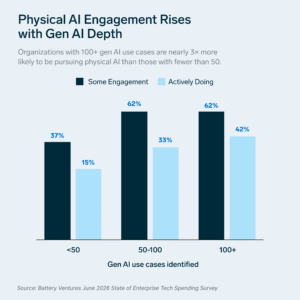
A notable correlation exists between an organization’s adoption of generative AI and its investment in physical AI. Enterprises that have integrated more than 100 generative AI use cases are nearly three times as likely to be working on physical AI initiatives compared to their peers who maintain fewer than 50 use cases. This suggests that the same internal digital transformation drivers—efficiency, automation, and data-driven decision-making—are the primary catalysts for moving AI into the physical domain.
A Fragmented Governance Landscape
Despite the capital-intensive nature of physical AI, there is a surprising lack of consensus regarding who should hold the reins of these initiatives. Ownership is currently decentralized, with 35% of CTOs and 27% of CIOs claiming responsibility. Perhaps most striking is the finding that only 8% of organizations place the strategy under the Chief Operating Officer (COO), despite these technologies having the most direct impact on manufacturing and logistics operations.
This governance gap presents a significant risk. Physical AI projects inherently involve physical safety, substantial capital expenditure (CapEx), and complex regulatory requirements. Without clear ownership at the operational level, organizations may struggle to reconcile the theoretical performance of an AI model with the real-world constraints of an industrial floor or a supply chain network. The remaining 8% of organizations report having no clear owner at all, a figure that industry analysts identify as a potential bottleneck for scaling these technologies beyond the pilot phase.
Segmenting the Technological Frontier
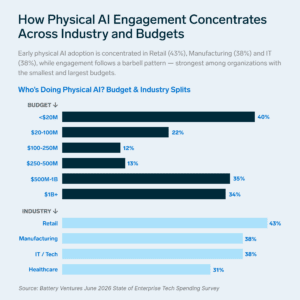
The deployment of physical AI is not uniform across all sectors. While retail has shown a high propensity for experimentation—with 43% of retail firms engaged—the manufacturing and information technology sectors report lower rates, at approximately 38%. Within these organizations, the application of physical AI varies by category:
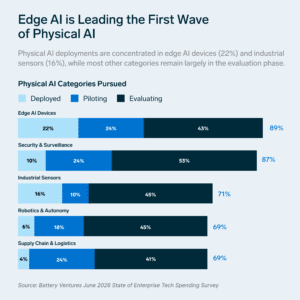
- Edge AI Devices: Currently the most mature category, these systems process data locally, allowing for real-time inference without the latency of cloud-based round trips. Eleven of the surveyed organizations have successfully deployed edge AI in production, primarily for real-time sensor reaction.
- AI-Enhanced Security: This includes smart camera systems and access control, with 17 organizations currently engaged.
- Industrial Sensors and Predictive Maintenance: Widely considered the most operationally stable subcategory, this area boasts the highest production deployment rate. Thirteen organizations are active in this space, with eight reaching full-scale production. It represents the "low-hanging fruit" of physical AI, where the return on investment (ROI) is most easily quantified through reduced downtime and optimized machinery health.
- Robotics and Autonomous Systems: Despite receiving the most media attention, these systems are currently the least prevalent in practical enterprise settings. Only three organizations have reached full production, though 22 are currently in the evaluation stage. The disparity between enthusiasm and deployment highlights the immense complexity involved in deploying autonomous hardware in dynamic, unpredictable environments.
The Economic and Strategic Rationale
The primary motivation for adopting physical AI is the generation of a "proprietary data moat." In a world where foundation models are increasingly commoditized, companies are looking to physical infrastructure to capture data that software alone cannot access.
For instance, in the steel industry, sensor networks are being used to monitor raw material consumption at a granular, real-time level, allowing for minute-by-minute adjustments to production yields. In the logistics sector, AI-enabled camera towers at loading docks are automating freight verification, reducing reliance on manual inspections and mitigating the risks of supply chain fraud. In agriculture, precision robotics use computer vision to identify and treat individual weeds, drastically reducing the volume of chemical inputs required. By generating and analyzing this data, firms create proprietary operational insights that are difficult for competitors to replicate.
Barriers to Widespread Adoption
While the potential is significant, the path to implementation is fraught with challenges distinct from those encountered in the software-only world. When asked to identify the primary hurdles, 69% of enterprises cited the complexity of integrating new AI hardware with legacy infrastructure. Many industrial environments rely on machinery that predates the modern cloud era, making data extraction and system synchronization a significant engineering challenge.
Infrastructure and hardware costs represent the second-largest barrier, cited by 59% of respondents. Unlike software, which can often be scaled with minimal marginal cost, physical AI requires significant upfront investment in hardware, installation, and physical maintenance. Security and safety concerns followed closely, identified by 55% of respondents. These concerns are rooted in the reality that a malfunctioning software bot may cause a service outage, but a malfunctioning physical robot can cause physical damage or injury.
Finally, 47% of enterprises report that unclear ROI remains a significant obstacle. As is the case with many emerging technologies, the business case is often being written in real-time. Organizations are still learning how to measure the long-term impact of autonomous systems against traditional labor and capital costs.
The Human-AI Collaboration Paradigm
The narrative surrounding physical AI is frequently framed as a debate over labor replacement, but the reality within the enterprise is far more nuanced. Of the organizations currently engaged with the technology, only 6% view physical AI as a means to replace human labor entirely. Conversely, 39% view the technology as a tool for augmentation, designed to assist workers and enhance their productivity. The majority of firms anticipate a hybrid model, where physical AI handles dangerous, repetitive, or high-precision tasks, while human workers manage complex decision-making and oversight.
This trend is consistent with broader findings in the 2026 enterprise technology landscape, which show a preference for augmenting human capabilities rather than displacing the workforce. However, physical AI stands alone as the only category where the prospect of replacing physical labor is a viable, if not immediate, consideration.
Future Implications and Strategic Outlook
The "physical layer" of enterprise AI is still in its infancy, yet the trajectory suggests that we are approaching an inflection point. The transition from "no plans" to "active exploration" is happening faster than many industry observers predicted. As edge devices become more capable and the cost of sensor technology continues to decline, the barriers to entry will inevitably lower.
For infrastructure providers and software vendors, the opportunity lies in bridging the gap between legacy systems and modern, intelligent hardware. The success of physical AI will depend less on the sophistication of the models themselves and more on the ability of organizations to safely integrate these systems into their existing workflows. As businesses move from experimental pilots to long-term production, the governance structures—who manages the hardware, who owns the data, and who is responsible for the safety of autonomous processes—will be the defining factors in determining which enterprises emerge as leaders in this next, more tangible wave of artificial intelligence.
