
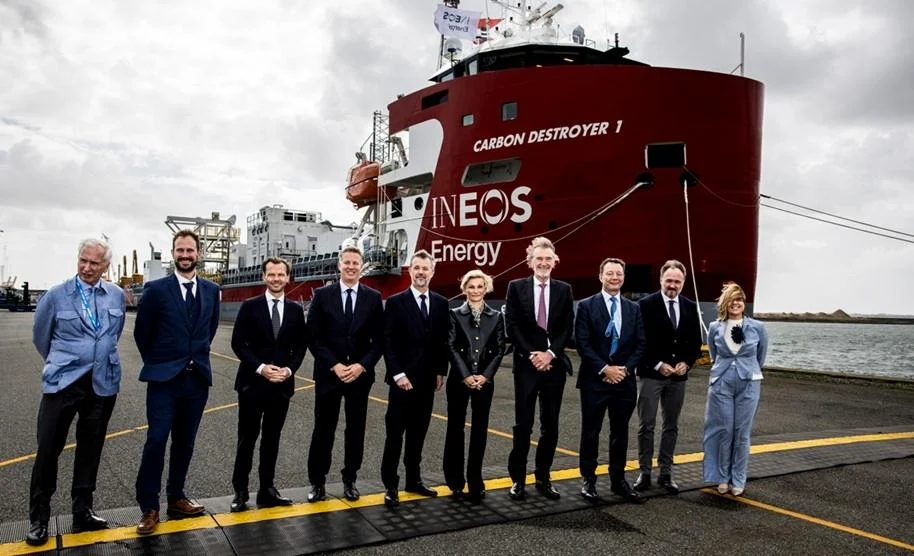
In a milestone event for European climate policy and industrial decarbonization, chemicals manufacturer Ineos has officially inaugurated Project Greensand in the Danish North Sea. This facility represents the European Union’s first fully operational, large-scale infrastructure dedicated to the permanent offshore sequestration of carbon dioxide. By injecting captured CO2 into depleted oil reservoirs 1,800 meters beneath the seabed, the project signals a critical transition from theoretical climate strategies to tangible, industrial-scale deployment.
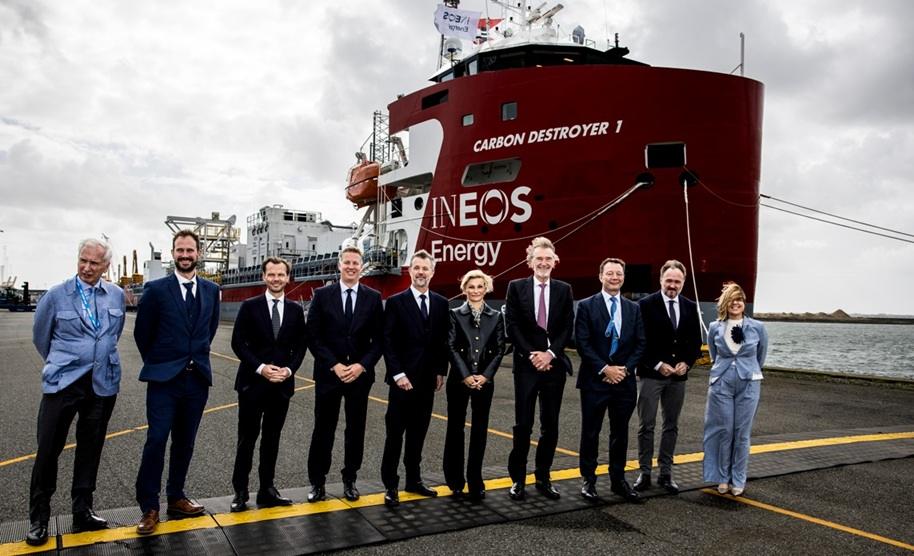
The launch event, held at the Port of Esbjerg, was attended by King Frederik X of Denmark and high-ranking European officials, underscoring the strategic importance of the site. With an initial storage capacity of 400,000 tonnes of CO2 per year, the project is designed to be highly scalable, with long-term projections suggesting it could eventually handle between 4 and 8 million tonnes annually—a significant contribution toward regional decarbonization goals.
A Strategic Response to the Net-Zero Industry Act
The establishment of Project Greensand is directly aligned with the European Union’s ambitious legislative framework for climate action. Under the EU’s Net-Zero Industry Act, the bloc has codified a target of reaching at least 50 million tonnes of annual CO2 injection capacity by 2030. However, the European Commission’s long-term modeling suggests that this is merely a starting point. Experts estimate that to remain on track for the EU’s 2040 climate objectives, the continent will need to capture and permanently sequester approximately 250 million tonnes of CO2 annually.
Project Greensand bridges the gap between pilot-scale experimentation and the massive industrial infrastructure required to meet these targets. By providing a secure, permanent repository for industrial emissions that cannot be easily mitigated through electrification or renewable energy substitution, the project serves as a cornerstone for the "hard-to-abate" sectors, including heavy manufacturing, chemical production, and waste-to-energy processes.
Chronology of Development: From Concept to Carbon Sink
The path to the operational phase of Project Greensand has been a multi-year effort involving intense cross-border cooperation and engineering innovation:
- 2021: The project is formally launched as a collaborative venture led by Ineos, in partnership with Harbour Energy and the Danish state-backed Nordsøfonden. The objective was to prove the feasibility of capturing CO2 from land-based sources, transporting it via specialized infrastructure, and injecting it into offshore geological formations.
- 2022-2023: Engineering teams finalize the logistics of the value chain, which includes capturing CO2 at source, liquefying it for transport, and repurposing maritime vessels for offshore delivery.
- 2024: Regulatory approvals are secured for the cross-border transport and injection of CO2, a complex legal hurdle that required aligning Danish maritime and environmental laws with broader EU climate standards.
- September 2026: Official inauguration of the facility. The first commercial shipments commence, focusing on carbon captured from Danish biomethane facilities.
Operational Mechanics and the Value Chain
The operational complexity of Project Greensand is significant, involving a highly synchronized supply chain. The process begins at various capture points, such as biomethane plants, where CO2 is separated from industrial exhaust streams. Once captured, the gas is liquefied—a process that makes it denser and easier to transport.
The liquefied CO2 is then transported by road to a specialized terminal at the Port of Esbjerg. From there, it is loaded onto the Carbon Destroyer 1, the EU’s first purpose-built CO2 carrier vessel. The ship navigates to the offshore site, located 250 kilometers into the North Sea, where the CO2 is injected into a depleted oil field. The geological integrity of this site is paramount; the depth of 1,800 meters ensures that the carbon is trapped beneath thick, impermeable rock layers, preventing any potential leakage back into the atmosphere or the water column.

Perspectives on Industrial Competitiveness
The rhetoric surrounding the project highlights a growing shift in European industrial policy. Sir Jim Ratcliffe, Chairman of Ineos, has been vocal about the necessity of carbon capture for the survival of European industry. His stance reflects a broader consensus among policymakers: that aggressive climate targets should not come at the cost of domestic industrial decline.
"Europe will not achieve net zero by closing factories and exporting its jobs," Ratcliffe stated during the opening ceremony. "We need solutions that allow industry to remain competitive while reducing emissions. Greensand proves it can be done. This is not a pilot project, a concept, or a political ambition. It is a fully operational carbon transport and storage business."
This sentiment was echoed by European Commissioner for Energy and Housing, Dan Jørgensen, who emphasized the role of the site in transforming climate policy into practical economic reality. "We show that we can move from demonstration to deployment," Jørgensen noted. "We set out a path for European industries: to continue their transition to a low-carbon future, while maintaining production, investments, and employment on our continent."
Economic and Environmental Implications
The implications of Project Greensand extend beyond the immediate reduction of carbon emissions. By establishing a functional market for carbon storage, the project provides a blueprint for other nations to follow.

- Industrial Retention: For sectors like chemicals and steel, which rely heavily on carbon-intensive chemical reactions, the availability of large-scale storage allows these companies to reach net-zero goals without abandoning their existing manufacturing footprints.
- Cross-Border Logistics: The project tests the legal and logistical framework for the trans-boundary movement of CO2. As more storage sites emerge across the North Sea—including those planned by Norway and the Netherlands—the European Union will likely see the creation of a "CO2 highway" network, where emissions are treated as a commodity to be transported and stored.
- Market Development: The scaling of the facility from 400,000 tonnes to 8 million tonnes per year represents a significant capital investment. As the technology matures and the volume of stored CO2 increases, the cost per tonne of carbon capture and storage (CCS) is expected to decrease, making it a more viable economic option for smaller industrial players.
Challenges and Future Outlook
Despite the success of the inauguration, the path ahead is not without challenges. The technical success of the Carbon Destroyer 1 and the injection site must be matched by a robust regulatory environment that provides long-term liability clarity for carbon storage. Furthermore, the economic viability of the project remains sensitive to the price of carbon under the EU Emissions Trading System (ETS). As the price of carbon permits fluctuates, the business case for companies to pay for CCS instead of purchasing allowances will evolve.
However, the opening of Project Greensand is a definitive moment for the European climate agenda. It demonstrates that the infrastructure for a carbon-neutral economy is no longer a matter of future planning, but a reality of current engineering. By integrating storage into the broader energy system—including the use of biomethane and the potential for future hydrogen-based manufacturing—Denmark and Ineos have positioned the North Sea as a global hub for the necessary, albeit challenging, work of planetary-scale carbon management.
As the site ramps up to its intended capacity, the industry will be watching the operational data closely. The success of this facility will likely serve as the primary catalyst for the next wave of investment in CCS, potentially securing the future of European manufacturing in a world that is increasingly demanding low-carbon commodities. The "Greensand" model is, in essence, a declaration that European industry intends to lead the global transition, not by retreating from production, but by engineering a way to exist within the constraints of a warming world.
