

Artificial intelligence stocks staged a tentative recovery on Friday following a severe multi-day rout that swept across global markets from Wall Street to key technology hubs in Asia. While the late-week green session offered a brief reprieve to battered traders, it did little to settle the overriding anxiety consuming financial institutions heading into the weekend: whether this sharp downturn marks a long-overdue, healthy market correction or represents the initial stages of a major speculative technology bubble bursting.
The dramatic swings underscored deep-seated vulnerabilities in the valuation models of high-flying semiconductor firms and cloud infrastructure providers. Nvidia shares climbed 2.78% to close at $186.64, attempting to claw back ground after plunging a staggering 9.3% just a day prior. Similarly, Advanced Micro Devices (AMD) bounced back to $449.04 following a brutal 17.3% collapse earlier in the week. Despite these recovery bounces, both industry giants remain deeply depressed compared to their lofty October peaks, illustrating how fleeting relief rallies fail to repair structural damage done during broad-based liquidations.
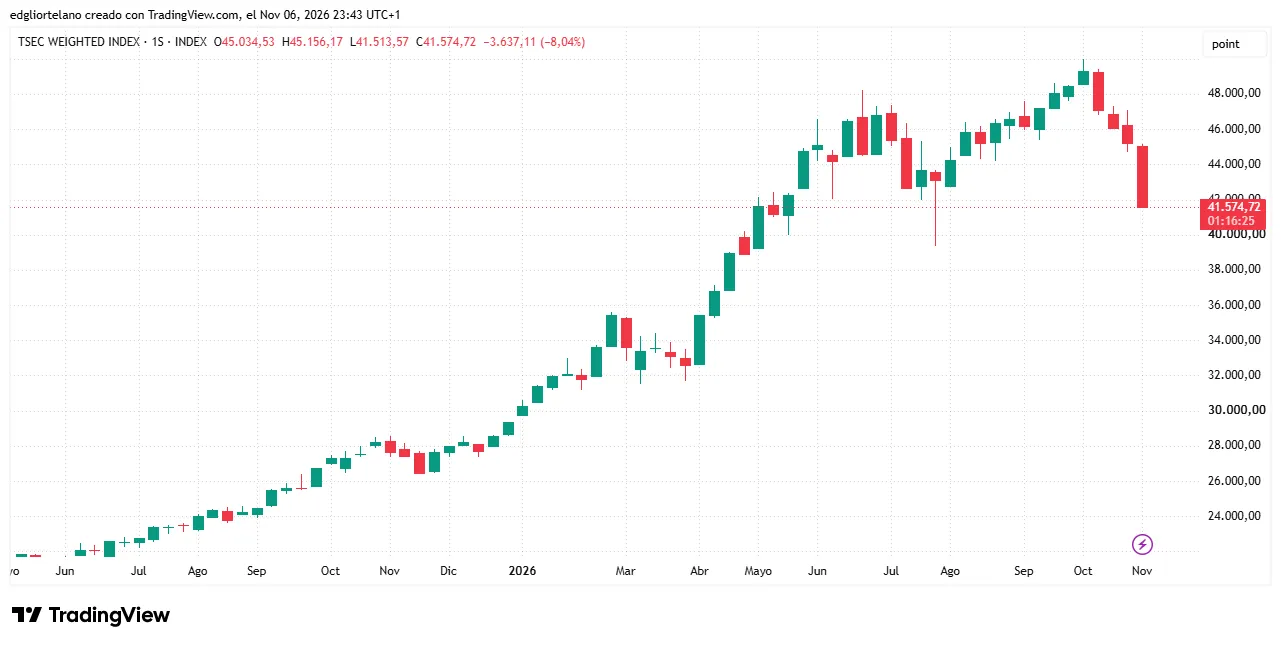
The contagion extended far beyond domestic U.S. equities, translating into a punishing week for international markets closely tied to the global semiconductor supply chain. South Korea’s benchmark KOSPI index suffered a punishing 6% loss on Friday alone, while Taiwan’s weighted index plummeted more than 8% over the course of the week, marking its worst multi-day performance in months. The sell-off was so severe that Taiwan Semiconductor Manufacturing Company (TSMC) hit its daily limit-down trading threshold. In response to the historic capital flight, Reuters reported that Taiwanese officials intervened, requesting that state-owned domestic banks deploy capital to support asset prices and stabilize local investor confidence.
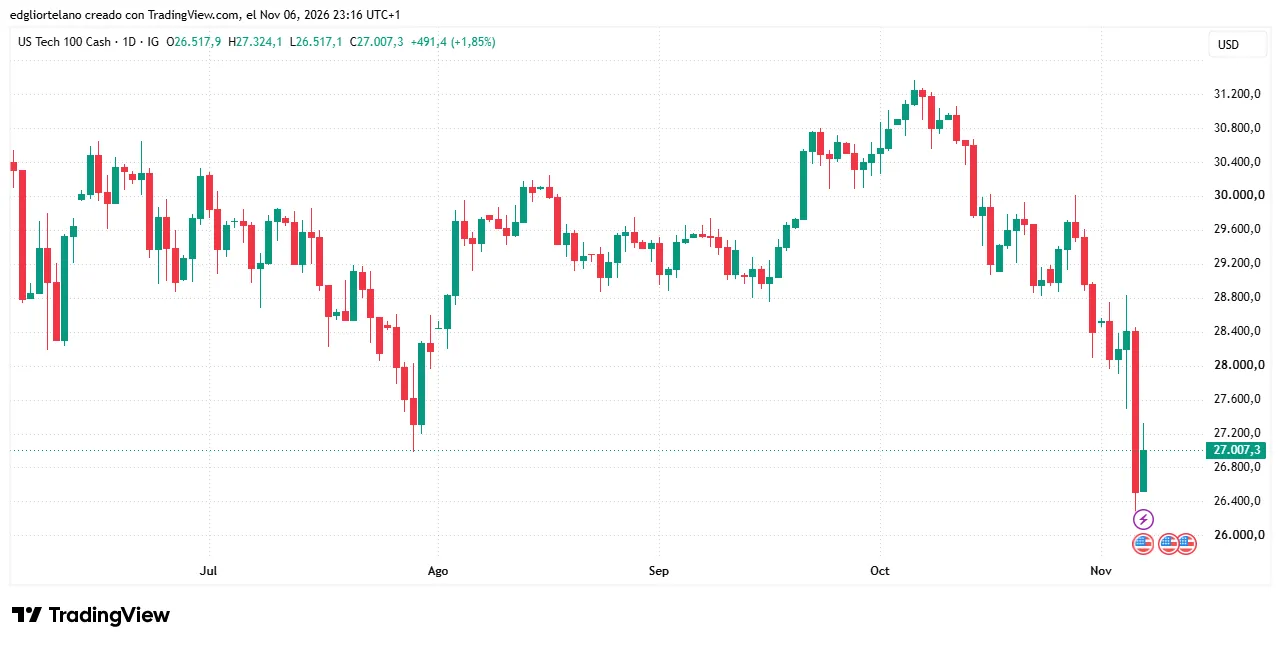
Concurrently, the US Tech 100 cash-market proxy managed a 1.85% rebound to finish at 27,007.3, though it still closed the week down more than 5.5%. Daily price action charts revealed that Friday’s bounce was merely a minor technical reaction following a steep descent from October’s all-time highs, rather than a resumption of the previous upward trajectory.

Unraveling the AI Trade: Geopolitical, Political, and Financial Pressures
The sudden unraveling of the artificial intelligence trade was catalyzed by a confluence of political headwinds and tightening macroeconomic conditions. In the United States, the fallout from recent midterm elections dramatically accelerated market anxiety regarding the future regulatory landscape for data centers. Democratic legislative gains signaled an impending era of heightened federal and local scrutiny directed at energy-intensive computing facilities.
Data from Ballotpedia highlighted a decisive local shift: across 41 local ballot contests held on November 3, voters favored limiting data center expansion in 40 of them, frequently rejecting pro-construction zoning measures outright. While certain municipal votes carried merely advisory weight, the political message delivered to Wall Street was unmistakable.
These local restrictions pose a direct threat to the core growth engine of the semiconductor industry. Modern artificial intelligence infrastructure relies on massive, uninterrupted capital expenditure to construct data centers requiring unprecedented allocations of processing units, server racks, high-capacity electrical power, and advanced liquid cooling systems. Regulatory bottlenecks, zoning restrictions, and construction moratoriums threaten to delay corporate hardware orders, inflate development overhead, or force project migrations to less optimal jurisdictions.
However, market skepticism predated the November elections. Tech enterprises and their enterprise customers have been aggressively scaling infrastructure capacity, often front-loading enormous capital expenditures before realizing tangible commercial returns on investment. This aggressive capital deployment has collided with a higher-for-longer interest rate environment, where elevated borrowing costs make debt-financed infrastructure bets significantly harder to sustain over multi-year horizons. Wall Street strategists noted that major sector equities had already reached valuations that were entirely "priced to perfection," leaving virtually zero margin for operational missteps or revenue misses.
Correction Versus Speculative Bubble: Lessons From History
To understand the current market turmoil, financial analysts differentiate carefully between a conventional market correction and the bursting of a structural bubble.
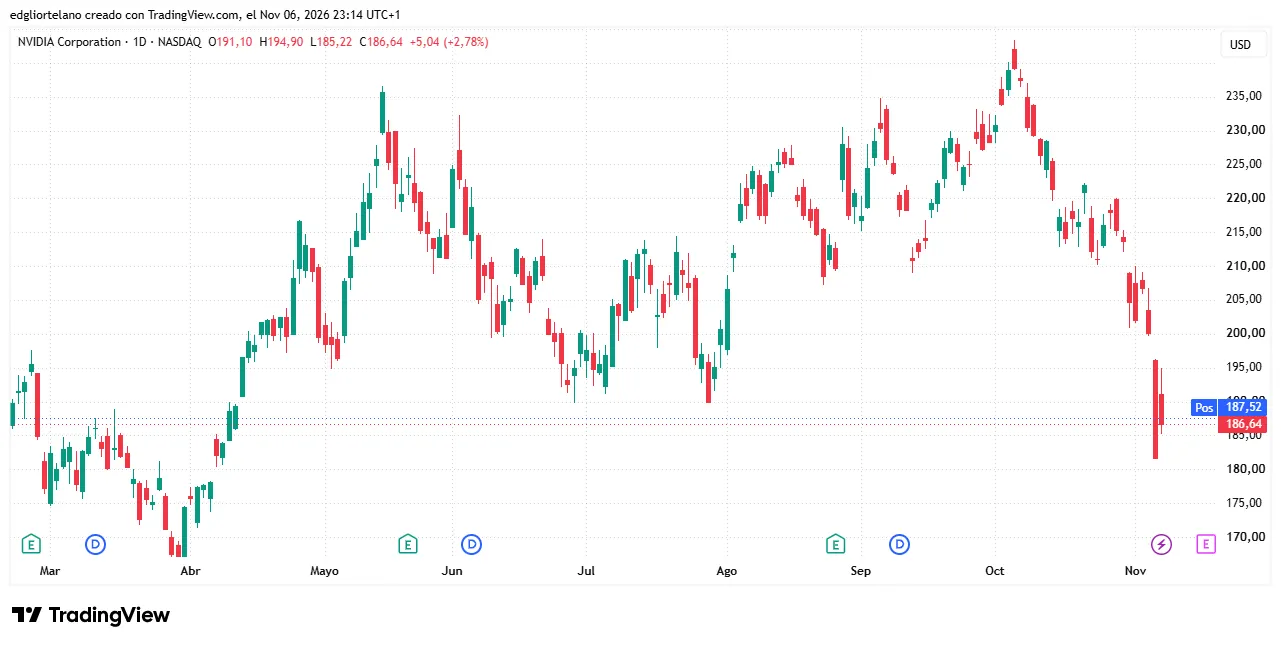
A market correction is classically defined as a decline of 10% or more from a recent asset peak, driven by shifting valuation multiples rather than fundamental business deterioration. For instance, if a premier semiconductor manufacturer trades at a price-to-earnings multiple of 60 based on expectations of hyper-growth, a sentiment shift causing investors to value those same earnings at a multiple of 40 will erase a third of the stock’s market value—even if the underlying company’s quarterly net income remains completely intact.
Conversely, the bursting of a bubble represents a systemic crisis of faith where speculative expectations prove fundamentally unachievable, causing the foundational capital supporting the boom to evaporate rapidly.
Financial history provides a sobering framework for evaluating this risk. During the dot-com crash of the early 2000s, the Nasdaq composite suffered an apocalyptic peak-to-trough decline of roughly 77% between March 2000 and October 2002. The underlying technological premise—that the internet would fundamentally reshape global commerce—was ultimately correct, but investors had drastically overestimated the speed at which commercial entities could monetize the infrastructure.
Telecom operators spent fortunes laying vast networks of transoceanic fiber-optic cables years before consumer and enterprise demand materialized. Global Crossing, a premier builder of international telecommunications infrastructure, filed for high-profile Chapter 11 bankruptcy protection in 2002. The internet survived, but countless overleveraged companies and retail shareholders were wiped out.
Artificial intelligence now faces an analogous mismatch between its immense long-term promise and the harsh realities of near-term cash generation. The ecosystem currently exhibits classic symptoms of speculative fervor: severe component bottlenecks—such as ongoing RAM shortages—are aggressively exploited by market participants seeking short-term arbitrage. Former cryptocurrency mining operations are pivoting to rent out idle hardware, while a proliferation of nascent cloud providers and inference startups crowd the market.
Consider a hypothetical corporate entity borrowing billions of dollars to construct a modern data center packed exclusively with Nvidia accelerators, banking on the assumption that it can lease out that raw computing power at premium rental rates for years to come. Should enterprise end-users pull back on AI spending, borrowing expenses increase, or construction schedules slip due to local zoning opposition, the underlying debt obligations remain absolute.
Under such pressure, the data center operator may be forced to cancel multi-billion-dollar semiconductor orders. Downstream, construction contractors lose critical business, regional utilities that planned massive grid expansions for anticipated power loads find themselves with excess capacity, and lenders holding corporate debt absorb severe write-downs. What begins as a localized stock market sell-off can quickly transmit systemic risk across the broader macroeconomy.
Structural Resiliency Among Big Tech
Despite these alarming structural parallels, institutional analysts emphasize a vital distinction between the current AI infrastructure boom and the speculative excesses of the dot-com era. Industry leaders such as Microsoft, Alphabet, Amazon, and Meta Platforms are immensely profitable legacy enterprises boasting established commercial customer bases, robust enterprise ecosystems, and massive, reliable free cash flows.
Unlike the pre-revenue, speculative dot-com startups of 2000, these mega-cap hyperscalers possess the balance-sheet strength to absorb cyclical contractions and delayed capital returns without threatening their core corporate survival. Consequently, it remains entirely plausible for artificial intelligence to successfully transform global industries over the coming decade while individual, over-leveraged AI component suppliers experience severe financial distress, and public market investors who overpaid for shares suffer prolonged drawdowns.
Nevertheless, financial warning lights are flashing brightly across the riskiest segments of the AI financing ecosystem. Market data published Friday revealed that the cost of insuring against a corporate debt default by specialized AI cloud provider CoreWeave climbed past 1,000 basis points. Credit default swaps function effectively as insurance policies on corporate loans; as protection costs surge, institutional investors are signaling elevated apprehension regarding the firm’s long-term debt-servicing capabilities.
At the same time, broader sovereign and corporate bond markets have continued to operate with relative stability, indicating that current market stress remains isolated to the most speculative, high-leverage corners of AI project financing rather than signaling an economy-wide banking crisis.
The Road Ahead: Upcoming Catalysts
The coming week will provide critical fundamental tests for the market far more definitive than daily technical price bounces. Upcoming financial results and operational disclosures from CoreWeave, Applied Materials, and Cisco Systems will offer hard data regarding whether enterprise clients are maintaining their hardware procurement schedules or quietly scaling back infrastructure orders.
Simultaneously, incoming macroeconomic inflation data will dictate central bank policy expectations, directly influencing the trajectory of borrowing costs. Persistent enterprise equipment orders, stable refinancing metrics, and manageable corporate debt profiles would substantiate the argument that the recent tech sell-off is merely a healthy, overdue market correction.
Conversely, repeated reports of canceled data center projects, failed debt refinancing rounds, and contracting enterprise sales would indicate that the financial foundations supporting the artificial intelligence boom are beginning to fracture. The central question facing global markets is no longer whether artificial intelligence possesses a transformative future, but whether every enterprise currently gambling billions of dollars on that future possesses the financial staying power to survive until it arrives.
