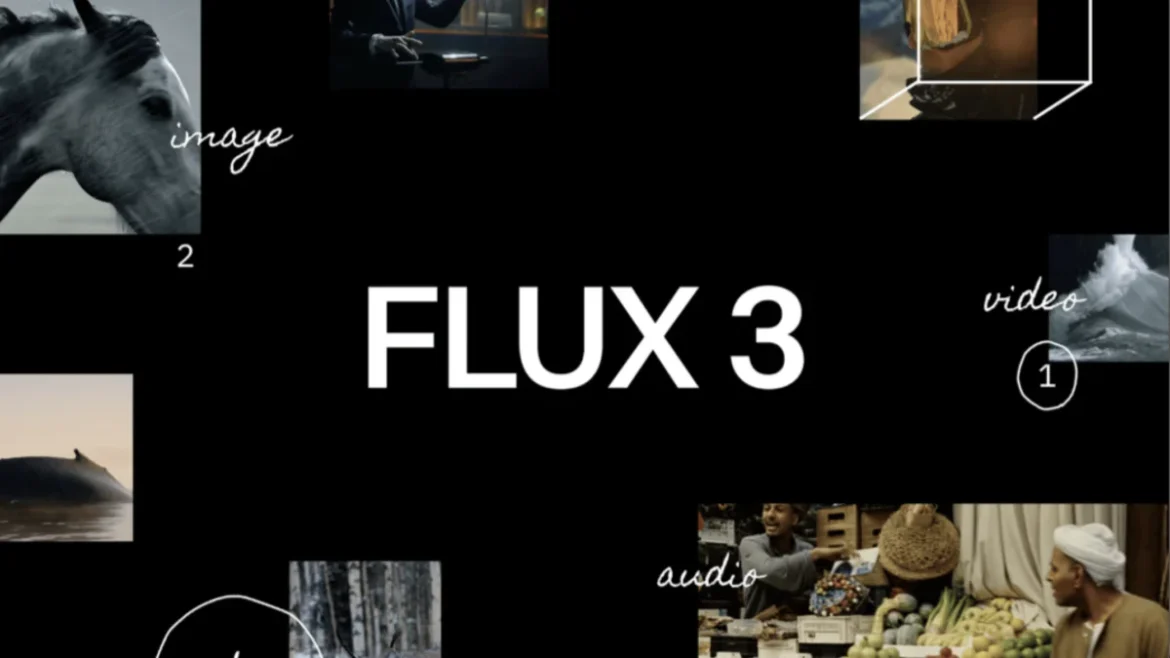
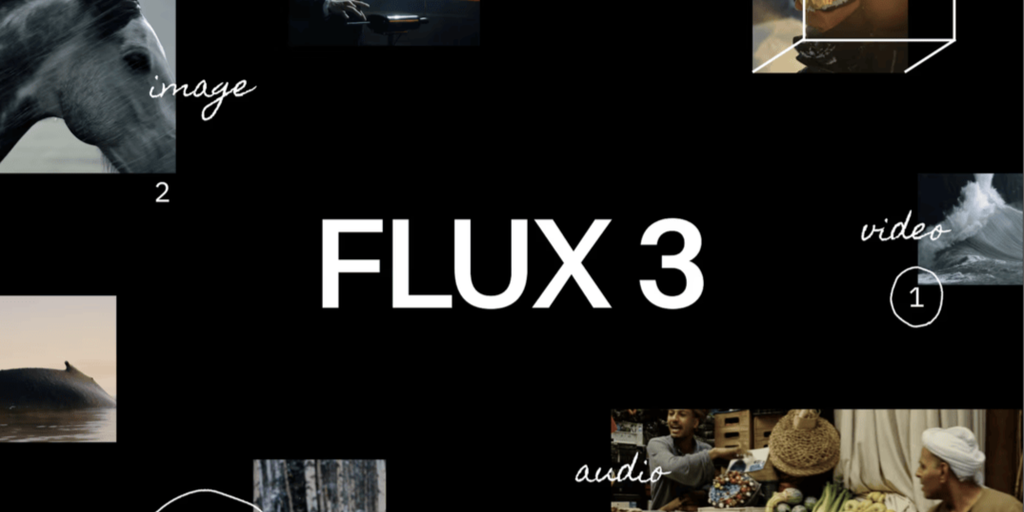
Black Forest Labs (BFL), the German artificial intelligence research powerhouse, on Thursday announced the release of FLUX 3, its latest flagship generative AI model. Marking a significant leap forward, FLUX 3 is the first iteration in the company’s acclaimed FLUX line to generate dynamic video content, moving beyond its foundational capabilities in still image synthesis. This pivotal development underscores BFL’s commitment to pushing the boundaries of generative AI, introducing a multimodal architecture that processes and learns from images, video, and audio concurrently within a singular, integrated system. This holistic approach to data processing positions FLUX 3 as a versatile tool with implications far beyond conventional content creation.
The Dawn of Multimodal Generative AI: FLUX 3’s Core Innovation
The core innovation driving FLUX 3 is its embrace of multimodality, a paradigm shift in AI model training where diverse data types—such as visual, auditory, and temporal information—are learned together by a single, unified model. Unlike previous generations of AI that often relied on separate, bolted-together tools for different media types, FLUX 3’s integrated architecture allows for a more profound understanding of the relationships between these elements. By simultaneously ingesting and processing images, video sequences, and associated audio, the model develops a richer, more coherent internal representation of the world, leading to more realistic and contextually appropriate outputs. This approach contrasts sharply with conventional methods where models specialized in one modality might struggle to accurately synthesize information from another without explicit external coordination.
The most anticipated feature of FLUX 3 is its groundbreaking ability to produce video clips, which can extend up to 20 seconds in length. Crucially, the system generates audio in perfect synchronicity with the visual content, encompassing everything from dialogue and intricate sound effects to ambient background noise. This level of integrated audio-visual generation represents a significant advancement, as many existing video AI models often require separate audio generation and subsequent synchronization, a process prone to inconsistencies and artificiality. FLUX 3’s native synchronization capability ensures a more immersive and believable output, bridging a critical gap in AI-generated media.
Benchmarking Performance: A New Standard in AI Video Generation
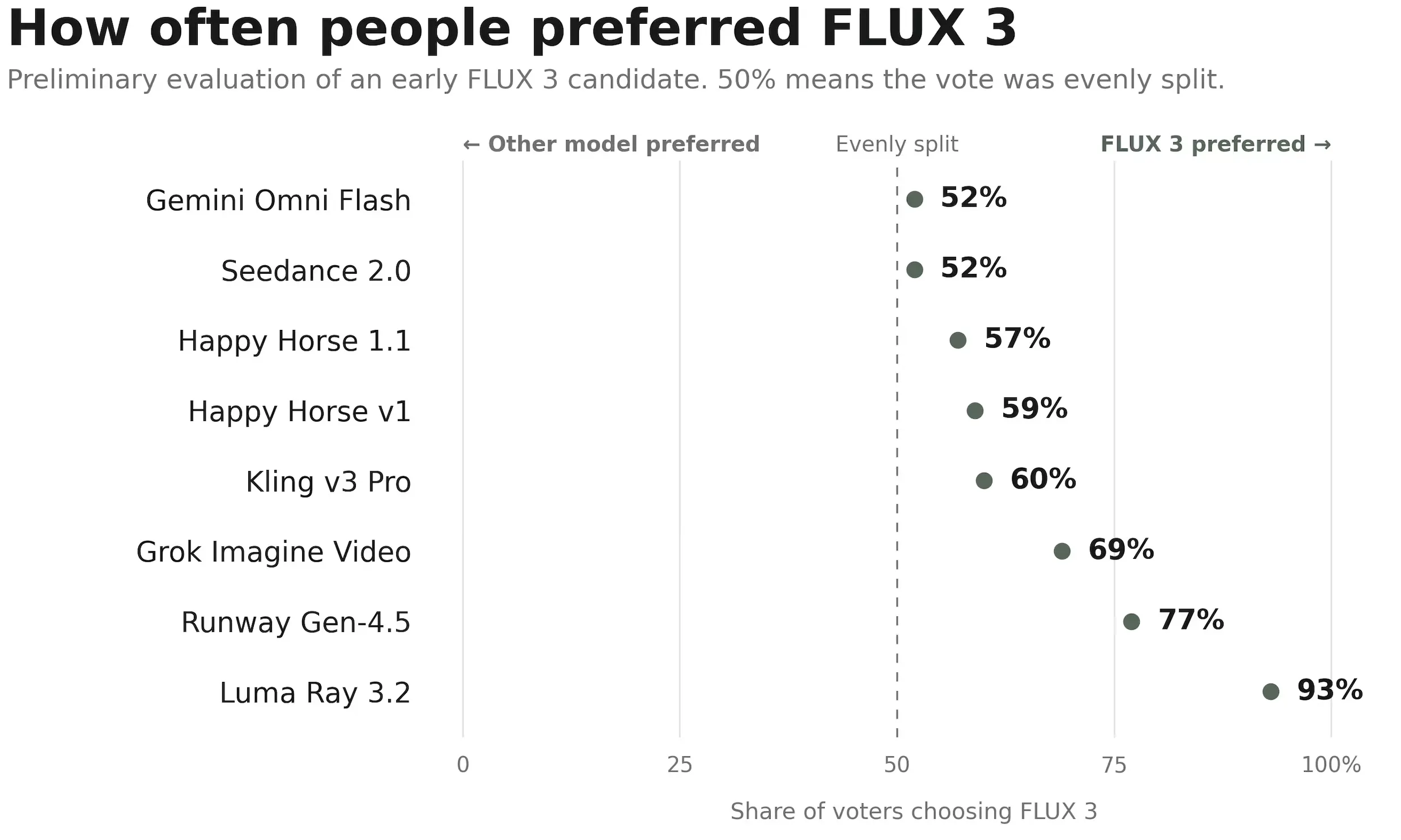
Initial evaluations of FLUX 3’s video generation capabilities have yielded impressive results, signaling a potential shift in the competitive landscape of generative AI. In head-to-head comparisons conducted by human reviewers, FLUX 3’s output was preferred over Runway Gen-4.5 in a remarkable 77% of cases. Its performance against Luma Ray 3.2 was even more dominant, with FLUX 3 being favored in 93% of comparisons. While the margin was narrower, FLUX 3 also demonstrated a slight edge over industry contenders like Gemini Omni and Seedance, winning 52% of those evaluations.
It is important to note that these evaluations were conducted as preference tests, where human reviewers simply selected the clip that appeared and sounded more convincing. This methodology, while subjective, is widely accepted in the field of generative AI as a robust indicator of perceived quality and realism, particularly for creative outputs where objective scoring rubrics can fall short. The consistent preference for FLUX 3’s generated content suggests a significant qualitative leap in its ability to produce engaging and high-fidelity video and audio.
Beyond its headline video capabilities, FLUX 3 maintains and even enhances BFL’s legacy in still image generation. The company has showcased a diverse array of images produced by FLUX 3, demonstrating its versatility across a broad spectrum of artistic styles, extending well beyond mere photorealism. This dual proficiency in both static and dynamic visual media solidifies FLUX 3’s position as a comprehensive generative tool.
From Pixels to Physics: FLUX-mimic and the Future of Robotics
Black Forest Labs views FLUX 3 as more than just a content creation utility. According to Robin Rombach, co-founder and CEO of BFL, "A model that only learns images can only generate images." This statement encapsulates the company’s ambitious vision: the multimodal training of FLUX 3, particularly its ability to predict and synthesize video, inherently fosters an understanding of the underlying physics of the real world. Concepts such as weight, contact dynamics, and precise timing—all crucial for depicting realistic motion in video—are implicitly learned by the model. This foundational understanding, BFL posits, is precisely what a machine needs to navigate and interact effectively within the physical environment.
This ambitious hypothesis has found tangible expression in FLUX-mimic, a collaborative project developed with Zurich-based mimic robotics. FLUX-mimic leverages FLUX 3’s advanced video-prediction engine and augments it with a lightweight "decoder"—a specialized component designed to translate the model’s internal understanding of physical motion into actual, executable robot movements. This innovative integration aims to bridge the gap between AI-driven perception and real-world robotic action.
The practical applications of FLUX-mimic are already being explored in critical industrial settings. German automotive giant Audi is actively testing the system for complex manufacturing tasks, such as the precise fitting of flexible door seals. This type of work has historically posed significant challenges for conventional automation systems due to the inherent variability and deformable nature of the materials involved. Stephan-Daniel Gravert, co-founder of mimic robotics, highlighted the strategic alignment, stating, "Audi represents the kind of manufacturing partner we built FLUX-mimic for." Christoph Schneider of Audi confirmed the system’s efficacy, noting that the robots powered by FLUX-mimic are now capable of "solve complex soft-body manipulation work" that was previously beyond the reach of older robotic technologies. BFL further claims that the full FLUX-mimic system boasts a reaction time of approximately 101 milliseconds, a speed comparable to human visual reflexes, underscoring its potential for agile and responsive industrial applications.
Black Forest Labs: A Chronology of Disruptive Innovation
The ascendancy of the FLUX series and Black Forest Labs itself is a compelling narrative of rapid innovation and market disruption. Founded in August 2024 by a cadre of veteran researchers who had previously contributed to the development of the original Stable Diffusion models at Stability AI, BFL quickly established itself as a formidable player in the generative AI landscape. The company’s initial FLUX models made an immediate impact, notably outperforming both MidJourney and Stability AI’s own then-underwhelming Stable Diffusion 3.
The open-source iterations, Flux Dev and Flux Schnell, swiftly garnered critical acclaim, seizing the unofficial title of "best open-source image generator." This achievement was particularly significant as it defied widespread industry expectations that Stability AI’s anticipated Stable Diffusion 3.5 "do-over" would reclaim this crown. However, Stability AI’s subsequent releases failed to match the quality and efficiency of BFL’s offerings.
Further solidifying its dominance, FLUX 1.1 Pro, a closed-source model, went on to top the prestigious Artificial Analysis image arena in October 2025, cementing BFL’s reputation for producing cutting-edge generative AI.
BFL continued its development trajectory with the release of FLUX 2 in November 2025. While technically advanced, FLUX 2 did not achieve the same level of widespread popularity as its predecessor, particularly within the open-source community. The open-source image generation crown, previously held by the original Flux, was eventually passed to Alibaba’s Z-Image Turbo in late 2025. Z-Image Turbo distinguished itself by matching Flux’s quality on lower-end consumer graphics cards, a feat that resonated deeply with independent AI artists and enthusiasts. A user on CivitAI, a popular platform for AI art models, famously remarked at the time, "This is what SD3 was supposed to be," reflecting the high expectations and subsequent disappointment surrounding Stability AI’s offerings compared to emerging competitors.
FLUX 3 now represents Black Forest Labs’ emphatic comeback, aiming to reclaim its leading position across multiple modalities.
Market Reception and Future Outlook
The release strategy for FLUX 3 is phased. Currently, its advanced video and robotics "Action" capabilities are available through early access via APIs and to select strategic partners, with mimic robotics being a prominent example. The powerful image generation features are slated for release "in the coming weeks." This controlled rollout allows BFL to refine the model based on early feedback from key users and industrial partners.
For the broader AI community and independent developers, the highly anticipated open-weight Dev version of FLUX 3, which will be the only tier BFL plans to release for local deployment and extensive customization, is not expected until later in 2026. This timeline suggests BFL’s strategy of first leveraging its advanced capabilities in enterprise and specialized applications before making it widely accessible, potentially maximizing its commercial impact while fostering community engagement in due course.
Broader Impact and Industry Implications
The introduction of FLUX 3, with its multimodal architecture and demonstrated prowess in both high-fidelity video generation and sophisticated robotic control, carries profound implications for several industries.
In the creative industries, FLUX 3’s ability to generate coherent, audio-synced video up to 20 seconds long could significantly accelerate content production workflows for filmmakers, advertisers, and digital artists. The model’s capacity to produce a broad variety of styles beyond photorealism offers unprecedented creative flexibility, enabling rapid prototyping of visual concepts and the generation of entirely new forms of media. The competitive edge over established video AI models like Runway Gen-4.5 and Luma Ray 3.2 positions FLUX 3 as a frontrunner in a rapidly evolving market, potentially driving further innovation and competition.
For the robotics and manufacturing sectors, the FLUX-mimic system represents a paradigm shift. By enabling robots to "learn the physics" of interaction through video prediction, BFL and mimic robotics are addressing long-standing challenges in automation, particularly those involving deformable objects and complex, nuanced manipulation tasks. The Audi partnership exemplifies how this technology can unlock new levels of automation in industries where precision, adaptability, and real-time responsiveness are paramount. This move could redefine assembly lines, logistics, and even service robotics, offering more versatile and intelligent automated solutions. The rapid reaction time of 101 milliseconds is critical for real-world industrial applications, where safety and efficiency are directly tied to a robot’s ability to respond swiftly to dynamic environments.
More broadly, FLUX 3’s multimodal foundation signals a maturing of generative AI technology. As models become more adept at understanding and synthesizing information across different sensory inputs, their potential applications expand exponentially. This development brings the industry closer to the creation of truly general-purpose AI agents capable of perceiving, reasoning, and acting in complex, real-world scenarios. The integration of "vision" (video) with an "understanding of physics" (via video prediction) into robotic "action" is a crucial step towards embodied AI, where intelligent systems can interact seamlessly with their physical surroundings.
Black Forest Labs, through FLUX 3, has not only delivered a powerful new tool for content creation but has also laid a significant groundwork for the next generation of AI-driven automation, reaffirming its position at the vanguard of artificial intelligence innovation. The coming months and years will undoubtedly reveal the full extent of its impact across diverse technological landscapes.