
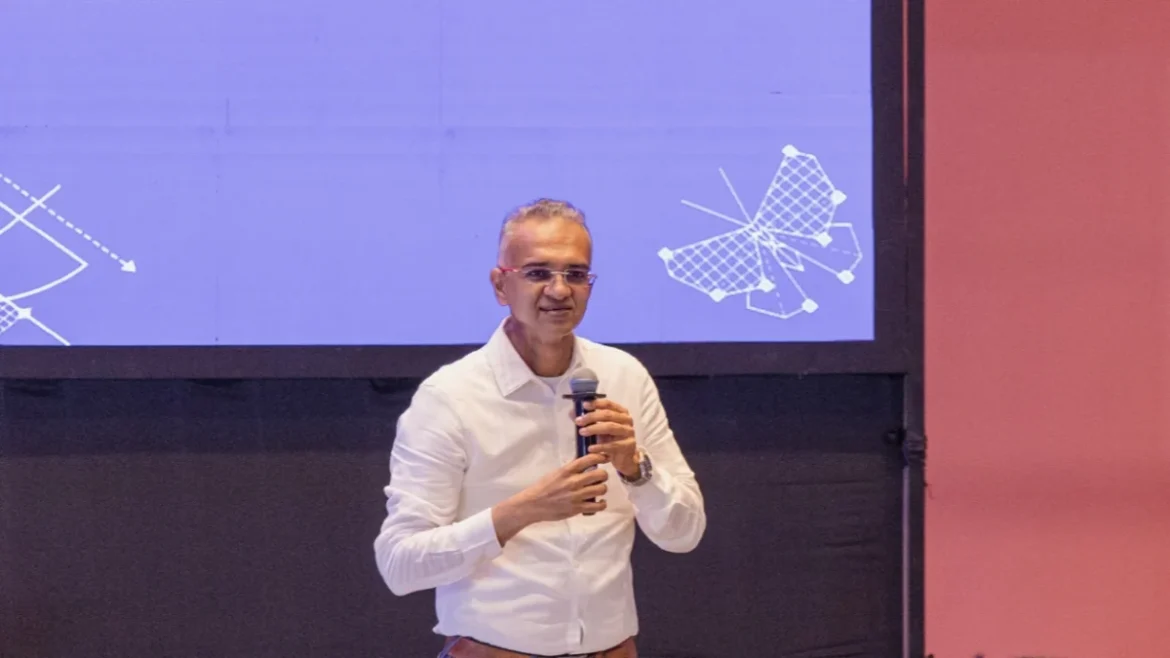
India’s digital payment landscape, spearheaded by the Unified Payment Interface (UPI), stands at the cusp of a transformative new era, with Artificial Intelligence (AI) poised to become the pivotal force driving its next phase of exponential growth. The National Payments Corporation of India (NPCI), the architect and operator of UPI, envisions a future where AI not only propels daily transactions past the one-billion mark but also fortifies security, expands credit access, and enhances user experience for hundreds of millions of new users. This ambitious vision was articulated by Dilip Asbe, managing director and CEO of NPCI, during a compelling interview with TechCrunch at Mumbai Tech Week (MTW) 2026 last month, highlighting a strategic shift towards AI integration across all facets of India’s digital financial ecosystem.
The journey of UPI has been nothing short of remarkable. Launched in 2016, this instant real-time payment system has democratized digital transactions, making them accessible even to those with basic feature phones. From humble beginnings, UPI has scaled unprecedented heights, currently processing over 750 million daily transactions. This astounding growth reflects India’s rapid digital adoption, driven by smartphone penetration, affordable data, and government initiatives promoting financial inclusion. The target of exceeding a billion daily transactions is not merely an incremental step but a testament to the system’s robust infrastructure and the immense untapped potential within India’s vast population. Reaching this milestone would further solidify India’s position as a global leader in digital payments, setting a benchmark for other developing economies.
The AI Imperative: Fueling the Next Growth Wave
Asbe’s discourse underscored that AI is not just an ancillary tool but a fundamental component for UPI’s evolution. "AI will be used very effectively when we look at the next wave of UPI, and that includes all aspects, including reaching new users," he stated, emphasizing a holistic integration strategy. The NPCI, in conjunction with the Reserve Bank of India (RBI) and the government, aims to leverage AI to onboard an additional half a billion users, a task that demands innovative approaches to overcome existing barriers of literacy, language, and digital familiarity.
One of AI’s most critical applications will be in fraud prevention and user protection. With the increasing volume and value of transactions, the threat of financial fraud, phishing, and scamming also escalates. AI-powered algorithms can analyze vast datasets of transaction patterns, user behavior, and network activities in real-time to detect anomalies and identify suspicious transactions indicative of fraud. This includes detecting "mules" – individuals who knowingly or unknowingly facilitate money laundering by allowing their accounts to be used for illicit transfers. By employing advanced machine learning models, NPCI aims to create a highly secure environment, safeguarding both current users and new entrants from financial malpractices. The ability to predict and prevent fraud before it occurs, rather than merely reacting to it, will be a game-changer for maintaining trust in the digital payment system.
Beyond security, AI is envisioned as a powerful enabler for credit distribution. Millions of small merchants and individuals in India, particularly in semi-urban and rural areas, lack access to formal credit due to insufficient traditional credit histories. However, their consistent use of UPI generates a rich "digital footprint" – a detailed record of their transactions, payment frequency, and business activity. Asbe highlighted this opportunity: "AI must also be used to provide credit to all the users and merchants who have digital footprints." By analyzing these digital footprints, AI models can assess creditworthiness, enabling banks and fintechs to offer tailored micro-loans, working capital, and other financial products. This has profound implications for financial inclusion, empowering small businesses to grow and individuals to manage their finances more effectively, thereby stimulating economic activity at the grassroots level.
Voice Interfaces: A Frontier for Financial Inclusion
A significant aspect of AI’s potential in India lies in its capacity to break down language and literacy barriers through voice and multilingual solutions. Asbe noted, "We must use AI to look at the voice and multilingual solutions to make onboarding simpler." Given India’s linguistic diversity, with hundreds of languages and dialects, a voice-enabled interface could be transformative for users who are not comfortable with text-based digital interactions. Imagine a farmer in a remote village making a payment by simply speaking a command in their native tongue.
While the concept of voice as an interface is widely discussed, particularly in a market like India, Asbe acknowledged that it is still in its nascent stages. NPCI itself launched "Hello UPI," a voice assistant-based interactive system, in 2023, designed to facilitate seamless transactions. However, its adoption has yet to gain significant traction. Asbe believes that for voice interfaces to become a critical component, models need to achieve higher accuracy and be integrated into compelling use cases that truly simplify user journeys. The challenges include understanding diverse accents, handling background noise, and processing complex financial instructions reliably. Nevertheless, the long-term potential for voice AI to bridge the digital divide and enhance accessibility for India’s diverse population remains immense.
Navigating AI in Finance: Regulation and Innovation
The rapid convergence of AI and finance raises critical questions regarding regulation, user protection, and ethical deployment. Globally, startups and established financial institutions are integrating AI into their offerings, from AI-powered trading agents to personalized financial advice chatbots. In the U.S., platforms like Coinbase and Robinhood are exploring agent-based trading, while OpenAI allows users to load personal account data into ChatGPT for financial insights. NPCI has also showcased agentic commerce and payments demos with partners like Razorpay, indicating a proactive exploration of these advanced capabilities.
However, Asbe emphasized that widespread rollout of such sophisticated AI functionalities in India must be predicated on a robust regulatory framework. "NPCI’s CEO thinks that with robust regulations and a framework, India can also adopt AI-powered finance," the original report noted. The paramount concern is ensuring sufficient protection for users and mitigating inherent risks. This includes establishing clear guidelines for data privacy, algorithmic transparency, and accountability. In scenarios where AI agents operate on behalf of users, there must be a clear audit trail of instructions and consent. If something goes awry, the system must be able to meticulously trace back to the user’s explicit directives and permissions given to the agent. This regulatory prudence is crucial for fostering public trust and preventing potential misuse or financial harm. The RBI, as India’s central banking institution, plays a vital role in crafting these forward-looking regulations, balancing innovation with consumer protection.
Cultivating Indigenous AI: The Power of Data and SLMs
Beyond the mere adoption of existing AI models, Asbe sees a unique opportunity for the Indian finance ecosystem to build its own small language models (SLMs). He posited, "We believe that the models will differentiate from each other based on the datasets that are made available to them. We have a very rich dataset in our ecosystem." India’s vast and diverse transactional data, stemming from UPI’s massive scale, represents an invaluable resource. This data, carefully anonymized and aggregated, can serve as the bedrock for training specialized AI models that are inherently "sharp, specific, and as deterministic as possible" for the Indian context.
This call to action for Indian banks, fintechs, and the broader ecosystem to invest in developing indigenous SLMs is strategic. Such models, trained on local languages, cultural nuances, and specific financial behaviors, would outperform generic global models in understanding and serving the Indian populace. These specialized SLMs could be deployed for a multitude of purposes, from personalized financial advisory to enhancing customer service and fraud detection with greater accuracy.
NPCI has already demonstrated a commitment to this vision with the launch of FIMI (Financial Inclusion and Mobility Intelligence) last year. FIMI is India’s first AI language model specifically tailored for payments, designed to solve user disputes. Asbe proudly stated that FIMI is already serving over a million users, helping them cancel mandates and resolve various issues, and is scaling rapidly. This homegrown solution exemplifies the potential for India to not only consume but also produce cutting-edge AI technologies relevant to its unique market needs.
The Competitive Landscape of UPI: Challenges and Strategies
While UPI’s growth story is compelling, the ecosystem faces challenges, particularly concerning market concentration. NPCI has consistently advocated for healthy competition among UPI applications, yet data reveals a significant dominance by Walmart-owned PhonePe and Google Pay, which collectively command over 80% of the market share. This duopoly raises concerns about potential monopolistic practices and stifling innovation from smaller players.
To address this, the regulator’s plan to cap an app’s market share at 30% is a critical intervention. Initially slated for implementation earlier, the deadline has been deferred multiple times and is currently set for December 31, 2026. This cap aims to foster a more diversified and competitive environment, encouraging new entrants and preventing any single entity from gaining undue influence.
Asbe acknowledged the low switching costs between UPI apps, with most core features being standardized. He attributed the market leaders’ position to the substantial investments PhonePe and Google have poured into their platforms. However, he posited that the underlying issue for concentration risk is the "availability of a viable commercial model." He believes that once more sustainable and profitable business models emerge within the fintech ecosystem, "newer players will start investing very heavily," leading to a more balanced market. This implies that the current models, heavily reliant on incentives and discounts, may not be sustainable for long-term diversification.
In a move to inject more competition and provide a sovereign alternative, NPCI spun off its BHIM UPI app in 2024, making it a wholly-owned subsidiary. While BHIM’s transaction volume has grown, its overall market share hovers around 1%. Asbe clarified that NPCI is not eyeing a specific market share target for BHIM. Instead, its primary objective is to establish BHIM as a "sovereign and secure alternative" to other apps, ensuring a robust, government-backed option for users and maintaining strategic independence in the digital payment infrastructure. This strategic positioning underscores India’s commitment to digital sovereignty and resilience.
Broader Economic and Regulatory Implications
India’s trajectory in digital payments, driven by UPI and now increasingly by AI, has profound implications for its position as a global digital economy. The success of UPI is often cited as a model for digital public infrastructure (DPI) worldwide, inspiring similar initiatives in other countries. The strategic integration of AI into this infrastructure will further enhance its capabilities and reach.
For investors, the evolving regulatory landscape surrounding AI in finance will be a crucial factor. Clear, robust, and forward-thinking regulations that balance innovation with consumer protection will attract further investment into India’s vibrant fintech sector. The opportunity to build specialized AI models leveraging India’s unique datasets could also spawn a new wave of deep tech startups and innovation hubs. This environment could foster healthy competition, driving down costs, improving services, and ultimately accelerating financial inclusion for India’s vast population.
The vision articulated by Dilip Asbe paints a picture of a technologically advanced, inclusive, and secure digital payment ecosystem in India. By strategically harnessing AI for user growth, fraud prevention, credit distribution, and the development of indigenous language models, NPCI aims to not only meet but exceed its ambitious transaction targets, solidifying UPI’s legacy as a global exemplar of digital transformation. The coming years will undoubtedly witness a dynamic interplay of innovation, regulation, and market forces shaping the future of finance in one of the world’s largest and fastest-growing digital economies.
