

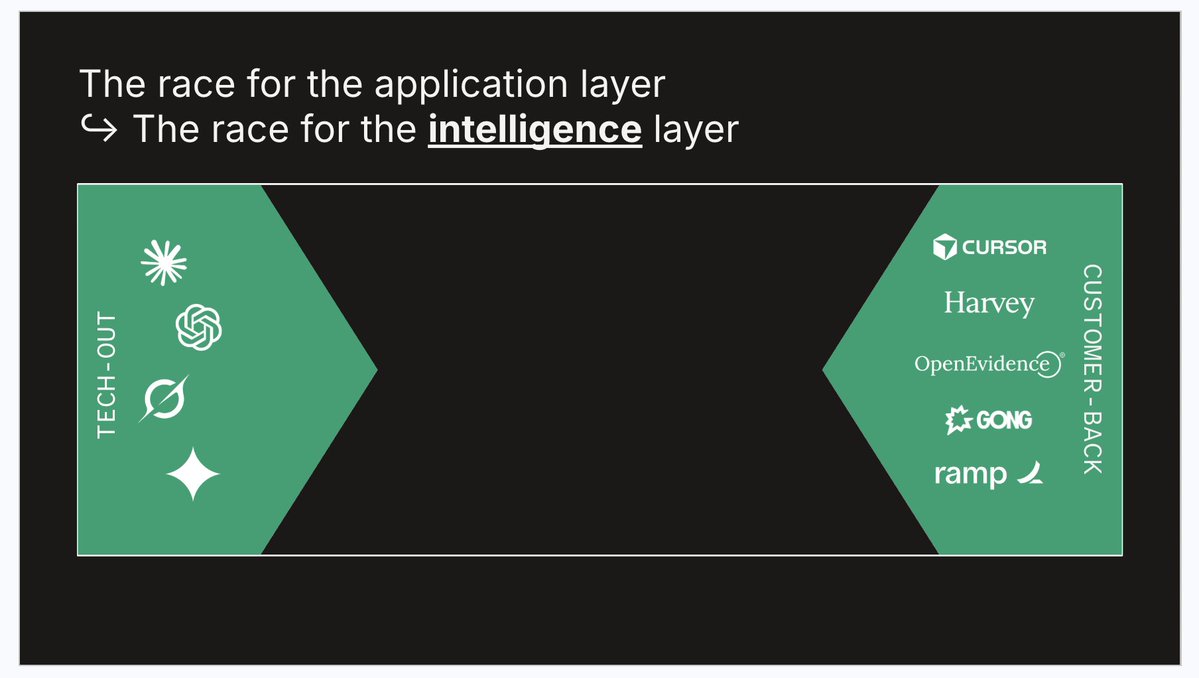
The modern corporate landscape is undergoing a fundamental architectural shift, moving past debates over user interfaces, software workflows, and go-to-market strategies to confront a much deeper imperative: the control of foundational intelligence itself. This evolving paradigm was thrust into sharp focus during a recent summit hosted by Silicon Valley venture capital firm Sequoia Capital. Bringing together a curated cohort of prominent artificial intelligence founders, researchers, and technical builders, the gathering served as a crucible for discussions on the post-training stack, open-weight accessibility, and the strategic necessity of vertical integration.
Echoing sentiments previously expressed by industry heavyweights—including Palantir CEO Alex Karp, who famously urged enterprises to "own the means of production," and Microsoft CEO Satya Nadella, who cautioned that relying entirely on frontier labs amounts to paying twice with capital and proprietary knowledge—the summit crystallized a growing consensus. While frontier application programming interfaces (APIs) and third-party agents remain vital for general workloads, a vanguard of high-growth technology companies is aggressively moving to vertically integrate, shaping model weights in-house to secure a long-term competitive moat.
The Shift from Renting to Owning: Background and Catalysts
For the past several years, the prevailing blueprint for software-as-a-service (SaaS) and enterprise tech companies building with artificial intelligence relied on renting intelligence. Organizations would leverage proprietary foundation models via cloud APIs, wrapping them in custom user interfaces and basic Retrieval-Augmented Generation (RAG) architectures. While this approach lowered the barrier to entry, it introduced systemic vulnerabilities: escalating inference costs, constrained operating speeds, exposure of sensitive proprietary data to external lab servers, and an over-reliance on external providers whose product roadmaps could easily overlap with or cannibalize an application layer startup.

Two recent developments have accelerated the feasibility of breaking free from this dependency. First, the open-weight frontier has evolved at a blistering pace. Baseline models such as Kimi K3 and GLM 5.2 have largely eliminated the historical treadmill wherein months of fine-tuning efforts were instantly rendered obsolete by the next major frontier lab release. Organizations can now build atop open-weight baselines that sit remarkably close to the absolute frontier of model performance.
Second, the independent post-training and infrastructure ecosystem has matured significantly. Companies like Fireworks, Mercor, and LangChain have democratized access to the sophisticated machinery previously locked inside elite research labs. Ranging from automated data synthesis and human-in-the-loop preference tuning to robust harness engineering and online production learning, the tooling required to build, test, and deploy customized models is now widely accessible.
Strategic Drivers for In-House Intelligence
Industry leaders participating in the Sequoia summit—including representatives from legal tech unicorn Harvey, AI developer platform LangChain, workflow automation firm Trajectory, and infrastructure provider Fireworks—outlined four primary economic and strategic triggers prompting organizations to make the leap toward owning their intelligence layer.
The first catalyst is cost economics, commonly framed as AI COGS (Cost of Goods Sold). As artificial intelligence applications scale to millions of active enterprise users, relying on per-token pricing from third-party APIs can severely compress gross margins. Owning and efficiently serving a distilled, domain-specific model drastically reduces inference expenditure at scale.

The second factor is operational latency. In latency-sensitive verticals such as automated software engineering (e.g., real-time tab-autocomplete) or cybersecurity threat detection, large, generalized frontier models are often too slow. Small, highly specialized, and distilled custom models routinely outperform massive general-purpose architectures simply because response time is the primary arbiter of utility.
The third driver involves data sovereignty and security. Enterprises operating in highly regulated fields—such as legal services, healthcare, and finance—are increasingly reluctant to route proprietary feedback loops, enterprise evaluations, and sensitive customer interactions through third-party APIs. Keeping these continuous learning loops strictly on-premise or within private cloud environments mitigates regulatory exposure and protects intellectual property.
Finally, organizations are driven by the imperative to control their own destiny. As foundational labs push upward into the application layer, and application companies push downward into model training loops, the distinction between the software product and the underlying intelligence is dissolving. To ensure long-term defensibility, companies must control the learning loop that dictates how their product reasons and adapts.
The Engineering Playbook: From Zero to One
Transitioning from a consumer of black-box APIs to an architect of proprietary intelligence requires a deliberate structural approach. Summit participants outlined a practical, four-pillar roadmap for organizations embarking on this journey.
1. Rigorous Evaluation Frameworks (Evals)
As Gabe Pereyra of legal tech leader Harvey noted during the sessions, "If you don’t have a good benchmark, you can’t train models." Constructing reliable evaluations is the foundational prerequisite for any serious in-house AI strategy. An effective eval transforms subjective qualitative assessments—often described as "vibe checks"—into repeatable, automated test suites consisting of prompts, domain-specific context, and programmatic graders. Harvey, for instance, constructed its proprietary Legal Agent Benchmark by distilling real-world legal workflows into over 1,200 distinct agent tasks spanning 24 practice areas, measured against more than 75,000 expert-authored rubrics. Establishing rigorous evals prior to model selection ensures that architectural decisions are driven by empirical data rather than speculation.
2. Harness and Context Engineering
An autonomous AI agent typically comprises three core components: the foundational model, the contextual data, and the harness. Harrison Chase, CEO of LangChain, emphasized that the primary responsibility of the harness is to route queries, manage memory, interface with external tools, and deliver the precise context to the model at the exact moment it is needed. As tasks grow increasingly out-of-distribution for off-the-shelf models, standard harnesses fail. A custom, inspectable harness allows engineering teams to trace every execution path, monitor tool utilization, enforce safety fallbacks, and dynamically route specialized sub-tasks to the most efficient model available.
3. Targeted Post-Training Methodologies
Post-training is not a monolith; rather, it encompasses a spectrum of techniques tailored to specific operational deficiencies. According to Lin Qiao, if a model lacks factual accuracy, post-training is unnecessary—simple RAG or expanded context windows will suffice. However, if output formatting or behavioral consistency is flawed, supervised fine-tuning is required. When the goal is aligning model output with nuanced product "taste," preference tuning is deployed. For complex, multi-step reasoning in specialized verticals, Reinforcement Learning (RL) serves as the primary mechanism, followed by model distillation to optimize speed and cost efficiency.
4. Continuous Online Learning
Deploying a static model into production is insufficient for complex enterprise workflows. As Arjun Karanam of LangChain observed, even the most brilliant general intellect dropped into a specialized corporate environment on day one lacks institutional experience. AI agents accumulate this vital experience through production trajectories—the complete record of context viewed, tools invoked, outputs generated, and subsequent human edits or retries. By capturing these trajectories via infrastructure tools like LangSmith, organizations establish a continuous learning loop where failed tasks automatically convert into new evals, missing knowledge populates context layers, and inefficient tool responses drive immediate harness improvements.

Strategic Implications and Industry Outlook
The push toward owning the intelligence layer carries profound implications for the broader technology sector. Adopting an in-house intelligence strategy undoubtedly raises operational complexity and introduces a lower performance floor for organizations lacking sophisticated engineering talent. However, it simultaneously unlocks an unprecedented ceiling of capability, customization, and economic sustainability.
As demonstrated by lean, highly efficient research teams—such as Harvey, which achieved groundbreaking domain-specific research milestones with a core team of just seven engineers—building proprietary intelligence is no longer the exclusive domain of trillion-dollar research laboratories. By leveraging open-source foundation models, independent post-training infrastructure, and rigorous internal evaluation frameworks, agile startups and forward-thinking enterprises are successfully cultivating specialized digital intellects tailored explicitly to their domain expertise.
Ultimately, the future of artificial intelligence will not be dictated by a monolithic monopoly of frontier labs. Instead, the maturation of the post-training stack heralds a pluralistic ecosystem where enterprises harness massive foundational brains for broad reasoning while simultaneously cultivating proprietary, domain-obsessed geniuses of their own. In this new paradigm, individual enterprise identity triumphs, and the ultimate battleground for software supremacy shifts decisively to the intelligence layer.
