
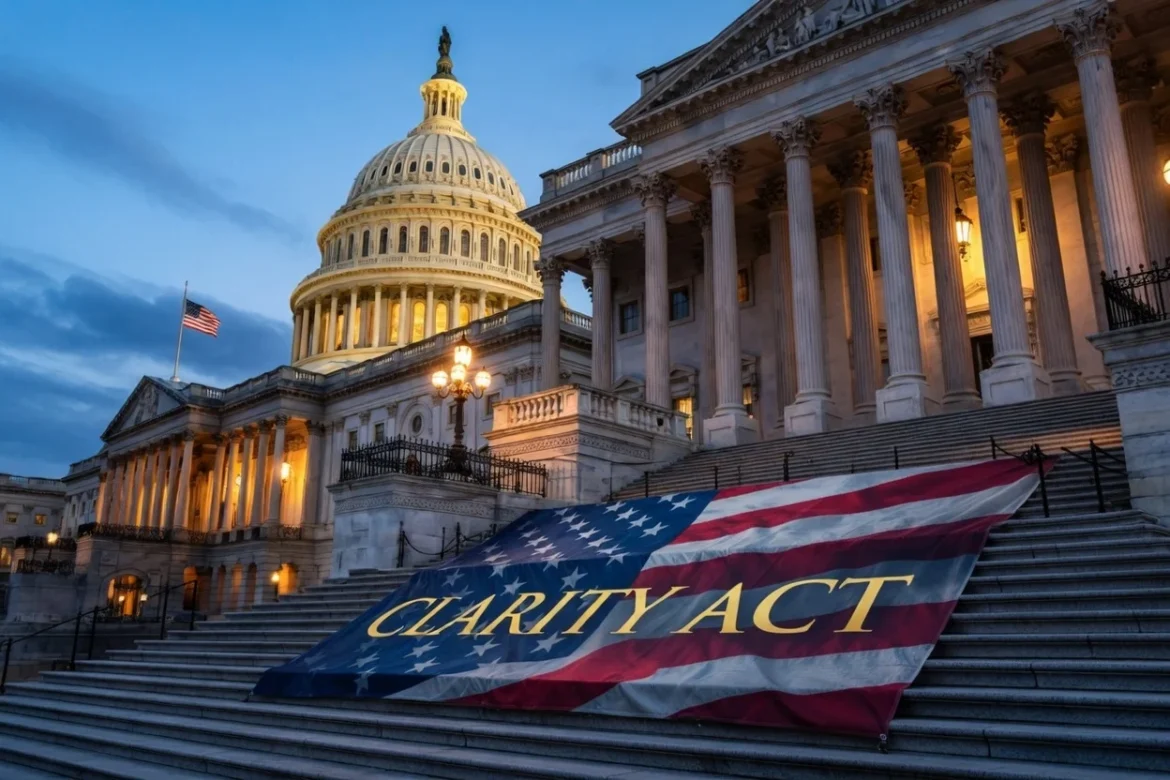
The CLARITY Act, a landmark piece of legislation designed to establish a comprehensive regulatory framework for digital assets in the United States, faces an increasingly precarious path towards passage as a fierce ethical dispute has erupted, primarily targeting Senate Democrat Kirsten Gillibrand (D-NY). Progressive advocacy groups have launched a concerted campaign, accusing the senator of hypocrisy related to her son’s involvement in a cryptocurrency venture, a development that now casts a significant shadow over efforts to secure the crucial 60 Senate votes required for the bill’s advancement before the looming August recess. The unresolved ethics provisions have rapidly emerged as the principal impediment blocking the passage of the CLARITY Act, which proposes to delineate and share oversight responsibilities for the burgeoning crypto industry between the Commodity Futures Trading Commission (CFTC) and the Securities and Exchange Commission (SEC).
The CLARITY Act: A Bid for Regulatory Certainty in a Volatile Market
The CLARITY Act, a bipartisan initiative, seeks to address the persistent regulatory ambiguity that has long characterized the U.S. digital asset landscape. For over a decade, the lack of clear federal guidelines has left market participants, from innovators and investors to exchanges and developers, navigating a patchwork of state laws and enforcement actions driven by various federal agencies, often leading to conflicting interpretations. The proposed legislation aims to provide much-needed clarity by defining which digital assets fall under the purview of the CFTC as commodities and which are deemed securities, subject to SEC oversight. This division is critical for fostering innovation while simultaneously ensuring robust consumer protection and market integrity. Proponents argue that a well-defined regulatory environment is essential for the U.S. to maintain its competitive edge in the global digital economy, attracting capital and talent that might otherwise seek more favorable jurisdictions. The global cryptocurrency market, valued at over $2 trillion, underscores the economic significance of establishing a stable and predictable regulatory regime. Without it, the U.S. risks falling behind regions like the European Union, which has already implemented comprehensive frameworks such as Markets in Crypto-Assets (MiCA).
The genesis of the CLARITY Act and similar legislative attempts stems from a growing recognition within Congress that the existing financial regulatory architecture, largely designed for traditional assets, is ill-equipped to handle the complexities and novelties of digital currencies and blockchain technology. Previous efforts, such as the Lummis-Gillibrand Responsible Financial Innovation Act, laid much of the groundwork, highlighting the bipartisan desire to bring order to the crypto space. The current CLARITY Act represents a refined attempt to achieve this goal, having undergone extensive consultations with industry stakeholders, financial regulators, and legal experts. Its passage is viewed by many as a critical step towards legitimizing digital assets within the broader financial system and unlocking their full potential.
Progressive Groups Escalate Pressure Over Family Crypto Ties
The current turbulence surrounding the CLARITY Act intensified this week with a scathing letter dispatched to every Democratic Senate office by a coalition of influential progressive organizations: Indivisible, Demand Progress, and the Revolving Door Project. The letter, publicly accessible and widely circulated, meticulously detailed accusations of hypocrisy against Senator Gillibrand, asserting that her conduct "undermines Democratic efforts to criticize Trump administration corruption." At the heart of their grievance lies the financial venture of Senator Gillibrand’s son, Theo Gillibrand, who serves as the founder of American Perpetuals Exchange. This crypto platform has successfully raised a substantial $30 million from investors, operating within the very industry that his mother is actively legislating.
American Perpetuals Exchange reportedly specializes in perpetual futures contracts, a type of derivative widely used in cryptocurrency markets. These products allow traders to speculate on the future price of an asset without an expiry date, offering high leverage but also carrying significant risks. The progressive groups argue that a direct family member of a sitting senator, especially one intimately involved in crafting cryptocurrency regulation, profiting from such a venture creates an undeniable perception of conflict of interest. They contend that this situation provides ammunition to critics who might otherwise be targets of Democratic accountability efforts, particularly those focused on the financial dealings of former President Donald Trump.
The letter explicitly characterized Senator Gillibrand as "a prime example of a Democratic leader whose conduct undermines" the party’s broader efforts to champion accountability and ethics in government. This strong language underscores the depth of concern within these groups regarding the optics and potential ramifications for the Democratic Party’s moral standing. They argue that when senior Democratic figures face similar scrutiny over family financial ties to regulated industries, criticisms directed at other politicians, such as former President Trump, for their own perceived conflicts of interest "fall flat."
Drawing Parallels to Trump’s Crypto Dealings
To bolster their argument, the progressive groups drew a direct and unflattering comparison between Senator Gillibrand’s situation and former President Donald Trump’s various crypto-related ventures. Trump’s engagement with digital assets, particularly through the issuance of non-fungible tokens (NFTs) and other digital collectibles, has reportedly generated an estimated $600 million. These ventures, often launched during or immediately after his presidency, have consistently raised questions about the ethics of public officials, or those closely associated with them, profiting from emerging technologies or markets that are directly impacted by policy decisions they have made or influenced.
For the progressive groups, the comparison serves a dual purpose: it highlights what they perceive as a systemic issue across the political spectrum and underscores the urgent need for robust ethical safeguards. They contend that the public’s trust in government is eroded when politicians, regardless of party affiliation, appear to benefit financially from their positions or from the legislative outcomes they help shape. The perception of self-enrichment, whether direct or indirect through family members, undermines the very principles of public service and impartial governance. This narrative becomes particularly potent when political parties attempt to hold their opponents accountable for similar ethical lapses.
Senator Gillibrand’s Public Pushback and Counter-Proposal
In response to the escalating accusations of hypocrisy, Senator Gillibrand has publicly pushed back, seeking to defend her position and address the ethical concerns head-on. She has consistently maintained that her legislative work on crypto regulation is driven by a commitment to public service and creating a responsible framework for the industry, rather than any personal or family financial interest. To demonstrate her commitment to ethical governance, Senator Gillibrand has put forth a proactive and somewhat sweeping proposal: a call for barring all elected officials and their spouses from issuing digital assets.
Her statement, notably emphasizing that officials "should not be issuing memecoins," aimed to frame her proposal as a bipartisan-friendly solution to a broader problem, rather than a direct response to the specific allegations concerning her son. By focusing on "memecoins" – often characterized by their speculative nature and lack of underlying utility – Gillibrand sought to highlight a common concern across the political divide regarding responsible market conduct and investor protection. This proposal suggests a willingness to impose stricter ethical boundaries, potentially extending beyond her immediate family’s situation, to encompass all lawmakers.
However, the efficacy and scope of Gillibrand’s proposed ban remain subjects of debate. Critics might argue that while banning elected officials and their spouses from issuing digital assets is a step, it may not fully address the perception of conflict when family members are involved in operating platforms or investing in the broader digital asset ecosystem. The intricate web of financial relationships in modern politics often extends beyond direct issuance, encompassing advisory roles, investment funds, and executive positions that can still create a perceived nexus between legislative action and personal gain.
Ethics Language Remains the Key Hurdle Before August Recess
The ethical considerations surrounding Senator Gillibrand’s family ties have thrown a significant wrench into the delicate legislative machinery attempting to advance the CLARITY Act. The August recess deadline looms large, intensifying pressure on senators to finalize compromise ethics language that can garner sufficient support. Without such agreement, the bill risks being shelved, potentially for an extended period, given the impending intensification of the election campaign season.
Currently, two distinct but complementary negotiation tracks are underway in the Senate to resolve the contentious ethics provisions. Senators Bernie Moreno (R-OH) and Cynthia Lummis (R-WY), both prominent figures in the crypto policy space, are actively engaged in discussions with White House officials. Reports indicate that these talks are progressing, though specific terms and potential compromises have not yet been released publicly. Concurrently, Senator Thom Tillis (R-NC) is spearheading separate bipartisan negotiations focused on the same critical ethics provisions. The involvement of multiple senators from both parties underscores the complexity and sensitivity of the issue, as well as the diverse perspectives that must be reconciled.
The specific "ethics language" being negotiated likely encompasses a range of provisions designed to prevent conflicts of interest and ensure transparency. These could include stricter disclosure requirements for lawmakers’ and their immediate families’ investments in digital assets, potential divestment mandates for certain holdings, and limitations on family members’ involvement in companies directly impacted by legislation. The precise scope of these rules—whether they apply to spouses, children, or even more extended family members, and what constitutes a "digital asset" or a "conflict"—is at the heart of the ongoing negotiations.
The Influence of Crypto Industry Political Spending
Adding another layer of complexity and pressure to the legislative process is the significant political spending by the cryptocurrency industry. Fairshake, a prominent super PAC backed by major industry players, has amassed an impressive war chest, holding approximately $125 million earmarked for future election spending. This substantial financial leverage provides lawmakers with a powerful incentive to finalize the CLARITY Act before the campaign season shifts into high gear. The crypto industry is actively seeking to elect "pro-innovation" candidates who are amenable to its policy objectives, and the promise of financial support—or the threat of opposition—can heavily influence legislative priorities.
Fairshake’s strategy is clear: to channel funds towards candidates who demonstrate a commitment to clear and favorable crypto regulation. Their financial might can sway primary and general elections, making it a formidable force in Washington. The existence of such a significant "war chest" creates a tangible incentive for lawmakers to address the industry’s concerns, including the passage of the CLARITY Act, lest they risk alienating a powerful and well-funded constituency. This dynamic underscores how financial interests are inextricably linked to legislative outcomes, making the ethics debate all the more critical.
Bipartisan Precedent and Future Outlook
Despite the current ethics standoff, there remains a discernible path for the CLARITY Act, supported by precedents of bipartisan cooperation on digital asset legislation. In May, the CLARITY Act successfully cleared the Senate Banking Committee, garnering crucial support from two Democrats, Senators Ruben Gallego (D-AZ) and Angela Alsobrooks (D-MD). Their backing signaled a bipartisan appetite for the bill’s passage, demonstrating that consensus is achievable even amidst internal party friction.
This bipartisan momentum is not without precedent. Last year, the GENIUS Act, which established federal rules for stablecoins—digital assets pegged to traditional currencies—saw 18 Senate Democrats vote in favor. The passage of the GENIUS Act highlighted that, under specific conditions and with carefully crafted language, bipartisan crypto legislation is indeed possible. Stablecoins, often viewed as less speculative and more aligned with traditional financial instruments, presented a clearer path for regulatory consensus, focusing on financial stability and consumer protection.
However, the CLARITY Act’s broader scope, encompassing a wider array of digital assets and their classification, makes it inherently more contentious. The current ethics dispute, therefore, is not merely a distraction but a fundamental challenge to the bill’s viability. If the ethics provisions cannot be resolved to the satisfaction of a broad spectrum of senators, particularly those concerned about public trust and accountability, the CLARITY Act risks failing to overcome the 60-vote filibuster threshold. The consequences of such a failure would be significant: continued regulatory uncertainty for the crypto industry, potential fragmentation of regulation across different states, and a possible decline in the U.S.’s global competitiveness in the digital asset space.
The internal party friction within the Democratic ranks over crypto policy, combining policy grounds with strategic political considerations, further complicates the legislative landscape. The progressive wing’s strong stance on ethics underscores a broader desire to differentiate the Democratic Party from perceived corruption, a narrative that the Gillibrand controversy directly challenges. As the August recess deadline approaches, the coming weeks will be critical in determining whether the CLARITY Act can navigate these turbulent ethical waters and secure its passage, or whether the ambition for clear crypto regulation in the U.S. will once again be deferred.
