
The global expansion of artificial intelligence infrastructure has sparked an intense debate centered primarily on energy generation, focusing heavily on the need for more wind turbines, solar farms, nuclear plants, and high-voltage transmission lines. However, recent catastrophic failures in the world’s most concentrated data center hubs reveal a starkly different reality: the unfolding energy crisis is not merely a supply shortage, but an acute architectural failure. As the technology sector prepares to deploy a massive wave of next-generation gigawatt-scale data center campuses, traditional electrical distribution models inside the facility fence are reaching their breaking point. To prevent widespread destabilization of the electrical grid, the industry must rethink power protection, moving it up the voltage stack, outside the building footprint, and directly into the primary power path.
Recent historical events in Northern Virginia underscore the vulnerability of legacy electrical architectures. On July 22, 2026, a major transmission line fault in Ashburn, Virginia—widely known as the heart of the global data center industry—triggered a staggering load drop of more than 3 gigawatts from the regional grid in a matter of seconds. This severe disruption was not an isolated incident. Just two years prior, a single failed surge arrester caused approximately 60 commercial data center facilities across Virginia to trip offline simultaneously, suddenly shedding 1,500 megawatts of load. Grid operators and utility planners found themselves grappling with an unprecedented phenomenon: a massive, uniform load response reacting to minor grid perturbations in lockstep, threatening regional blackouts and forcing emergency protocol evaluations.
The fundamental mismatch between modern high-performance computing loads and traditional power infrastructure lies in historical design parameters. The electrical grid was originally engineered to support predictable, stable industrial and residential loads, such as steel mills, chemical refineries, and municipal housing sectors. These traditional loads drew power smoothly, experienced minor operational variances, and recovered gracefully from external disturbances. In stark contrast, modern artificial intelligence data centers operate with radical volatility. An enterprise AI training cluster can dynamically swing up to 70 percent of its total electrical load within milliseconds during intensive computation phases, and subsequently trip offline just as rapidly if upstream anomalies threaten billions of dollars in specialized hardware. When scaled across multiple gigawatt-sized facilities, these microsecond load swings create harmonic stress and instability that legacy grid systems were never designed to accommodate.
The vulnerability of the standard data center power architecture stems from a multi-decade-old design philosophy. Under the conventional model, medium-voltage power is delivered from utility substations, stepped down via internal transformers, and subsequently conditioned by low-voltage uninterruptible power supply (UPS) units before finally reaching the server racks. When applied to modern AI workloads operating at hyperscale capacities, this traditional power stack fractures across three critical dimensions. First, the low-voltage UPS is located deep within the physical building structure, functioning essentially as an undersized spare tire designed to bridge short-term outages for a few minutes, rather than absorbing massive, relentless, around-the-clock load fluctuations.
Second, conventional UPS architectures spend the vast majority of their operational lifespans in bypass mode. Because legacy power converters inherently waste significant amounts of energy through heat dissipation, operators routinely configure systems in eco-mode. In this configuration, a static switch routes grid power directly to the server racks without active filtering in either direction. Consequently, aggressive compute load swings are transmitted outward into the grid unchecked, while sub-millisecond grid transients—harmful electrical spikes capable of destroying sensitive semiconductor hardware—penetrate the facility faster than mechanical switches can react.
Third, legacy protection schemes were developed during an era when a "large load" constituted approximately 50 megawatts. Modern protection logic is largely blind to the broader electrical grid parameters it now heavily influences. When grid anomalies occur, these systems frequently execute pre-programmed responses that exacerbate the crisis rather than mitigating it. During the 2024 Virginia grid disturbance, post-incident reviews revealed that the vast majority of dropped data center load was directly attributable to protective relays programmed to monitor voltage sags and automatically disconnect the facility upon detecting the third successive dip. This protective logic functioned precisely as engineered, yet delivered catastrophic results at the worst possible moment. Industry engineers emphasize that this is not a symptom of sloppy engineering, but rather a glaring case of heavy industrial infrastructure being fundamentally outgrown by the scale of its own computational load.
To resolve these systemic vulnerabilities, power systems engineers advocate for a fundamental redesign characterized by three decisive structural shifts. First, operators must move power protection up the voltage stack, transitioning from low-voltage 480-volt systems to medium-voltage architectures operating at 13.8 kilovolts and higher, matching the voltage profile that large-scale sites draw directly from utility transmission systems. Second, protection infrastructure must be moved outside the main data hall, relocating modular medium-voltage enclosures directly adjacent utility substations. This relocation ensures that the primary data facility houses exclusively high-density compute hardware and the specialized cooling infrastructure required to sustain it. Third, energy storage and conditioning mechanisms must be placed directly into the primary power path. Rather than relying on standby batteries that passively monitor and react to failures, modern facilities require fully inline systems through which every electron flows continuously. In such an architecture, there are no transfer delays, no switching latency, and no transient gaps, because power is never actively routed around the conditioning layer.
Implementing this architectural paradigm shift yields profound operational and economic advantages. When thousands of advanced graphics processing units and specialized AI accelerators spin up simultaneously, an inline medium-voltage system instantaneously absorbs the immense power swing, presenting the external utility grid with a perfectly flat, predictable load profile. Conversely, when external grid disturbances occur, downstream computational hardware remains completely insulated from the event. Furthermore, utility interconnection processes are streamlined dramatically. Instead of forcing grid operators to meticulously review and certify every individual transformer, low-voltage UPS, chiller unit, pump, and switchgear assembly housed within a facility, utilities can certify a single standardized medium-voltage enclosure. This simplification enables engineering teams to upgrade semiconductor generations without triggering exhaustive new interconnection studies, effectively shaving months or even years off facility permitting timelines.
Inside the facility fence, the financial equation shifts dramatically. Reclaiming the physical footprint previously dedicated to massive internal UPS rooms allows operators to repurpose valuable interior space for additional revenue-generating compute infrastructure or advanced liquid-cooling systems, thereby maximizing power density per square foot of construction capital. From a financial perspective, medium-voltage, outdoor-located inline energy storage systems qualify for federal clean energy tax credits and can actively generate supplemental revenue by participating in lucrative grid service programs, including peak shaving, frequency regulation, and demand response. Backup power transitions dynamically from an expensive insurance liability into an active revenue-generating asset.
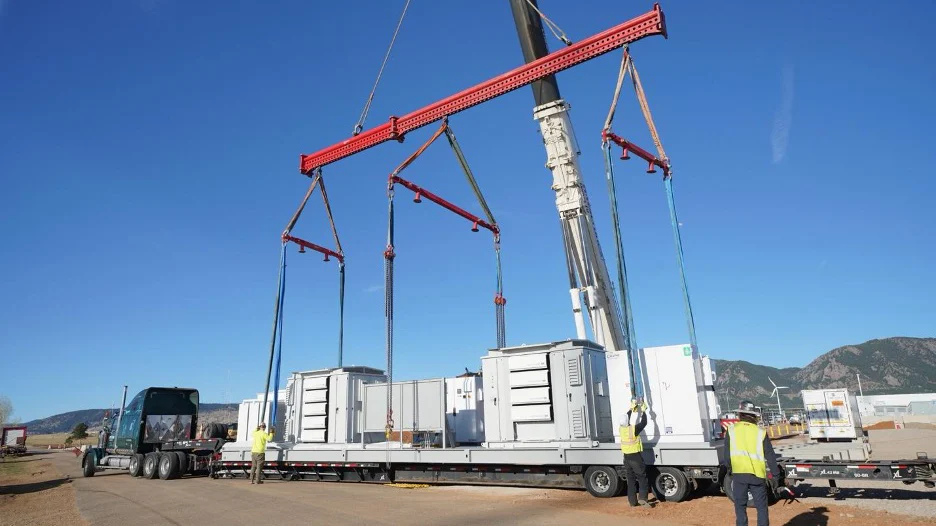
Rigorous empirical testing has validated the operational viability of these next-generation architectures. Earlier in 2026, industry engineers conducted comprehensive, full-scale stress tests at the National Renewable Energy Laboratory (NREL) in the United States, utilizing specialized facilities capable of simultaneously replicating harsh real-world grid faults and extreme AI-scale load fluctuations within a closed-loop electrical environment. During testing, systems were subjected to aggressive, authentic AI load profiles at full medium-voltage specifications while simultaneously absorbing severe utility-side disruptions, including complete zero-voltage events. The compute infrastructure remained entirely unaffected, demonstrating absolute immunity to upstream transients. Furthermore, the architecture successfully cleared the stringent large-load voltage ride-through requirements mandated by regional transmission organizations such as the Electric Reliability Council of Texas (ERCOT) with substantial operational margins to spare.
As grid operators increasingly enforce strict compliance standards to safeguard regional power stability against the surging footprint of hyperscale data centers, most industry participants view these regulatory hurdles as burdensome obstacles. However, advanced medium-voltage inline systems achieve full compliance inherently out of the box. Regulatory adherence ceases to be an expensive add-on feature and becomes an intrinsic property of the underlying electrical architecture.
Ultimately, much of what appears to be an intractable grid capacity crisis during the ongoing artificial intelligence infrastructure boom is, in root cause, an internal architectural failure born of legacy equipment sized for an industrial era that no longer exists. By elevating power protection to medium-voltage tiers, shifting infrastructure outside physical data halls, and integrating conditioning directly into the primary power path, facility operators can transform data centers from acute grid liabilities into reliable structural assets. As technology firms construct the next wave of artificial intelligence factories, the industry faces a definitive choice: deploy infrastructure that strains regional power grids to their breaking point, or implement robust architectural models that reinforce grid resilience from the ground up.
